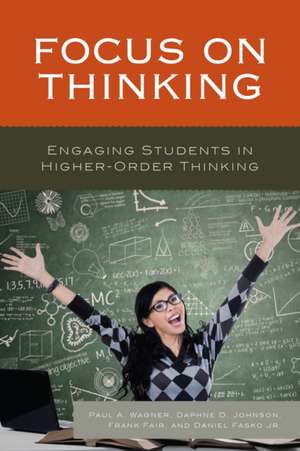
Focus on Thinking: Engaging Educators in Higher-Order Thinking
Autor Paul A. Wagner, Daphne Johnson, Frank Fair, Daniel Fasko Jr.en Limba Engleză Paperback – 23 ian 2017
This book uniquely combines two things. First, it provides resources for classroom teachers in middle and secondary school that make it possible to, at a moment's notice, take advantage of a teachable moment by drawing students into productive intellectual discussions. Second, it gives the reader an overview of the rationale and the research base for engaging students in educational activities that are truly intellectual and that are not limited to training for testing success.
Preț: 141.94 lei
Preț vechi: 188.53 lei
-25%
Puncte Express: 213
Carte tipărită la comandă
Livrare economică 28 noiembrie-12 decembrie
Livrare prin curier în România Termenul estimat este afișat lângă disponibilitate.
Transport gratuit de la 400.00 lei Plată online sau ramburs, în funcție de opțiunile comenzii.
Retur gratuit în 14 zile Comandă securizată și suport în română.
Specificații
ISBN-13: 9781475833522
ISBN-10: 1475833520
Pagini: 112
Dimensiuni: 156 x 230 x 9 mm
Greutate: 0.2 kg
Editura: Bloomsbury Publishing
Colecția Rowman & Littlefield
Locul publicării:New York, United States
ISBN-10: 1475833520
Pagini: 112
Dimensiuni: 156 x 230 x 9 mm
Greutate: 0.2 kg
Editura: Bloomsbury Publishing
Colecția Rowman & Littlefield
Locul publicării:New York, United States
V-ar putea interesa
-
 Handbook of Psychological TestingPaul Kline-18%Preț: 1083.28 lei1321.08 lei
 -
 Preț: 321.42 lei
 -
 The Psychological Assessment of Presidential CandidatesStanley A. RenshonPreț: 353.92 lei
 -
 Prediction in Forensic and Neuropsychology: Sound Statistical PracticesRonald D. Franklin-18%Preț: 1123.53 lei1370.16 lei
 -
 Scoring the Rorschach: Seven Validated SystemsRobert F. Bornstein-18%Preț: 1067.19 lei1301.44 lei
 -
 -5%Preț: 1129.24 lei1188.67 lei
 -
 Preț: 228.02 lei
 -
 Ethical Decision Making in School AdministrationPaul A. Wagner-27%Preț: 1091.78 lei1495.60 lei
 -
 -25%Preț: 177.38 lei237.78 lei
 -
 Thinking Ahead: Engaging All Teachers in Critical ThinkingPaul A. Wagner-25%Preț: 219.85 lei292.52 lei
 -
 The Personality of Math: A Key to Learning and Teaching MathPaul A. Wagner-25%Preț: 177.09 lei237.61 lei
 -
 -30%Preț: 502.50 lei714.52 lei
 -
 Insightful Quality: Beyond Continuous ImprovementVictor SowerPreț: 117.78 lei
 -
 Love TraumaPaul A. WagnerPreț: 80.00 lei
Cuprins
Acknowledgments
Introduction
Chapter 1 Critical Thinking and the Schools
Chapter 2Middle School Scripts
Chapter 3Secondary School Scripts
Appendix AResources for Further Information
Appendix BBuilding Your Own Scripts
Appendix C Elements of Mindware
References
Introduction
Chapter 1 Critical Thinking and the Schools
Chapter 2Middle School Scripts
Chapter 3Secondary School Scripts
Appendix AResources for Further Information
Appendix BBuilding Your Own Scripts
Appendix C Elements of Mindware
References
Recenzii
Focus on Thinking makes a valuable contribution to teachers who are committed to encouraging their students to think more critically about their day-to-day learning experiences and about their worlds in general. The scripts provide powerful and appropriate exemplars of stimuli that can be used to encourage students to explore the meaning of concepts and effectively develop their reasoning skills. Focus on Thinking also provides a clear underpinning of practice within a well-grounded theoretical framework. This text supports and empowers teachers to adapt the guidelines given so that their teaching practice can be developed to encourage more skillful thinking in their students, while at the same time meeting the realities of core curricula and high stakes assessments. Focus in Thinking is clearly written, practical, wide-ranging yet focused, and it will be a welcome resource for teachers who are determined to support and challenge their students to think more critically.
Teachable moments occur all of the time - but even the most experienced of us either don't always recognize them or take advantage of them when we do. These scripts aide novice and veteran teachers alike in guiding those unexpected student conversations and lead students to profound, not superficial, discussions.
'We have styled our approach to accommodate teachers working in restricted climates of core curricula and high stakes standardized testing'. It's a sad fact that this is the situation in so many countries yet right from chapter 1 I had the feeling 'I've come home!' The authors have provided so many 'nuggets' with which I found a resonance and also a feeling of hope! Hope that despite the constrictions of education structures there is still the possibility of fostering the 'search for optimal skills and dispositions in reasoning'.
The authors have re-stated again the idea of 'inviting' others into the Great Conversation, and this is a powerful and compelling idea. In this book they have provided scripts that may be used in a variety of creative ways throughout the year - recognizing the difficulty for many of establishing a separate time slot in the curriculum.
Taking this theory and practice as a whole, this is an approach that is 'of our time'. It builds on the past (Lipman and others) and will be useful not only for those new to developing critical thinking, but also those who have previously been engaged in such work. It is incumbent on us all to continually review our own ideas and methods and break free from the shackles of old habit, 'my way' and so on. The tools and dispositions outlined in chapter one will be useful in this respect, and the scripts and guidance on writing scripts complete the approach. A very useful and practical contribution to developing this 'heart and soul of philosophy'.
This book provides nuts and bolts lessons for teachers to engage students in the kind of critical and creative thinking that is currently absent from much of the school day. This is a book that many teachers have been waiting for and many others didn't know a book like this would be possible. These lessons are tightly designed to slip in these kinds of discussions where those teachable moments emerge.
Teachable moments occur all of the time - but even the most experienced of us either don't always recognize them or take advantage of them when we do. These scripts aide novice and veteran teachers alike in guiding those unexpected student conversations and lead students to profound, not superficial, discussions.
'We have styled our approach to accommodate teachers working in restricted climates of core curricula and high stakes standardized testing'. It's a sad fact that this is the situation in so many countries yet right from chapter 1 I had the feeling 'I've come home!' The authors have provided so many 'nuggets' with which I found a resonance and also a feeling of hope! Hope that despite the constrictions of education structures there is still the possibility of fostering the 'search for optimal skills and dispositions in reasoning'.
The authors have re-stated again the idea of 'inviting' others into the Great Conversation, and this is a powerful and compelling idea. In this book they have provided scripts that may be used in a variety of creative ways throughout the year - recognizing the difficulty for many of establishing a separate time slot in the curriculum.
Taking this theory and practice as a whole, this is an approach that is 'of our time'. It builds on the past (Lipman and others) and will be useful not only for those new to developing critical thinking, but also those who have previously been engaged in such work. It is incumbent on us all to continually review our own ideas and methods and break free from the shackles of old habit, 'my way' and so on. The tools and dispositions outlined in chapter one will be useful in this respect, and the scripts and guidance on writing scripts complete the approach. A very useful and practical contribution to developing this 'heart and soul of philosophy'.
This book provides nuts and bolts lessons for teachers to engage students in the kind of critical and creative thinking that is currently absent from much of the school day. This is a book that many teachers have been waiting for and many others didn't know a book like this would be possible. These lessons are tightly designed to slip in these kinds of discussions where those teachable moments emerge.