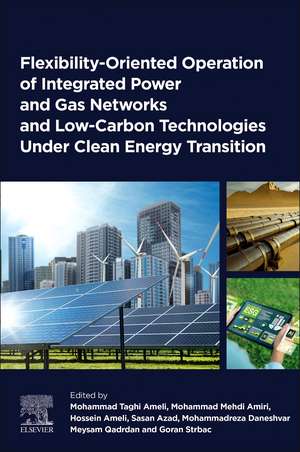
Flexibility-Oriented Operation of Integrated Power and Gas Networks and Low-Carbon Technologies Under Clean Energy Transition
Editat de Mohammad Taghi Ameli, Mohammad Mehdi Amiri, Hossein Ameli, Sasan Azad, Mohammadreza Daneshvar, Meysam Qadrdan, Goran Strbacen Limba Engleză Paperback – iun 2026
The book also details operational strategies for achieving net-zero emissions and introduces intelligent methods for assessing adaptability in energy networks. It offers a conceptual overview of integrated system decarbonization, discusses the integration of artificial intelligence, and examines the decoupling of emissions from economic growth. Highlighting negative emission technologies and solutions like carbon capture and hydrogen production, the book also features global case studies, making it a valuable reference for researchers, engineers, policymakers, and students interested in clean energy transition and innovative energy solutions.
- Explores the flexibility mechanisms necessary for the effective integration of gas and electricity networks, focusing on demand response and energy storage solutions that enhance system resilience and grid optimization
- Examines operational and optimization strategies aimed at achieving net-zero carbon emissions within integrated gas and electricity networks
- Investigates the feasibility and application of artificial intelligence in the decarbonization of integrated energy networks
- Discusses the role of negative emission technologies (NETs) in contributing to low-carbon gas and electricity networks
- Presents real-world case studies of successful integrated gas and electricity networks, showcasing lessons learned and best practices
Preț: 942.37 lei
Preț vechi: 1035.57 lei
-9% Precomandă
Puncte Express: 1414
Preț estimativ în valută:
166.73€ • 194.54$ • 145.77£
166.73€ • 194.54$ • 145.77£
Carte nepublicată încă
Doresc să fiu notificat când acest titlu va fi disponibil:
Se trimite...
Preluare comenzi: 021 569.72.76
Specificații
ISBN-13: 9780443445262
ISBN-10: 0443445265
Pagini: 373
Dimensiuni: 152 x 229 mm
Greutate: 0.45 kg
Editura: ELSEVIER SCIENCE
ISBN-10: 0443445265
Pagini: 373
Dimensiuni: 152 x 229 mm
Greutate: 0.45 kg
Editura: ELSEVIER SCIENCE
Cuprins
1. Flexibility for the coupled structure of gas and electricity networks
2. Operational and optimization strategies for net-zero carbon gas and electricity networks
3. Intelligent-oriented methods to assess and improve the flexibility of integrated power and gas networks
4. A conceptual introduction and review of the decarbonization of integrated energy networks
5. Investigation and feasibility of using artificial intelligence (AI) in decarbonization of integrated gas and electricity networks
6. Decoupling of emissions, economic growth, and solutions for carbon neutrality in coupled gas and electricity networks
7. Applicability of negative emission technologies (NETs): Challenges and their contribution to low-carbon gas and electricity networks
8. Net-zero energy supply, oxy-turbine power cycles, gas carbon capture and storage (CCS), and hydrogen production technologies
9. Transactive energy: How decentralized renewable energy can support decarbonization of integrated energy structure: A case study
10. Hydrogen interactions in the decarbonization of the power and gas coupled infrastructure: Real-world case studies
11. Role and value of compressor station in facilitating cost-effective energy system decarbonization: A case study
2. Operational and optimization strategies for net-zero carbon gas and electricity networks
3. Intelligent-oriented methods to assess and improve the flexibility of integrated power and gas networks
4. A conceptual introduction and review of the decarbonization of integrated energy networks
5. Investigation and feasibility of using artificial intelligence (AI) in decarbonization of integrated gas and electricity networks
6. Decoupling of emissions, economic growth, and solutions for carbon neutrality in coupled gas and electricity networks
7. Applicability of negative emission technologies (NETs): Challenges and their contribution to low-carbon gas and electricity networks
8. Net-zero energy supply, oxy-turbine power cycles, gas carbon capture and storage (CCS), and hydrogen production technologies
9. Transactive energy: How decentralized renewable energy can support decarbonization of integrated energy structure: A case study
10. Hydrogen interactions in the decarbonization of the power and gas coupled infrastructure: Real-world case studies
11. Role and value of compressor station in facilitating cost-effective energy system decarbonization: A case study