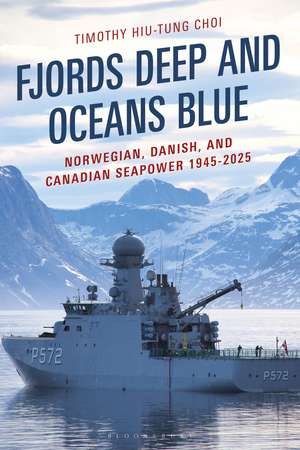
Fjords Deep and Oceans Blue: Norwegian, Danish, and Canadian Seapower 1945-2025
Autor Timothy Hiu-Tung Choien Limba Engleză Hardback – 4 feb 2027
Preț: 197.06 lei
Preț vechi: 257.04 lei
-23% Precomandă
Puncte Express: 296
Carte nepublicată încă
Livrare prin curier în România Precomanda se expediază când titlul devine disponibil.
Transport gratuit de la 400.00 lei Plată online sau ramburs, în funcție de opțiunile comenzii.
Retur gratuit în 14 zile Comandă securizată și suport în română.
Doresc să fiu notificat când acest titlu va fi disponibil:
Se trimite...
Specificații
ISBN-13: 9781666956924
ISBN-10: 1666956929
Pagini: 272
Ilustrații: 6 images
Dimensiuni: 152 x 229 mm
Editura: Bloomsbury Publishing
Colecția Bloomsbury Academic
Locul publicării:New York, United States
ISBN-10: 1666956929
Pagini: 272
Ilustrații: 6 images
Dimensiuni: 152 x 229 mm
Editura: Bloomsbury Publishing
Colecția Bloomsbury Academic
Locul publicării:New York, United States
Cuprins
Introduction
Setting the Scene
The Empirical Impetus: Naval Development in Peace
The Theoretical Impetus: Smaller Navies, Peacetime Sea Power, and Sea Control
Purpose of the Book
Methodology
What is Sea Power anyway?
Chapter Layout
Summary of Findings
Chapter 1: Norway: Developing Offshore Capability in a Coastal Defence Strategy
Part I: Marinen - NATO's Frontline in the Northx
Part II: The Norwegian Coast Guard and the Path Towards It
Concluding Remarks
Chapter 2: Denmark: An Overseas Fleet for a Blue Water Era
Part I: Denying the Coastal Seas: the Danish Navy's Military Role, 1945-1990
Part II: The Constabulary RDN in Greenland and the Faroes, 1945-2020
Part III: from Homeland Defence to Expeditionary Operations.and Back Again, 1988-2020
Concluding Remarks
Chapter 3: Canada: A Blue Water Fleet for A Medium Navy
Part I: Preparing for Armageddon: the RCN's Military Role in the Cold War
Part II: Constabulary Sea Control in the Cold War and Beyond
Part III: Military and Constabulary Convergence and the Future Fleet
Concluding Remarks
Conclusion and Analysis
Here for a Good Time, Not a Long Time
Answering the Researching Questions
Theoretical Contribution: Smaller Navies Within Sea Control and Sea Power Theory
Avenues for Further Research
Bibliography
About the Author
Setting the Scene
The Empirical Impetus: Naval Development in Peace
The Theoretical Impetus: Smaller Navies, Peacetime Sea Power, and Sea Control
Purpose of the Book
Methodology
What is Sea Power anyway?
Chapter Layout
Summary of Findings
Chapter 1: Norway: Developing Offshore Capability in a Coastal Defence Strategy
Part I: Marinen - NATO's Frontline in the Northx
Part II: The Norwegian Coast Guard and the Path Towards It
Concluding Remarks
Chapter 2: Denmark: An Overseas Fleet for a Blue Water Era
Part I: Denying the Coastal Seas: the Danish Navy's Military Role, 1945-1990
Part II: The Constabulary RDN in Greenland and the Faroes, 1945-2020
Part III: from Homeland Defence to Expeditionary Operations.and Back Again, 1988-2020
Concluding Remarks
Chapter 3: Canada: A Blue Water Fleet for A Medium Navy
Part I: Preparing for Armageddon: the RCN's Military Role in the Cold War
Part II: Constabulary Sea Control in the Cold War and Beyond
Part III: Military and Constabulary Convergence and the Future Fleet
Concluding Remarks
Conclusion and Analysis
Here for a Good Time, Not a Long Time
Answering the Researching Questions
Theoretical Contribution: Smaller Navies Within Sea Control and Sea Power Theory
Avenues for Further Research
Bibliography
About the Author
Recenzii
In this book Timothy Choi has done two things with impeccable timing. First, he has refocused attention on how small but well-equipped navies play a crucial role in statecraft. Second, he has situated his study in arguably the most strategically important region on the planet - the Arctic. Put those two things together and you have a must-read analysis for today's policy-makers and practitioners.
A model of comparative defense analysis. Choi pairs fieldwork with decades of naval history to explain why Norway, Denmark, and Canada built the fleets they did, and to overturn easy assumptions about what smaller navies are for. Rigorous and original, it recasts sea control as an instrument of peace as much as war.
As the three large powers - China, Russia and the United States - advance their rupture of the international order, Timothy Choi assesses how three smaller navies - Norway, Denmark and Canada - have evolved to meet the challenge. This in-depth study, with an emphasis on the implications of exclusive economic zones for the exercise of constabulary force, offers insights to other small powers.
An outstanding contribution to the very small literature on small navies that definitively answers the question of whether these fleets are even worth studying. The book clearly notes how three small navies employ naval strategy in ways that are similar and different to their larger cousins.
Choi ably points out how the vast majority of the day-to-day operations of all navies, but especially small ones, is focused on peacetime operations largely oriented around the conduct of "good order at sea" according to the national policies of the states they serve. This area is decidedly "not sexy" but critical to the conduct of maritime activities, nonetheless. The exploration of the vagaries of power at sea, using the concepts of compulsive/institutional/structural/productive power is an excellent addition to the literature on seapower that adds particular richness to this topic. It illustrates how important the less exciting aspects of constabulary operations shape behavior at sea in ways that benefit small nations over larger naval powers. The inclusion of para-naval forces such as coast guards, maritime gendarmeries, and other agencies involved in the enforcement of order at sea, in conjunction with regular naval forces is particularly valuable to the study of this subject.
Choi rightly joins the lineage of writers such as Julian Corbett, James Cable, Ken Booth, Michael Morris, and Geoff Till with this rich addition to the literature on sea power.
A compelling examination of the Norwegian, Danish, and Canadian navies. Choi adds significantly to our knowledge of sea power by going beyond standard assessments of combat ship numbers in great power navies to reveal a hitherto unexamined link between forces built by small and medium navies for constabulary roles, and their marked ability to carry out expeditionary, blue water roles.
Choi's carefully researched book addresses a question that is often overlooked in discussions of sea power: what is the connection between the defense of one's coast and naval capability projection overseas? Comparing and contrasting the cases of Canada, Denmark, and Norway, Choi shows that coastal defense and international naval power projection are intimately connected, and makes a significant contribution to strategic studies.
Timothy Hiu-Tung Choi's comprehensive study of the post Cold-War modernization of the Norwegian, Danish and Canadian navies is essential reading for all students of sea power. In examining how small and medium-sized navies responded to the end of the Cold War and the introduction of UNCLOS, this excellent book provides vital insights into how navies transform and ensure maritime interests are met.
This important book makes a hugely valuable contribution to the literature on contemporary naval affairs. It deftly blends the conceptual, refining sea power theory relating to small and medium navies, and the empirical, exploring how three navies in the key Arctic region balance peacetime sea control of their offshore maritime zones with the potential need for wartime sea denial.
This book is essential reading for anyone interested in modern maritime affairs. Through a detailed analysis of three smaller coastal states Choi shines a light on the ways in which changing legal structures and perceptions of sovereignty have reshaped how power is exerted at sea. In doing he so not only moves beyond the usual focus on great powers, and the Anglosphere, but furthers our understanding of the concept of sea power across the spectrum, from peace, through competition, to conflict.
Most of the world's warships do not belong to great powers, and almost all the work done by navies occurs outside of war. Choi takes the classic wartime mission of great naval powers-sea control-and shows how Norway, Denmark, and Canada pursue it in peacetime through naval and coast-guard capabilities, law, diplomacy, and international institutions. Along the way, he illustrates ways coercion and cooperation can interact to allow small fleets to control enormous maritime spaces. His cases reveal a navy's potential for political effects far beyond what its order of battle would suggest-a lesson even the world's largest sea power needs to learn.
A model of comparative defense analysis. Choi pairs fieldwork with decades of naval history to explain why Norway, Denmark, and Canada built the fleets they did, and to overturn easy assumptions about what smaller navies are for. Rigorous and original, it recasts sea control as an instrument of peace as much as war.
As the three large powers - China, Russia and the United States - advance their rupture of the international order, Timothy Choi assesses how three smaller navies - Norway, Denmark and Canada - have evolved to meet the challenge. This in-depth study, with an emphasis on the implications of exclusive economic zones for the exercise of constabulary force, offers insights to other small powers.
An outstanding contribution to the very small literature on small navies that definitively answers the question of whether these fleets are even worth studying. The book clearly notes how three small navies employ naval strategy in ways that are similar and different to their larger cousins.
Choi ably points out how the vast majority of the day-to-day operations of all navies, but especially small ones, is focused on peacetime operations largely oriented around the conduct of "good order at sea" according to the national policies of the states they serve. This area is decidedly "not sexy" but critical to the conduct of maritime activities, nonetheless. The exploration of the vagaries of power at sea, using the concepts of compulsive/institutional/structural/productive power is an excellent addition to the literature on seapower that adds particular richness to this topic. It illustrates how important the less exciting aspects of constabulary operations shape behavior at sea in ways that benefit small nations over larger naval powers. The inclusion of para-naval forces such as coast guards, maritime gendarmeries, and other agencies involved in the enforcement of order at sea, in conjunction with regular naval forces is particularly valuable to the study of this subject.
Choi rightly joins the lineage of writers such as Julian Corbett, James Cable, Ken Booth, Michael Morris, and Geoff Till with this rich addition to the literature on sea power.
A compelling examination of the Norwegian, Danish, and Canadian navies. Choi adds significantly to our knowledge of sea power by going beyond standard assessments of combat ship numbers in great power navies to reveal a hitherto unexamined link between forces built by small and medium navies for constabulary roles, and their marked ability to carry out expeditionary, blue water roles.
Choi's carefully researched book addresses a question that is often overlooked in discussions of sea power: what is the connection between the defense of one's coast and naval capability projection overseas? Comparing and contrasting the cases of Canada, Denmark, and Norway, Choi shows that coastal defense and international naval power projection are intimately connected, and makes a significant contribution to strategic studies.
Timothy Hiu-Tung Choi's comprehensive study of the post Cold-War modernization of the Norwegian, Danish and Canadian navies is essential reading for all students of sea power. In examining how small and medium-sized navies responded to the end of the Cold War and the introduction of UNCLOS, this excellent book provides vital insights into how navies transform and ensure maritime interests are met.
This important book makes a hugely valuable contribution to the literature on contemporary naval affairs. It deftly blends the conceptual, refining sea power theory relating to small and medium navies, and the empirical, exploring how three navies in the key Arctic region balance peacetime sea control of their offshore maritime zones with the potential need for wartime sea denial.
This book is essential reading for anyone interested in modern maritime affairs. Through a detailed analysis of three smaller coastal states Choi shines a light on the ways in which changing legal structures and perceptions of sovereignty have reshaped how power is exerted at sea. In doing he so not only moves beyond the usual focus on great powers, and the Anglosphere, but furthers our understanding of the concept of sea power across the spectrum, from peace, through competition, to conflict.
Most of the world's warships do not belong to great powers, and almost all the work done by navies occurs outside of war. Choi takes the classic wartime mission of great naval powers-sea control-and shows how Norway, Denmark, and Canada pursue it in peacetime through naval and coast-guard capabilities, law, diplomacy, and international institutions. Along the way, he illustrates ways coercion and cooperation can interact to allow small fleets to control enormous maritime spaces. His cases reveal a navy's potential for political effects far beyond what its order of battle would suggest-a lesson even the world's largest sea power needs to learn.