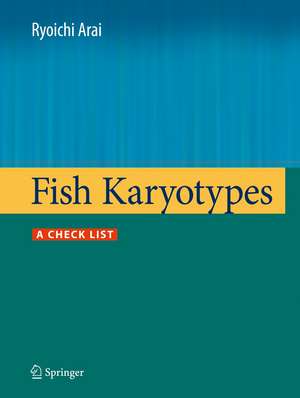
Fish Karyotypes: A Check List
Autor Ryoichi Araien Limba Engleză Hardback – 17 apr 2011
Prezentat sub formă de manual de referință și listă de control (check list), Fish Karyotypes reprezintă un instrument de lucru fundamental pentru cercetătorii din domeniul citogeneticii și ihtiologiei. Autorul Ryoichi Arai sintetizează o cantitate impresionantă de date acumulate de la ultima lucrare majoră de profil din 1995, oferind o bază de date actualizată ce cuprinde 3.425 de specii. Ne-a atras atenția rigoarea cu care sunt tratate sinonimiile speciilor, fiind listate atât denumirile actuale, cât și cele utilizate în lucrările citogenetice originale, facilitând astfel navigarea prin literatura de specialitate adesea fragmentată.
Din punct de vedere tehnic, volumul aduce clarificări metodologice esențiale: definește precis numărul de brațe cromozomiale (NF1 și NF2) și integrează date despre dimensiunea genomului, ploidie și prezența cromozomilor sexuali sau a cromozomilor B. Această abordare extinde cadrul teoretic propus de Fish Cytogenetics de E Pisano cu date noi și o organizare taxonomică strictă bazată pe lucrarea de referință Fishes of the World a lui Joseph S Nelson. În timp ce Fish Cytogenetics se concentrează pe aplicațiile citogeneticii în acvacultură și genomică, volumul de față servește drept inventar analitic indispensabil pentru verificarea filogeniilor bazate pe arbori genetici.
Structura este logică și orientată spre utilizare practică, începând cu protocoalele de identificare (vouchering) și terminând cu o bază de date vastă. Această progresie permite utilizatorului să înțeleagă nu doar datele brute, ci și contextul lor evolutiv, prin introducerea conceptului de Număr Cromozomial Ancestral (ACN). Subliniem importanța acestei monografii ca resursă centrală pentru studiile de biogeografie și biodiversitate, oferind o perspectivă clară asupra mecanismelor de adaptare evolutivă ale celui mai numeros grup de vertebrate.
Preț: 1192.20 lei
Preț vechi: 1453.90 lei
-18%
Carte disponibilă
Livrare economică 16-30 octombrie
Specificații
ISBN-10: 4431538763
Pagini: 348
Ilustrații: V, 340 p.
Dimensiuni: 210 x 279 x 24 mm
Greutate: 1.1 kg
Ediția:2011
Editura: Springer
Colecția Springer
Locul publicării:Tokyo, Japan
V-ar putea interesa
-
 Evolutionary Ecology: The Trinidadian GuppyAnne E. Magurran-29%Preț: 450.98 lei630.76 lei
 -
 Quantitative Ecology and the Brown TroutJ. M. Elliott-28%Preț: 453.40 lei632.17 lei
 -
 Ecological and Environmental Physiology of FishesF. Brian Eddy-22%Preț: 420.65 lei542.39 lei
 -
 Biology of FishesQuentin Bone-9%Preț: 689.15 lei757.31 lei
 -
 -23%Preț: 620.53 lei805.89 lei
 -
 Reproductive Biology of Teleost FishesRobert J Wootton-23%Preț: 1007.15 lei1307.99 lei
 -
 Fishes of the WorldJoseph S. Nelson-23%Preț: 913.22 lei1186.00 lei
 -
 Bacterial Fish PathogensB. Austin-18%Preț: 1208.17 lei1473.38 lei
 -
 Ecology and Conservation of FishesHarold M. Tyus-18%Preț: 795.43 lei970.03 lei
 -
 Fish Cognition and BehaviorCulum Brown-9%Preț: 1179.75 lei1296.44 lei
 -
 Biology of ButterflyfishesMorgan S. Pratchett-18%Preț: 1125.63 lei1372.71 lei
 -
 The Biology of GobiesRobert Patzner-18%Preț: 1493.47 lei1821.31 lei
 -
 Metamorphosis in FishSylvie Dufour-18%Preț: 901.28 lei1099.11 lei
 -
 Modelling and Quantitative Methods in FisheriesMalcolm Haddon-18%Preț: 771.75 lei941.16 lei
 -
 A Fish Caught in TimeSamantha WeinbergPreț: 58.87 lei
 -
 A Colour Atlas of Salmonid DiseasesDavid W. Bruno-23%Preț: 1287.98 lei1672.70 lei
Public țintă
ResearchDe ce să citești această carte
Recomandăm această lucrare ca pe o resursă bibliografică definitivă pentru orice laborator de ihtiologie sau genetică. Cititorul câștigă acces la un inventar vast de date cariotipice pentru peste 3.000 de specii, economisind timp prețios de documentare. Este un instrument esențial pentru cei care doresc să coreleze datele citogenetice cu clasificările taxonomice moderne și să investigheze relațiile filogenetice complexe dintre speciile de pești.
Descriere scurtă
Descriere
Cuprins
Recenzii
“This checklist contains the descriptions of karyotypes of 3,425 fish species … . the author stresses the relative value of karyotyping fish for systematics and phylogeny. He provides information on karyotypes of species of cyclostomes, chondrychthyes, actinopterygians and even lobe-finned fishes (!) gathered from numerous well-known and easily accessible journals. … a valuable source for all those over the world, who are interested in fish chromosomes and their significance in systematics and phylogeny.” (Hartmut Greven, Bulletin of Fish Biology, Vol. 13 (1/2), 2011)
Caracteristici
Includes 12 bits of data for each karyotype for each species
Karyotypes of more than 3400 species/subspecies—the most complete checklist