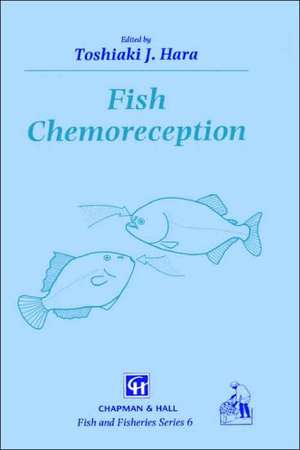
Fish Chemoreception: Fish & Fisheries Series, cartea 6
Editat de T.J. Haraen Limba Engleză Hardback – 31 iul 1992
| Toate formatele și edițiile | Preț | Express |
|---|---|---|
| Paperback (1) | 1749.34 lei 6-8 săpt. | |
| SPRINGER NETHERLANDS – 9 noi 2012 | 1749.34 lei 6-8 săpt. | |
| Hardback (1) | 1755.09 lei 6-8 săpt. | |
| SPRINGER NETHERLANDS – 31 iul 1992 | 1755.09 lei 6-8 săpt. |
Din seria Fish & Fisheries Series
- 18%
 Preț: 1066.93 lei
 - 18%
 Preț: 1194.30 lei
 - 18%
 Preț: 1176.11 lei
 - 18%
 Preț: 1177.19 lei
 - 18%
 Preț: 906.17 lei
 - 18%
 Preț: 1185.07 lei
 - 15%
 Preț: 622.42 lei
 - 18%
 Preț: 2393.07 lei
 - 18%
 Preț: 1190.96 lei
 - 24%
 Preț: 1407.45 lei
 - 18%
 Preț: 2017.88 lei
 - 15%
 Preț: 625.09 lei
 - 18%
 Preț: 1766.14 lei
 - 18%
 Preț: 1179.46 lei
 - 18%
 Preț: 1182.94 lei
 - 18%
 Preț: 910.58 lei
 - 18%
 Preț: 924.52 lei
 - 18%
 Preț: 1185.98 lei
 - 18%
 Preț: 1178.40 lei
 - 18%
 Preț: 1177.32 lei
 - 18%
 Preț: 1185.98 lei
 - 18%
 Preț: 1186.57 lei
 - 15%
 Preț: 688.48 lei
 - 18%
 Preț: 1188.09 lei
 - 18%
 Preț: 928.63 lei
 - 18%
 Preț: 1182.04 lei
 - 18%
 Preț: 2339.21 lei
 - 18%
 Preț: 956.69 lei
 - 18%
 Preț: 1185.21 lei
 - 18%
 Preț: 1182.77 lei
 - 18%
 Preț: 1075.73 lei
 - 18%
 Preț: 1175.66 lei
Preț: 1755.09 lei
Preț vechi: 2140.35 lei
-18%
Puncte Express: 2633
Preț estimativ în valută:
310.37€ • 365.93$ • 269.23£
310.37€ • 365.93$ • 269.23£
Carte tipărită la comandă
Livrare economică 21 martie-04 aprilie
Specificații
ISBN-13: 9780412351402
ISBN-10: 0412351404
Pagini: 373
Ilustrații: XIV, 373 p.
Dimensiuni: 155 x 235 x 22 mm
Greutate: 0.72 kg
Ediția:1992
Editura: SPRINGER NETHERLANDS
Colecția Springer
Seria Fish & Fisheries Series
Locul publicării:Dordrecht, Netherlands
ISBN-10: 0412351404
Pagini: 373
Ilustrații: XIV, 373 p.
Dimensiuni: 155 x 235 x 22 mm
Greutate: 0.72 kg
Ediția:1992
Editura: SPRINGER NETHERLANDS
Colecția Springer
Seria Fish & Fisheries Series
Locul publicării:Dordrecht, Netherlands
V-ar putea interesa
-
 Evolutionary Ecology: The Trinidadian GuppyAnne E. Magurran-24%Preț: 405.48 lei536.45 lei
 -
 Quantitative Ecology and the Brown TroutJ. M. Elliott-24%Preț: 406.90 lei537.31 lei
 -
 Ecological and Environmental Physiology of FishesF. Brian Eddy-23%Preț: 387.11 lei499.94 lei
 -
 Biology of FishesQuentin Bone-9%Preț: 667.96 lei734.03 lei
 -
 Marine Fisheries EcologyS. Jennings-19%Preț: 444.28 lei548.48 lei
 -
 Reproductive Biology of Teleost FishesR Wootton-23%Preț: 975.88 lei1267.38 lei
 -
 -9%Preț: 1180.46 lei1297.21 lei
 -
 -18%Preț: 1197.18 lei1459.97 lei
 -
 Fish Cognition and BehaviorCulum Brown-9%Preț: 1130.55 lei1242.36 lei
 -
 Modelling and Quantitative Methods in FisheriesMalcolm Haddon-18%Preț: 736.61 lei898.30 lei
 -
 A Fish Caught in TimeSamantha WeinbergPreț: 58.65 lei
 -
 Reef Fish Identification: Tropical PacificPaul HumannPreț: 294.88 lei
 -
 A Colour Atlas of Salmonid DiseasesDavid W. Bruno-23%Preț: 1138.23 lei1478.22 lei
Public țintă
ResearchCuprins
1 Overview and introduction.- 1.1 Chemical stimuli in the aquatic environment.- 1.2 Characteristic features of fish chemosensory organs.- 1.3 Signal transduction and transmission.- 1.4 Receptor sensitivity and specificity.- 1.5 Chemoreception in behavior.- 1.6 Chemoreception and water pollution.- 1.7 Conclusion.- References.- 2 Structure, development, and evolutionary aspects of the peripheral olfactory system.- 2.1 Introduction.- 2.2 Gross morphology.- 2.3 Histology.- 2.4 Development.- 2.5 Adaptation and evolution.- 2.6 Summary and conclusion.- Acknowledgement.- References.- 3 Synaptic organization of the olfactory bulb and its central projection.- 3.1 Introduction.- 3.2 Olfactory bulb.- 3.3 Telencephalic hemisphere and secondary olfactory areas.- Acknowledgements.- Abbreviations.- References.- 4 Structure of the peripheral gustatory organ, represented by the siluroid fish Plotosus lineatus (Thunberg).- 4.1 Introduction.- 4.2 Distribution and gross anatomy of taste buds.- 4.3 Fine structure of taste buds.- 4.4 Discussion.- Acknowledgements.- Abbreviations.- References.- 5 Central representation and projections of gustatory systems.- 5.1 Introduction.- 5.2 Primary gustatory centres.- 5.3 Medullary networks and descending gustatory projections.- 5.4 Supramedullary gustatory pathways.- 5.5 Summary.- Acknowledgement.- Abbreviations.- References.- Solitary chemosensory cells.- 6.1 Introduction.- 6.2 Distribution.- 6.3 Cytology.- 6.4 Innervation.- 6.5 Physiology.- 6.6 The common chemical sense.- 6.7 Paraneurones.- 6.8 Conclusion.- Acknowledgements.- References.- 7 Molecular mechanisms of chemosensory transduction: gustation and olfaction.- 7.1 Introduction.- 7.2 Receptor events in chemoreception.- 7.3 Receptor-mediated chemosensory transduction.- 7.4 Conclusion.- Acknowledgements.- References.- 8 Mechanisms of olfaction.- 8.1 Introduction.- 8.2 Sensory transduction.- 8.3 Signal transmission.- 8.4 Sensitivity and specificity.- 8.5 Neural coding.- 8.6 Summary and conclusion.- Acknowledgements.- References.- 9 Teleost gestation.- 9.1 Introduction.- 9.2 Historical background of gustatory peripheral nerve physiology.- 9.3 Response features for simple chemical compounds.- 9.4 Receptor site types for amino acids.- 9.5 Taste responses of single facial taste fibres.- 9.6 Enhanced taste activity.- 9.7 Behaviour to chemical stimuli.- 9.8 Tactile sensitivity of peripheral neurons.- 9.9 Summary.- Acknowledgements.- References.- 10 Hormones, pheromones and chemoreception.- 10.1 Introduction.- 10.2 History of the definition of pheromone.- 10.3 Origins of the hypothesis that fish use hormonal sex pheromones.- 10.4 Current status of the hypothesis and future considerations.- 10.5 Neural responsiveness to sex pheromones.- 10.6 General conclusions.- Acknowledgements.- References.- 11 Kin recognition in fish mediated by chemical cues.- 11.1 Introduction.- 11.2 Salmonids.- 11.3 Studies of nonsalmonid fishes.- Acknowledgement.- References.- 12 Olfactory control of homingbehaviour in salmonids.- 12.1 Introduction.- 12.2 Ecological framework.- 12.3 Olfaction and homing behavior.- 12.4 Olfactory hypotheses in salmonid homing.- 12.5 Possible mechanisms of olfactory control.- 12.6 A model system and its ecological implications.- 12.7 Summary and conclusions.- References.- 13 Gustation and nutrition in fishes: application to aquaculture.- 13.1 Introduction.- 13.2 Identification of feeding stimulants.- 13.3 Relevance of feeding stimulants to nutrition and feeding.- 13.4 Dietary application of feeding stimulants.- 13.5 Feeding stimulant effects on nutrition.- 13.6 Conclusions and prospects.- Acknowledgements.- References.- 14 Food search behaviour in fish and the use of chemical lures in commercial and sports fishing.- 14.1 Introduction.- 14.2 Food search behavior.- 14.3 Modifiers of food search.- 14.4 Effectiveness of natural materials as food search inducers.- 14.5 Chemical nature of food search inducers.- 14.6 Chemical lures.- Acknowledgements.- References.- 15 Environmental contaminants and chemoreception in fishes.- 15.1 Introduction.- 15.2 Histological effects of contaminants.- 15.3 Physiological and biochemical effects of contaminants.- 15.4 Behavioural responses to contaminants.- 15.5 Future research.- Ackowledgements.- References.- Author index.- Species index.
Recenzii
Some important new information on receptors is presented...This book is a good mix of detailed information on physiology and anatomy linked with information on behaviour, ecology and aquaculture. A wide range of readers from comparative anatomists to fishery managers will find it a useful addition to their libraries - Journal of Fish Biology