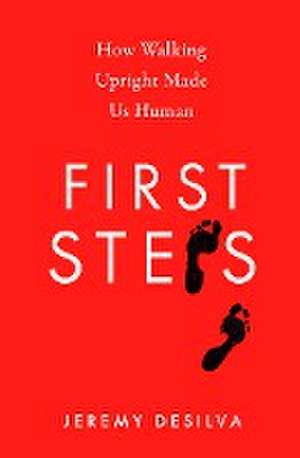
First Steps
Autor Jeremy Desilvaen Limba Engleză Hardback – 22 iul 2021
Putem afirma că First Steps reprezintă o analiză clinică și antropologică riguroasă a trăsăturii care definește specia noastră: bipedalismul. Departe de a fi doar o cronică istorică, lucrarea semnată de Jeremy DeSilva oferă clinicianului o perspectivă evoluționistă asupra patologiilor contemporane. Subliniem faptul că autorul nu se limitează la succesele evolutive, ci investighează meticulos „costurile” trecerii la mersul vertical. Cititorul va înțelege cum restructurarea pelvisului a complicat procesul nașterii și de ce structura noastră scheletică ne predispune la afecțiuni precum herniile sau problemele cronice ale sinusurilor.
Suntem de părere că această perspectivă este esențială pentru a înțelege biomecanica umană actuală. Clinicienii care folosesc Lowly Origin de Jonathan Kingdon ca referință pentru bazele bipedalismului vor găsi în lucrarea lui DeSilva o completare necesară, axată pe descoperirile fosile recente care rescriu cronologia evoluției noastre. În timp ce alte lucrări similare, precum In Praise of Walking de Shane O'Mara, se concentrează pe beneficiile neurologice ale mersului, First Steps ancorează discuția în paleoantropologie și anatomie comparată.
În contextul operei sale, această carte continuă efortul de sintetizare a teoriilor darwiniene început în A Most Interesting Problem, unde Jeremy DeSilva a coordonat cercetători de elită pentru a evalua evoluția umană. Aici, el aplică aceeași rigoare științifică pentru a demonstra cum mersul pe două picioare a servit drept punte către dezvoltarea limbajului, a tehnologiei și chiar a trăsăturilor de altruism. Structura narativă îmbină vizitele în laboratoare de psihologie experimentală cu situri fosile din Africa și Eurasia, oferind o imagine completă a transformării noastre din primate în „strideri” globali.
Preț: 151.95 lei
Preț vechi: 159.94 lei
-5%
Carte disponibilă
Livrare economică 05-19 august
Livrare express 21-25 iulie pentru 33.86 lei
Specificații
ISBN-10: 0008342830
Pagini: 352
Dimensiuni: 240 x 163 x 37 mm
Greutate: 0.56 kg
Editura: HarperCollins Publishers
De ce să citești această carte
Recomandăm această carte profesioniștilor din medicină și antropologie care doresc să înțeleagă rădăcinile anatomice ale constituției umane. Veți câștiga o perspectivă profundă asupra motivelor pentru care corpul uman prezintă anumite vulnerabilități structurale, explicând legătura directă dintre bipedalism și provocările clinice moderne. Este o resursă valoroasă pentru oricine dorește să exploreze mecanismele care au facilitat ascensiunea speciei noastre, dincolo de simpla locomoție.
Despre autor
Jeremy DeSilva este un reputat paleoantropolog, specializat în studiul evoluției locomoției umane. Expertiza sa se concentrează pe analiza fosilelor timpurii ale hominizilor, explorând tranziția critică de la viața arboricolă la bipedalismul terestru. Activitatea sa academică este recunoscută prin numeroase distincții, inclusiv Premiul W.W. Howells. DeSilva este cunoscut și pentru capacitatea de a coordona lucrări colective de anvergură, precum „A Most Interesting Problem”, în care reevaluează moștenirea lui Charles Darwin prin prisma datelor științifice contemporane, consolidându-și poziția de autoritate în domeniul evoluției umane.
Descriere
Recenzii
— New York Times Book Review
“Before our ancestors thought symbolically, before they used fire, before they made stone tools, or even entered the open savanna, our ancestors walked upright. In one way or another, this odd locomotory style has underwritten the whole spectrum of our vaunted human uniquenesses, from our manual dexterity to our hairless bodies, and our large brains. In the modern world it even influences the way other people recognize us at a distance, and it is crucial to our individual viability. In this authoritative but charmingly discursive and accessible book, Jeremy DeSilva lucidly explains how and why.” — Ian Tattersall, author of Masters of the Planet and The Strange Case of the Rickety Cossack
“Master anatomist and paleontologist Jeremy DeSilva makes no bones about the fact that when looking at fossils ‘I let myself be emotional…’ Thus does this world expert and gifted story teller take us on a tour through the sprawling, complicated, saga of human origins. Drawing on his personal knowledge of topics ranging from sports medicine to childcare and his acquaintance with a host of colorful characters—whether lying inert in museum drawer, sitting behind microscopes or feuding with one other—DeSilva adds flesh and projects feelings onto the bones he studies, a tour de force of empathic understanding.” — Sarah Blaffer Hrdy, author of Mother Nature and Mothers and Others: The evolutionary origins of mutual understanding
“It should come as no surprise that walking matters. But what will surprise most readers is how and why. DeSilva takes us on a brilliant, fun, and scientifically deep stroll through history, anatomy, and evolution, in order to illustrate the powerful story of how a particular mode of movement helped make us one of the most wonderful, dangerous and fascinating species on Earth.” — Agustín Fuentes, Professor of Anthropology, Princeton University and author of Why We Believe: Evolution and the Human Way of Being
"DeSilva has a gift for identifying important but often overlooked observations . . . While the subject of human evolution might seem daunting—especially discussions of the relationships between ape and hominin ancestors—DeSilva uses personable language and always keeps it interesting." — Library Journal (starred review)
DeSilva makes a solid scientific case with an expert history of human and ape evolution . . . Accessible, valuable popular anthropology. — Kirkus Reviews
“A brisk jaunt through the history of bipedalism . . . DeSilva’s ability to turn anatomical evidence into a focused tale of human evolution and his enthusiasm for research will leave readers both informed and uplifted.” — Publishers Weekly
“This is breezy popular science at its best, interweaving anecdotes from the field and lab with scientific findings and the occasional pop culture reference. DeSilva gets extra credit for naming oft-overlooked experts who made key discoveries . . . [DeSIlva] makes a compelling case overall.” — Science News
"DeSilva has written one of the most interesting 'science books' I’ve read in the last five years and one of the most interesting 'walking books' over the same span." — First Things