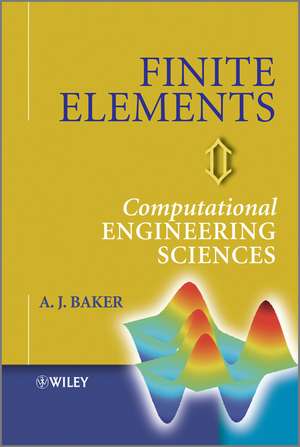
Finite Elements
Autor A. J. Bakeren Limba Engleză Hardback – 8 oct 2012
Preț: 584.88 lei
Preț vechi: 891.15 lei
-34%
Puncte Express: 877
Carte indisponibilă temporar
Doresc să fiu notificat când acest titlu va fi disponibil:
Se trimite...
Specificații
ISBN-13: 9781119940500
ISBN-10: 1119940508
Pagini: 288
Dimensiuni: 174 x 251 x 20 mm
Greutate: 0.58 kg
Ediția:New.
Editura: Wiley
Locul publicării:Chichester, United Kingdom
ISBN-10: 1119940508
Pagini: 288
Dimensiuni: 174 x 251 x 20 mm
Greutate: 0.58 kg
Ediția:New.
Editura: Wiley
Locul publicării:Chichester, United Kingdom
Public țintă
Primary: Graduate Course Students; Professional engineers using FE analysis; Developers of FE softwareSecondary: Senior Level Undergraduate ME, AE,CE; Professional Engineers in Commercial Practice across the Computational Engineering Sciences Spectrum; Undergraduate and Postgraduate Students studying applied Mathematics or Physics; Civil Engineers; Heat Transfer Engineers; Computational Scientists
Notă biografică
A. J. Baker is Professor Emeritus, Engineering Science and Computational Engineering, The University of Tennessee, USA. He is an elected Fellow of the International Association for Computational Mechanics (IACM) and the US Association for Computational Mechanics (USACM) and an Associate Fellow of the American Institute of Aeronautics and Astronautics (AIAA).
Cuprins
Preface viii Notation xi
1 COMPUTATIONAL ENGINEERING SCIENCE 1
1.1 Engineering simulation 1
1.2 A problem solving environment 2
1.3 Problem statements in engineering 4
1.4 Decisions on forming WS N 6
1.5 Discrete approximate WS h implementation 8
1.6 Chapter summary 9
1.7 Chapter references 10
2 PROBLEM STATEMENTS 11
2.1 Engineering simulation 11
2.2 Continuum mechanics viewpoint 12
2.3 Continuum conservation law forms 12
2.4 Constitutive closure for conservation law PDEs 14
2.5 Engineering science continuum mechanics 18
2.6 Chapter references 20
3 SOME INTRODUCTORY MATERIAL 21
3.1 Introduction 21
3.2 Multi-dimensional PDEs, separation of variables 22
3.3 Theoretical foundations, GWS h 27
3.4 A legacy FD construction 28
3.5 An FD approximate solution 30
3.6 Lagrange interpolation polynomials 31
3.7 Chapter summary 32
3.8 Exercises 34
3.9 Chapter references 34
4 HEAT CONDUCTION35
4.1 A steady heat conduction example 35
4.2 Weak form approximation, error minimization 37
4.3 GWS N discrete implementation, FE basis38
4.4 Finite element matrix statement 41
4.5 Assembly of {WS}e to form algebraic GWS h 43
4.6 Solution accuracy, error distribution 45
4.7 Convergence, boundary heat flux 47
4.8 Chapter summary 47
4.9 Exercises 48
4.10 Chapter reference 48
5 STEADY HEAT TRANSFER, n =149
5.1 Introduction 49
5.2 Steady heat transfer, n = 1 50
5.3 FE k = 1 trial space basis matrix library 52
5.4 Object-oriented GWS h programming 55
5.5 Higher completeness degree trial space bases58
5.6 Global theory, asymptotic error estimate 62
5.7 Non-smooth data, theory generalization 66
5.8 Temperature dependent conductivity, non-linearity 69
5.9 Static condensation, p-elements 72
5.10 Chapter summary 75
5.11 Exercises 76
5.12 Computer labs 77
5.13 Chapter references 78
6 ENGINEERING SCIENCES, n =1 79
6.1 Introduction 79
6.2 The Euler-Bernoulli beam equation 80
6.3 Euler-Bernoulli beam theory GWS h reformulation 85
6.4 The Timoshenko beam theory 92
6.5 Mechanical vibrations of a beam 99
6.6 Fluid mechanics, potential flow 106
6.7 Electromagnetic plane wave propagation110
6.8 Convective-radiative finned cylinder heat transfer 112
6.9 Chapter summary 120
6.10 Exercises122
6.10 Computer labs 123
6.11 Chapter references 124
7 STEADY HEAT TRANSFER, n > 1 125
7.1 Introduction 125
7.2 Multi-dimensional FE bases and DOF 126
7.3 Multi-dimensional FE operations 129
7.4 The NC k = 1,2 basis FE matrix library 132
7.5 NC basis {WS}e template, accuracy, convergence 136
7.6 The tensor product basis element family 139
7.7 Gauss numerical quadrature, k = 1 TP basis library 141
7.8 Convection-radiation BC GWS h implementation 146
7.9 Linear basis GWS h template unification 150
7.10 Accuracy, convergence revisited 152
7.11 Chapter summary 153
7.12 Exercises155
7.13 Computer labs 155
7.14 Chapter references 156
8 FINITE DIFFERENCES OF OPINION 159
8.1 The FD-FE correlation159
8.2 The FV-FE correlation162
8.3 Chapter summary 167
8.4 Exercises168
9 CONVECTION-DIFFUSION, n = 1 169
9.1 Introduction169
9.2 The Galerkin weak statement 170
9.3 GWS h completion for time dependence172
9.4 GWS h + qTS algorithm templates 173
9.5 GWS h + qTS algorithm asymptotic error estimates 175
9.6 Performance verification test cases 177
9.7 Dispersive error characterization 180
9.8 A modified Galerkin weak statement 184
9.9 Verification problem statements revisited 187
9.10 Unsteady heat conduction 190
9.11 Chapter summary 193
9.12 Exercises 193
9.13 Computer labs 194
9.14 Chapter references 195
10 CONVECTION-DIFFUSION, n > 1 197
10.1 The problem statement 197
10.2 GWS h + qTS formulation reprise 198
10.3 Matrix library additions, templates 200
10.4 mPDE Galerkin weak forms, theoretical analyses 202
10.5 Verification, benchmarking and validation 207
10.6 Mass transport, the rotating cone verification 208
10.7 The gaussian plume benchmark 211
10.8 The steady n-D Peclet problem verification 213
10.9 Mass transport, a validated n = 3 experiment 215
10.10 Numerical linear algebra, matrix iteration 222
10.11 Newton and AF TP jacobian templates 227
10.12 Chapter summary 229
10.13 Exercises231
10.14 Computer labs 231
10.15 Chapter references232
11 ENGINEERING SCIENCES, n > 1 235
11.1 Introduction 235
11.2 Structural mechanics236
11.3 Structural mechanics, virtual work FE form 240
11.4 Plane stress/strain, GWS h implementation 242
11.5 Elasticity computer lab 246
11.6 Fluid mechanics, incompressible-thermal flow 251
11.7 Vorticity-streamfunction GWS h + qTS algorithm 254
11.8 An isothermal INS validation experiment 258
11.9 Multi-mode convection heat transfer262
11.10 Mechanical vibrations, normal mode GWS h 267
11.11 Normal modes of a vibrating membrane270
11.12 Multi-physics solid-fluid mass transport 276
11.13 Chapter summary 280
11.14 Exercises 282
11.15 Computer labs283
11.14 Chapter references 284
12 CONCLUSION 287
Index 289
1 COMPUTATIONAL ENGINEERING SCIENCE 1
1.1 Engineering simulation 1
1.2 A problem solving environment 2
1.3 Problem statements in engineering 4
1.4 Decisions on forming WS N 6
1.5 Discrete approximate WS h implementation 8
1.6 Chapter summary 9
1.7 Chapter references 10
2 PROBLEM STATEMENTS 11
2.1 Engineering simulation 11
2.2 Continuum mechanics viewpoint 12
2.3 Continuum conservation law forms 12
2.4 Constitutive closure for conservation law PDEs 14
2.5 Engineering science continuum mechanics 18
2.6 Chapter references 20
3 SOME INTRODUCTORY MATERIAL 21
3.1 Introduction 21
3.2 Multi-dimensional PDEs, separation of variables 22
3.3 Theoretical foundations, GWS h 27
3.4 A legacy FD construction 28
3.5 An FD approximate solution 30
3.6 Lagrange interpolation polynomials 31
3.7 Chapter summary 32
3.8 Exercises 34
3.9 Chapter references 34
4 HEAT CONDUCTION35
4.1 A steady heat conduction example 35
4.2 Weak form approximation, error minimization 37
4.3 GWS N discrete implementation, FE basis38
4.4 Finite element matrix statement 41
4.5 Assembly of {WS}e to form algebraic GWS h 43
4.6 Solution accuracy, error distribution 45
4.7 Convergence, boundary heat flux 47
4.8 Chapter summary 47
4.9 Exercises 48
4.10 Chapter reference 48
5 STEADY HEAT TRANSFER, n =149
5.1 Introduction 49
5.2 Steady heat transfer, n = 1 50
5.3 FE k = 1 trial space basis matrix library 52
5.4 Object-oriented GWS h programming 55
5.5 Higher completeness degree trial space bases58
5.6 Global theory, asymptotic error estimate 62
5.7 Non-smooth data, theory generalization 66
5.8 Temperature dependent conductivity, non-linearity 69
5.9 Static condensation, p-elements 72
5.10 Chapter summary 75
5.11 Exercises 76
5.12 Computer labs 77
5.13 Chapter references 78
6 ENGINEERING SCIENCES, n =1 79
6.1 Introduction 79
6.2 The Euler-Bernoulli beam equation 80
6.3 Euler-Bernoulli beam theory GWS h reformulation 85
6.4 The Timoshenko beam theory 92
6.5 Mechanical vibrations of a beam 99
6.6 Fluid mechanics, potential flow 106
6.7 Electromagnetic plane wave propagation110
6.8 Convective-radiative finned cylinder heat transfer 112
6.9 Chapter summary 120
6.10 Exercises122
6.10 Computer labs 123
6.11 Chapter references 124
7 STEADY HEAT TRANSFER, n > 1 125
7.1 Introduction 125
7.2 Multi-dimensional FE bases and DOF 126
7.3 Multi-dimensional FE operations 129
7.4 The NC k = 1,2 basis FE matrix library 132
7.5 NC basis {WS}e template, accuracy, convergence 136
7.6 The tensor product basis element family 139
7.7 Gauss numerical quadrature, k = 1 TP basis library 141
7.8 Convection-radiation BC GWS h implementation 146
7.9 Linear basis GWS h template unification 150
7.10 Accuracy, convergence revisited 152
7.11 Chapter summary 153
7.12 Exercises155
7.13 Computer labs 155
7.14 Chapter references 156
8 FINITE DIFFERENCES OF OPINION 159
8.1 The FD-FE correlation159
8.2 The FV-FE correlation162
8.3 Chapter summary 167
8.4 Exercises168
9 CONVECTION-DIFFUSION, n = 1 169
9.1 Introduction169
9.2 The Galerkin weak statement 170
9.3 GWS h completion for time dependence172
9.4 GWS h + qTS algorithm templates 173
9.5 GWS h + qTS algorithm asymptotic error estimates 175
9.6 Performance verification test cases 177
9.7 Dispersive error characterization 180
9.8 A modified Galerkin weak statement 184
9.9 Verification problem statements revisited 187
9.10 Unsteady heat conduction 190
9.11 Chapter summary 193
9.12 Exercises 193
9.13 Computer labs 194
9.14 Chapter references 195
10 CONVECTION-DIFFUSION, n > 1 197
10.1 The problem statement 197
10.2 GWS h + qTS formulation reprise 198
10.3 Matrix library additions, templates 200
10.4 mPDE Galerkin weak forms, theoretical analyses 202
10.5 Verification, benchmarking and validation 207
10.6 Mass transport, the rotating cone verification 208
10.7 The gaussian plume benchmark 211
10.8 The steady n-D Peclet problem verification 213
10.9 Mass transport, a validated n = 3 experiment 215
10.10 Numerical linear algebra, matrix iteration 222
10.11 Newton and AF TP jacobian templates 227
10.12 Chapter summary 229
10.13 Exercises231
10.14 Computer labs 231
10.15 Chapter references232
11 ENGINEERING SCIENCES, n > 1 235
11.1 Introduction 235
11.2 Structural mechanics236
11.3 Structural mechanics, virtual work FE form 240
11.4 Plane stress/strain, GWS h implementation 242
11.5 Elasticity computer lab 246
11.6 Fluid mechanics, incompressible-thermal flow 251
11.7 Vorticity-streamfunction GWS h + qTS algorithm 254
11.8 An isothermal INS validation experiment 258
11.9 Multi-mode convection heat transfer262
11.10 Mechanical vibrations, normal mode GWS h 267
11.11 Normal modes of a vibrating membrane270
11.12 Multi-physics solid-fluid mass transport 276
11.13 Chapter summary 280
11.14 Exercises 282
11.15 Computer labs283
11.14 Chapter references 284
12 CONCLUSION 287
Index 289
Descriere
Approaches computational engineering sciences from the perspective of engineering applications Uniting theory with hands-on computer practice, this book gives readers a firm appreciation of the error mechanisms and control that underlie discrete approximation implementations in the engineering sciences.