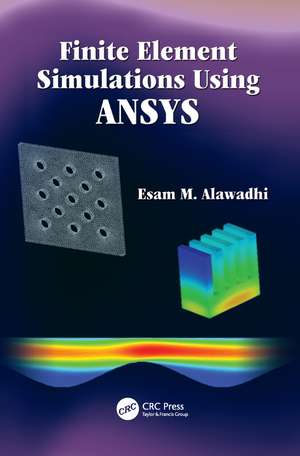
Finite Element Simulations Using ANSYS
Autor Esam M. Alawadhien Limba Engleză Paperback – 22 mai 2017
The book presents fundamental knowledge of numerical simulation using ANSYS. It covers all disciplines in mechanical engineering: structure, solid mechanics, vibration, heat transfer, and fluid dynamics, with adequate background material to explain the physics behind the computations. The author treats each physical phenomenon independently, enabling readers to single out subjects or related chapters and study them as self-contained units. Because a finite element solution is greatly affected by the quality of the mesh, a separate chapter on mesh generation is included as a simple meshing guide, emphasizing the basics. Each chapter contains a number of pictorially guided problems with appropriate screenshots that provide a step-by-step, easy-to-follow technical demonstration. The book includes end-of-chapter problems, several practical, open-ended case studies, and a number of complete tutorials on using ANSYS to resolve the issues engineers tackle on a regular basis.
Instructors can liberally select appropriate chapters to be covered depending on the objectives of the course. The author first explains multiphysics analyses, such as structure-thermal or fluid-thermal analyses, in terms of theory, then derives the equations governing the physical phenomena and presents modeling techniques. Many of the sample problems, questions, and solved examples were used in CAD courses in many universities around the world. They cover structural analysis, solid mechanics and vibration, steady-state and transient heat-transfer analysis, fluid dynamics, multiphysics simulations, and modeling and meshing. Written and organized so that it can easily be used for self-study, this book guides readers through the basic modeling requirements to the correct and physically meaningful numerical result.
Preț: 602.21 lei
Preț vechi: 654.58 lei
-8%
Puncte Express: 903
Carte tipărită la comandă
Livrare economică 27 noiembrie-11 decembrie
Livrare prin curier în România Termenul estimat este afișat lângă disponibilitate.
Transport gratuit pentru acest produs Plată online sau ramburs, în funcție de opțiunile comenzii.
Retur gratuit în 14 zile Comandă securizată și suport în română.
Specificații
ISBN-13: 9781138111837
ISBN-10: 113811183X
Pagini: 416
Ilustrații: 742
Dimensiuni: 156 x 234 x 22 mm
Greutate: 0.45 kg
Ediția:1
Editura: CRC Press
Colecția CRC Press
ISBN-10: 113811183X
Pagini: 416
Ilustrații: 742
Dimensiuni: 156 x 234 x 22 mm
Greutate: 0.45 kg
Ediția:1
Editura: CRC Press
Colecția CRC Press
V-ar putea interesa
-
 Introduction to Computational Fluid Dynamics, AnH. Versteeg-9%Preț: 615.20 lei676.03 lei
 -
 Concepts and Applications of Finite Element AnalysisRobert D. Cook-18%Preț: 1345.31 lei1640.62 lei
 -
 Applied Mechanics of SolidsAllan F. Bower-14%Preț: 792.43 lei921.43 lei
 -
 An Introduction to ANSYS Fluent 2021John E. Matsson-20%Preț: 473.07 lei591.34 lei
 -
 -20%Preț: 446.08 lei557.60 lei
 -
 -20%Preț: 484.65 lei605.82 lei
 -
 -20%Preț: 442.15 lei552.68 lei
 -
 Analysis of Machine Elements Using SOLIDWORKS Simulation 2024Shahin S. Nudehi-20%Preț: 491.92 lei614.90 lei
 -
 An Introduction to Ansys Fluent 2023John E. Matsson-20%Preț: 528.65 lei660.82 lei
 -
 An Introduction to Ansys Fluent 2024John E. Matsson-20%Preț: 541.36 lei676.70 lei
 -
 -20%Preț: 552.03 lei690.03 lei
 -
 -20%Preț: 521.59 lei651.98 lei
 -
 -20%Preț: 558.32 lei697.90 lei
 -
 -20%Preț: 434.19 lei542.73 lei
 -
 -20%Preț: 512.80 lei640.99 lei
 -
 An Introduction to Ansys Fluent 2025John E. Matsson-20%Preț: 574.69 lei718.37 lei
Cuprins
Introduction. The Finite Element Method. Element Types. Symmetries in Models. Introduction to ANSYS. Trusses. Development of Bar Elements. Analyzing a Bar-Truss Structure. Development of Horizontal Beam Elements. Analyzing of Horizontal Beam Structure. Beam Truss Structure Under a Transient Loading. Solid Mechanics & Vibration. Development of Plane Stress-Strain Elements. Stress Concentration of a Plate with a Hole. Displacement Analysis of a Vessel. Three Dimensional Stress Analysis of I-Beam. Contact Element Analysis of Two Beams. Vibration Analysis. Modal Vibration for a Plate with Holes. Harmonic Vibration for a Plate with Holes. Higher Order Elements. Heat Transfer. Introduction to Heat Conduction. Finite Element for Heat Transfer. Thermal Analysis for Fin and Chip. Unsteady Thermal Analyses of Fin. Phase Change Heat Transfer. Fluid Mechanics. Governing Equations for Fluid Mechanics. Finite Element for Fluid Mechanics. Flow Development in a Channel. Flow Over a Cylinder. Multi-Physics. Introduction. Thermal and Structural Analysis of a Thermo-Couple. Chips Cooling in a Forced Convection Domain. Natural Convection Flow in a Square Enclosure. Oscillations of a Square Heated Cylinder in a Channel. Meshing Guide. Mesh Refinement. Element Distortion. Mapped Meshes. Mapped Meshes with ANSYS.
Descriere
ANSYS is extensively used in the design cycle by industry leaders in the U.S. and around the world and is available in computer labs in most universities. This volume focuses on the use of ANSYS in solving practical engineering problems, providing students and practicing engineers with the fundamental knowledge of numerical simulation. It treats each physical phenomenon independently in a way that enables readers to pick out single subjects or related chapters and study them as a self-contained unit. The last chapter is devoted to multi-physics analyses and problems. Additionally, the book contains a number of complete tutorials on using ANSYS for real, practical problems.