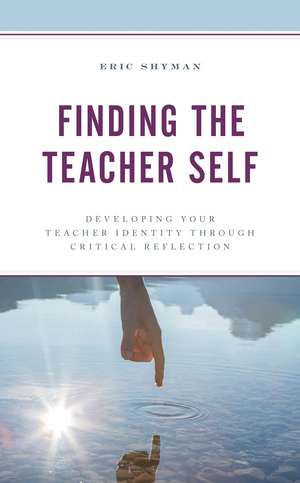
Finding the Teacher Self: Developing Your Teacher Identity through Critical Reflection
Autor Eric Shymanen Limba Engleză Paperback – 8 apr 2020
Preț: 167.95 lei
Preț vechi: 229.77 lei
-27%
Puncte Express: 252
Carte tipărită la comandă
Livrare economică 20 noiembrie-04 decembrie
Livrare prin curier în România Termenul estimat este afișat lângă disponibilitate.
Transport gratuit de la 400.00 lei Plată online sau ramburs, în funcție de opțiunile comenzii.
Retur gratuit în 14 zile Comandă securizată și suport în română.
Specificații
ISBN-13: 9781475853209
ISBN-10: 1475853203
Pagini: 120
Ilustrații: 30 textboxes
Dimensiuni: 153 x 219 x 11 mm
Greutate: 0.2 kg
Editura: Bloomsbury Publishing
Colecția Rowman & Littlefield
Locul publicării:New York, United States
ISBN-10: 1475853203
Pagini: 120
Ilustrații: 30 textboxes
Dimensiuni: 153 x 219 x 11 mm
Greutate: 0.2 kg
Editura: Bloomsbury Publishing
Colecția Rowman & Littlefield
Locul publicării:New York, United States
V-ar putea interesa
-
 Preț: 67.61 lei
 -
 The Reassuring UniverseDon RayPreț: 294.39 lei
 -
 -18%Preț: 757.22 lei923.44 lei
 -
 Karma BusterJoe NunziataPreț: 79.00 lei
 -
 Living by Heart: Empowering Children's Connection to Universal WisdomTherese Evans PhdPreț: 60.04 lei
 -
 Letters from the Inner Self: The Indwelling SpiritAurora Juliana Ariel PhdPreț: 128.54 lei
 -
 All Is OneSeth FalconerPreț: 76.26 lei
 -
 Power of a Positive TeenKarol LaddPreț: 99.30 lei
 -
 The Secret TriangleRebecca LynnePreț: 116.96 lei
 -
 -26%Preț: 176.91 lei237.48 lei
 -
 -17%Preț: 352.54 lei425.93 lei
 -
 -23%Preț: 322.16 lei416.97 lei
 -
 The IlluminatorRajith RajappanPreț: 59.80 lei
 -
 Preț: 68.10 lei
 -
 Preț: 71.40 lei
 -
 The Spiritual Man Versus the Carnal ManAnthony L McKoyPreț: 123.73 lei
 -
 AFRICAN RELIGION VOLUME 5Muata AshbyPreț: 88.00 lei
 -
 Preț: 88.52 lei
 -
 Preț: 53.95 lei
 -
 Preț: 184.44 lei
 -
 L'Art de connaître les hommes (Éd.1806-1809)Johann Caspar LavaterPreț: 192.04 lei
Cuprins
Acknowledgments
Preface
Introduction
Selected Works to Use Along with this Book
Part I
Chapter 1- The Teaching Mirror: What is Reflective Teaching and Why Is It Important?
Chapter 2- Who Am I Really? Framing and Forming Your Teacher Identity
Chapter 3- The Stories We Tell: Narratives and the Formation of our Identities
Chapter 4- The Space Between Us: Administrators and Creating a Culture of Reflection
Chapter 5- The Necessity of Diversity: Pinning Down Cultural Bias
Part II
Chapter 6- Us and Them: Cultural Responsiveness and the Reflective Teacher
Chapter 7- Making Peace with Ourselves: Peace Education and the Reflective Teacher
Chapter 8- Thinking and Acting: The Teacher as Scholar Activist
Chapter 9- What Don't I Know Yet: Engaging Perpetually as a Reflective Teacher
Bibliography
Preface
Introduction
Selected Works to Use Along with this Book
Part I
Chapter 1- The Teaching Mirror: What is Reflective Teaching and Why Is It Important?
Chapter 2- Who Am I Really? Framing and Forming Your Teacher Identity
Chapter 3- The Stories We Tell: Narratives and the Formation of our Identities
Chapter 4- The Space Between Us: Administrators and Creating a Culture of Reflection
Chapter 5- The Necessity of Diversity: Pinning Down Cultural Bias
Part II
Chapter 6- Us and Them: Cultural Responsiveness and the Reflective Teacher
Chapter 7- Making Peace with Ourselves: Peace Education and the Reflective Teacher
Chapter 8- Thinking and Acting: The Teacher as Scholar Activist
Chapter 9- What Don't I Know Yet: Engaging Perpetually as a Reflective Teacher
Bibliography
Recenzii
Eric Shyman provides preservice and in-service teachers and administrators an accessible guide for critically reflecting on how educator identities are shaped by our political culture and how educators who aspire to be culturally responsive can turn reflection into practice that serves all children. With a wide variety of reflective exercises, Shyman helps educators to name and work through alienating workplace constraints in order to develop into critical decision-makers and activists for peace and social justice in their schools and communities. These highly recommended pages give substance to what it can mean to become a life-long critical learner and educator.
Finding the Teacher Self: Developing Teacher Identity Through Critical Reflection is a surprisingly compact book with a rich and multilayered message: We teach who we are; and we are all complex cultural beings who share an essential humanity. Shyman takes the reader on a journey to understand our teaching selves. It is well worth the trip.
Eric Shyman's Finding the Teacher Self: Developing Your Teacher Identity Through Critical Reflection provides a cogent reminder that we all understand, interpret, and interact with our world through deeply-situated perspectives or frames. As such, the process of knowing the world around us must begin with a critical examination of the various frames and identities that comprise the self. Shyman's book provides a fresh take of the importance of critical self-reflection as a vehicle to better understand ourselves, our craft as educators, and the lived realities of the students, parents, and communities with whom we work and interact on a daily basis.
Eric Shyman's text is a useful companion for teachers and reflective practitioners working at the intersections of education and social progress, particularly those looking for innovative methods for teaching. His analysis in the book is critical yet hopeful. He brings together meta-narratives and micro-practices to explore the challenges and possibilities for educators seeking to contribute creatively to social transformation. The book will be valuable today for those teachers concerned with the role of critical reflection in enhancing educational practices toward peace and justice.
Finding the Teacher Self: Developing Teacher Identity Through Critical Reflection is a surprisingly compact book with a rich and multilayered message: We teach who we are; and we are all complex cultural beings who share an essential humanity. Shyman takes the reader on a journey to understand our teaching selves. It is well worth the trip.
Eric Shyman's Finding the Teacher Self: Developing Your Teacher Identity Through Critical Reflection provides a cogent reminder that we all understand, interpret, and interact with our world through deeply-situated perspectives or frames. As such, the process of knowing the world around us must begin with a critical examination of the various frames and identities that comprise the self. Shyman's book provides a fresh take of the importance of critical self-reflection as a vehicle to better understand ourselves, our craft as educators, and the lived realities of the students, parents, and communities with whom we work and interact on a daily basis.
Eric Shyman's text is a useful companion for teachers and reflective practitioners working at the intersections of education and social progress, particularly those looking for innovative methods for teaching. His analysis in the book is critical yet hopeful. He brings together meta-narratives and micro-practices to explore the challenges and possibilities for educators seeking to contribute creatively to social transformation. The book will be valuable today for those teachers concerned with the role of critical reflection in enhancing educational practices toward peace and justice.