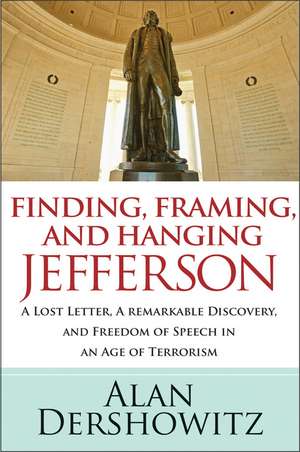
Finding Jefferson
Autor Alan Dershowitzen Limba Engleză Paperback – apr 2009
Preț: 91.97 lei
Puncte Express: 138
Carte disponibilă
Livrare economică 03-17 noiembrie
Livrare prin curier în România Termenul estimat este afișat lângă disponibilitate.
Transport gratuit de la 400.00 lei Plată online sau ramburs, în funcție de opțiunile comenzii.
Retur gratuit în 14 zile Comandă securizată și suport în română.
Specificații
ISBN-13: 9780470450437
ISBN-10: 0470450436
Pagini: 258
Dimensiuni: 140 x 216 x 15 mm
Greutate: 0.33 kg
Editura: Trade Paper Press
Locul publicării:Hoboken, United States
ISBN-10: 0470450436
Pagini: 258
Dimensiuni: 140 x 216 x 15 mm
Greutate: 0.33 kg
Editura: Trade Paper Press
Locul publicării:Hoboken, United States
V-ar putea interesa
-
 The Best DefenseAlan DershowitzPreț: 134.55 lei
 -
 The Trials Of ZionAlan DershowitzPreț: 245.09 lei
 -
 BlasphemyAlan DershowitzPreț: 91.61 lei
 -
 The Case Against Israel's EnemiesAlan DershowitzPreț: 96.19 lei
 -
 ChutzpahAlan M. DershowitzPreț: 155.81 lei
 -
 The Vanishing American JewAlan M. DershowitzPreț: 153.06 lei
 -
 Preț: 408.35 lei
 -
 Preț: 459.48 lei
 -
 The Bloody South Carolina Election of 1876Jerry L. WestPreț: 225.02 lei
 -
 Union General John A. McClernand and the Politics of CommandChristopher C. MeyersPreț: 224.35 lei
 -
 Sitting in and Speaking OutJeffrey A TurnerPreț: 269.02 lei
 -
 A Century of RevolutionGilbert M JosephPreț: 293.99 lei
 -
 Preț: 359.02 lei
 -
 MichiganBruce A RubensteinPreț: 347.13 lei
 -
 Preț: 432.03 lei
 -
 Colonial America – A History to 1763 4eR. MiddletonPreț: 546.26 lei
 -
 Bartolomé de las CasasClaytonPreț: 200.44 lei
 -
 The Last CaudilloJürgen BuchenauPreț: 172.28 lei
 -
 The IncasTerence N. D'AltroyPreț: 293.45 lei
 -
 Broke by the WarEdmund L DragoPreț: 186.86 lei
 -
 Spiritual ActivismRabbi Avraham WeissPreț: 98.12 lei
Public țintă
Fans of Alan Dershowitz, collectors, current affairs readers; readers interested in freedom of speech; those interested in US History.Descriere
History
" This book is a wonderful adventure story that uses Jefferson′s arguments and Dershowitz′s counters to illuminate issues that were important and difficult when the U.S. was a new nation and that remain so today. I recommend it to every citizen concerned with preserving our liberties and combating terrorism."
–President William Jefferson Clinton
"The 1801 letter of Thomas Jefferson to Elijah Boardman is of tremendous interest and importance, as is the remarkable story of its discovery by Alan Dershowitz."
–David McCullough, Pulitzer Prize winning author
"This book is terrific on every level: as a memoir of a passionate collector, it is delightful; as an account of an important historical discovery, it is riveting; as a defense of free speech, it is brilliant."
–Doris Kearns Goodwin, author of Team of Rivals: The Political Genius of Abraham Lincoln
" This book is a wonderful adventure story that uses Jefferson′s arguments and Dershowitz′s counters to illuminate issues that were important and difficult when the U.S. was a new nation and that remain so today. I recommend it to every citizen concerned with preserving our liberties and combating terrorism."
–President William Jefferson Clinton
"The 1801 letter of Thomas Jefferson to Elijah Boardman is of tremendous interest and importance, as is the remarkable story of its discovery by Alan Dershowitz."
–David McCullough, Pulitzer Prize winning author
"This book is terrific on every level: as a memoir of a passionate collector, it is delightful; as an account of an important historical discovery, it is riveting; as a defense of free speech, it is brilliant."
–Doris Kearns Goodwin, author of Team of Rivals: The Political Genius of Abraham Lincoln
Cuprins
Acknowledgments. PART I THE COLLECTOR AND HIS PASSIONS.
1 My Passion for Collecting.
2 My Passions for Freedom of Speech, Criminal Law, and Thomas Jefferson.
PART II THE LETTER.
3 Finding the Jefferson Letter.
4 The Provenance of the Jefferson–Boardman Letter.
PART III MY LETTER TO JEFFERSON.
5 Where We Have Come since 1826.
6 Jefferson s First Argument: An Expressed Opinion Can Never Constitute an Overt Act.
7 Jefferson s Second Argument: If Conscience Will Govern.
8 Jefferson s Third Argument: "We Have Nothing to Fear from the Demoralizing Reasonings of Some, if Others Are Left Free to Demonstrate Their Errors".
9 Jefferson s Fourth Argument: "The Law Stands Ready to Punish the First Criminal Act Produced by the False Reasoning".
10 Jefferson s Fifth Argument: "These Are Safer Correctives than the Conscience of a Judge".
PART IV WHAT WOULD JEFFERSON SAY ABOUT TERRORISM AND FREEDOM OF SPEECH TODAY?
11 Jefferson s Views on the "Terrorism" of His Era.
12 Jefferson s Actions in the Burr Case.
13 Jefferson s Views on Torture, Habeas Corpus, and Other Issues Currently Debated in the Context of Terrorism.
14 How Would Jefferson Strike the Balance between Freedom of Speech and Prevention of Terrorism.
15 My View, as Influenced by Jefferson and the Experiences of Our Time.
Appendix A A Transcript of the Jefferson Letter and Letterpress Copy.
Appendix B Excerpted from "Discourse: Truth Its Own Test and God Its Only Judge".
Notes.
Index.
1 My Passion for Collecting.
2 My Passions for Freedom of Speech, Criminal Law, and Thomas Jefferson.
PART II THE LETTER.
3 Finding the Jefferson Letter.
4 The Provenance of the Jefferson–Boardman Letter.
PART III MY LETTER TO JEFFERSON.
5 Where We Have Come since 1826.
6 Jefferson s First Argument: An Expressed Opinion Can Never Constitute an Overt Act.
7 Jefferson s Second Argument: If Conscience Will Govern.
8 Jefferson s Third Argument: "We Have Nothing to Fear from the Demoralizing Reasonings of Some, if Others Are Left Free to Demonstrate Their Errors".
9 Jefferson s Fourth Argument: "The Law Stands Ready to Punish the First Criminal Act Produced by the False Reasoning".
10 Jefferson s Fifth Argument: "These Are Safer Correctives than the Conscience of a Judge".
PART IV WHAT WOULD JEFFERSON SAY ABOUT TERRORISM AND FREEDOM OF SPEECH TODAY?
11 Jefferson s Views on the "Terrorism" of His Era.
12 Jefferson s Actions in the Burr Case.
13 Jefferson s Views on Torture, Habeas Corpus, and Other Issues Currently Debated in the Context of Terrorism.
14 How Would Jefferson Strike the Balance between Freedom of Speech and Prevention of Terrorism.
15 My View, as Influenced by Jefferson and the Experiences of Our Time.
Appendix A A Transcript of the Jefferson Letter and Letterpress Copy.
Appendix B Excerpted from "Discourse: Truth Its Own Test and God Its Only Judge".
Notes.
Index.
Notă biografică
Alan Dershowitz, the Felix Frankfurter Professor of Law at Harvard Law School, is one of the country′s foremost appellate lawyers and a distinguished defender of individual liberties. His many books include the #1 New York Times bestsellers Chutzpah and The Case for Israel. He lives in Cambridge, Massachusetts.
Recenzii
Contemplating whether the government could censor imams whose preaching might incite terrorism, Harvard law professor Dershowitz ( Blasphemy ) wondered what Thomas Jefferson would say about "where to draw the appropriate line, between dangerous speech and harmful conduct." Dershowitz found an answer in New York′s Argosy Bookstore, where he stumbled over a letter written by Jefferson on July 3, 1801, addressing the limits of free speech, especially religious and political speech. Based in part on his reading of Jefferson, Dershowitz concludes that we ought not to censor the speech of even the most violent religious leaders. Echoing Jefferson, he says that liberty is dangerous and adds that in any case censorship would not prevent either violence or incitement to it. This book is not without its annoyances: it opens with a self–indulgent tour through the many objects Dershowitz likes to collect, from baseball paraphernalia to the odd picture of Abraham Lincoln, and the bulk of Dershowitz′s ruminations are cast in a long letter to Jefferson—a distracting device. These meditations from one of our most provocative constitutional scholars may not evoke as much controversy as have his earlier suggestions that there be warrants for interrogators to use torture in limited circumstances, but the main contribution here is the publication of Jefferson′s letter. Photos. (Nov.) ( Publishers Weekly , September 3, 2007)