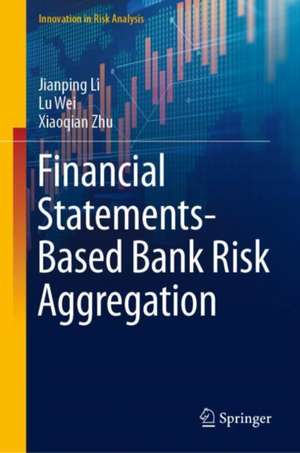
Financial Statements-Based Bank Risk Aggregation: Innovation in Risk Analysis
Autor Jianping Li, Lu Wei, Xiaoqian Zhuen Limba Engleză Hardback – 16 mar 2022
This book proposes a bank risk aggregation framework based on financial statements. Specifically, bank risk aggregation is of great importance to maintain stable operation of banking industry and prevent financial crisis. A major obstacle to bank risk management is the problem of data shortage, which makes many quantitative risk aggregation approaches typically fail. Recently, to overcome the problem of inaccurate total risk results caused by the shortage of risk data, some researchers have proposed a series of financial statements-based bank risk aggregation approaches. However, the existing studies have drawbacks of low frequency and time lag of financial statements data and usually ignore off-balance sheet business risk in bank risk aggregation. Thus, by reviewing the research progress in bank risk aggregation based on financial statements and improving the drawbacks of existing methods, this book proposes a bank risk aggregation framework based on financial statements. It makes full use of information recorded in financial statements, including income statement, on- and off-balance sheet assets, and textual risk disclosures, which solves the problem of data shortage in bank risk aggregation to some extent and improves the reliability and rationality of bank risk aggregation results.
This book not only improves the theoretical studies of bank risk aggregation, but also provides an important support for the capital allocation of the banking industry in practice. Thus, this book has theoretical and practical importance for bank managers and researchers of bank risk management.

Preț: 980.83 lei
Preț vechi: 1196.14 lei
-18%
Puncte Express: 1471
Carte tipărită la comandă
Livrare economică 24 decembrie 26 - 07 ianuarie 27
Livrare prin curier în România Termenul estimat este afișat lângă disponibilitate.
Transport gratuit pentru acest produs Plată online sau ramburs, în funcție de opțiunile comenzii.
Retur gratuit în 14 zile Comandă securizată și suport în română.
Specificații
ISBN-13: 9789811904073
ISBN-10: 9811904073
Pagini: 220
Ilustrații: VIII, 210 p. 49 illus., 3 illus. in color.
Dimensiuni: 160 x 241 x 18 mm
Greutate: 0.45 kg
Ediția:1st ed. 2022
Editura: Springer
Colecția Innovation in Risk Analysis
Seria Innovation in Risk Analysis
Locul publicării:Singapore, Singapore
ISBN-10: 9811904073
Pagini: 220
Ilustrații: VIII, 210 p. 49 illus., 3 illus. in color.
Dimensiuni: 160 x 241 x 18 mm
Greutate: 0.45 kg
Ediția:1st ed. 2022
Editura: Springer
Colecția Innovation in Risk Analysis
Seria Innovation in Risk Analysis
Locul publicării:Singapore, Singapore
Cuprins
Chapter 1. Basic concepts of bank risk aggregation.- Chapter 2. Research review of bank risk aggregation.- Chapter 3. Financial statements based bank risk aggregation framework.- Chapter 4. Bank risk aggregation based on income statement.- Chapter 5. A “factor-integral” approach to solve the low-frequency problem of income statement data.- Chapter 6. A two-stage bank risk aggregation approach based on financial statements data and external loss data.- Chapter 7. Bank risk aggregation based on income statement and balance sheet.- Chapter 8. Bank risk aggregation with off-balance sheet (OBS) items.- Chapter 9. Analysis of textual risk factors disclosed in financial statements.- Chapter 10. Bank risk aggregation with forward–looking textual risk disclosures.- Chapter 11. Main conclusions and future research.
Notă biografică
Prof. Jianping Li is the former President of Fujian Normal University, Director of FJNU Branch of National Research Center of Comprehensive Economic Competitiveness, PhD supervisor, an expert on Fujian Province, and recipient of the State Council Special Allowance and National Young & Mid-aged Expert with Outstanding Contribution. He is also an academic leader at Fujian University's key discipline "Political Economics", a PhD program focusing on Theoretical Economics and the sub-discipline Fundamentals of Marxism. He is Vice Chairman of the China Association of Capital Studies, the National Association of Marxist Economics History, China Association of Historic Materialism, Fujian Province Association of Social Sciences, and Fujian Province Association for Science and Technology, as well as economic adviser of the People's Government of Fujian Province. Prof. Li's research focuses on Marxist economic ideological history, capital and socialist market economies, economicreform methodologies, and regional economic development. He has led over 20 national and provincial/ministerial key research projects, compiled/wrote more than 60 academic books (including those he coauthored) such as Dialectic Exploration on Volume I of Capital and A Report of Overall Competitiveness of China's Provincial Economy, and has published over 100 academic papers in periodicals like People's Daily and Economics Information. He is the recipient of seven first prizes and two second prizes including the Fujian Province Excellent Philosophy and Social Sciences Research Result Award, as well as the Excellent Theoretical Paper Award in the 7th National "Five-One" Project.
Prof. Minrong Li holds a PhD in Economics. He is currently Director General of the China Institute of Science and Technology Evaluation. He is a former Director of the Development Research Center of the People's Government of Fujian Province, adjunct professor at Fujian Normal University, doctoral supervisor and Vice President of the China Regional Economics Society. Prof. Li's main research interests are in macroeconomics, regional economic competitiveness, and modern logistics, and he has published more than 20 books (including those he coauthored), such as A Study of the Overall Competitiveness of China's Provincial Economy (1998-2004), Annual Report on Competitiveness of China's Provincial Agriculture, Annual Report on Competitiveness of China's Provincial Forestry, and West Shore of Taiwan Straits and Taiwan published in Taiwan; he has also contributed more than 240 academic papers in periodicals like People's Daily, Qiushi Journal, Management World, and Economics Information. Recently he has led several provincial key research projects, including the National Social Science Fund project, A Research of Forecasting and Evaluation of Overall Competitiveness of China's Provincial Economy, Application of the Empirical Economics Theories and Methodology inRegional Economy, and A Study on the Several Key Issues in Constructing Western Taiwan Straits Economic Zone during the "Eleventh Five-year" period. His research achievements include more than 10 provincial/ministerial awards, including third prizes of the second and third Excellent Achievements in Social Sciences award of Xinjiang Uygur Autonomous Region, as well as the Provincial Prize for Progress in Science and Technology (third place), first prizes of the 7th and 8th Excellent Achievements in Social Sciences, second prize of the 6th Excellent Achievements in Social Sciences, and third prize of the 7th Excellent Achievements in Social Sciences in Fujian Province.
Prof. Maoxing Huang is the Vice (Managing) Dean of the School of Economics at Fujian Normal University, Executive Deputy Director of the FJNU Branch of the National Research Center of Comprehensive Economic Competitiveness, Executive Director of the Talent Development Research Centerof Fujian Province, Vice Direc
Textul de pe ultima copertă
This book proposes a bank risk aggregation framework based on financial statements. Specifically, bank risk aggregation is of great importance to maintain stable operation of banking industry and prevent financial crisis. A major obstacle to bank risk management is the problem of data shortage, which makes many quantitative risk aggregation approaches typically fail. Recently, to overcome the problem of inaccurate total risk results caused by the shortage of risk data, some researchers have proposed a series of financial statements-based bank risk aggregation approaches. However, the existing studies have drawbacks of low frequency and time lag of financial statements data and usually ignore off-balance sheet business risk in bank risk aggregation. Thus, by reviewing the research progress in bank risk aggregation based on financial statements and improving the drawbacks of existing methods, this book proposes a bank risk aggregation framework based on financial statements. Itmakes full use of information recorded in financial statements, including income statement, on- and off-balance sheet assets, and textual risk disclosures, which solves the problem of data shortage in bank risk aggregation to some extent and improves the reliability and rationality of bank risk aggregation results.
This book not only improves the theoretical studies of bank risk aggregation, but also provides an important support for the capital allocation of the banking industry in practice. Thus, this book has theoretical and practical importance for bank managers and researchers of bank risk management.