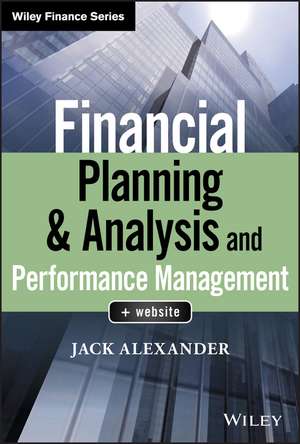
Financial Planning & Analysis and Performance Management
Autor Jack Alexanderen Limba Engleză Hardback – 13 iun 2018
Considerăm că eficiența unui departament financiar nu mai poate fi măsurată astăzi doar prin acuratețea raportărilor istorice, ci prin capacitatea de a influența viitorul organizației. Să luăm exemplul unui CFO care se confruntă cu indicatori de performanță (KPI) decuplați de realitatea operațională; lucrarea de față propune trecerea de la aceste cifre statice la un model de prognoză rulată (rolling forecast) care permite adaptarea strategiei în timp real. În Financial Planning & Analysis and Performance Management, Jack Alexander distilează decenii de consultanță și experiență executivă pentru a oferi un manual robust despre cum finanțele pot deveni un partener de business autentic. Găsim în această carte o abordare care depășește teoria academică, concentrându-se pe 'arta' și 'știința' FP&A. Autorul integrează secțiuni revigorante despre managementul capitalului uman și inovație, elemente adesea ignorate în manualele tehnice, dar esențiale pentru profitabilitatea pe termen lung. Volumul se distinge prin claritatea cu care explică implementarea tablourilor de bord care chiar generează decizii, nu doar date. Complementar volumului Financial Analysis – A Controller′s Guide 2e de SM Bragg, care se concentrează pe tehnici concrete de rezolvare a problemelor contabile, lucrarea lui Alexander extinde perspectiva către planificarea strategică și crearea de valoare pentru acționari. Față de Financial Forecasting, Analysis, and Modelling de Michael Samonas, care pune accent pe simularea riscurilor și incertitudine, Financial Planning & Analysis and Performance Management oferă un cadru mai vast, integrând execuția operațională cu managementul performanței. În contextul operei sale, această carte rafinează conceptele din Performance Dashboards + WS, oferind o viziune holistică asupra ecosistemului financiar modern.
Preț: 392.37 lei
Preț vechi: 426.50 lei
-8%
Carte disponibilă
Livrare economică 02-16 noiembrie
Livrare express 17-23 octombrie pentru 60.95 lei
Specificații
ISBN-10: 1119491487
Pagini: 640
Dimensiuni: 159 x 236 x 43 mm
Greutate: 1 kg
Editura: Wiley
Locul publicării:Hoboken, United States
V-ar putea interesa
-
 Preț: 110.09 lei
 -
 The Sustainable EconomyRobert S DevinePreț: 108.17 lei
 -
 Youth Strength TrainingAvery FaigenbaumPreț: 200.92 lei
 -
 Preț: 182.69 lei
 -
 English Literature in ContextPaul PoplawskiPreț: 257.82 lei
 -
 -10%Preț: 205.31 lei228.38 lei
 -
 Rational Emotive Behavior TherapyAlbert EllisPreț: 303.36 lei
 -
 -23%Preț: 596.08 lei774.13 lei
 -
 Preț: 237.15 lei
 -
 -28%Preț: 86.21 lei119.44 lei
 -
 Great Book of Woodworking TipsRandy JohnsonPreț: 147.25 lei
 -
 Forest EcosystemsLee Zieger-15%Preț: 475.60 lei559.53 lei
 -
 Python ProgrammingRyan Turner-20%Preț: 161.54 lei201.92 lei
 -
 TourismPeter Robinson-23%Preț: 678.09 lei880.64 lei
 -
 Advances in Accounting Behavioral ResearchKhondkar E. Karim-19%Preț: 592.19 lei731.09 lei
 -
 Philosophies of Hospitality and TourismProkopis A. ChristouPreț: 345.78 lei
 -
 The Complete Guide to Joint-MakingJohn BullarPreț: 152.68 lei
 -
 The Advanced Business English GuideChristopher HillPreț: 104.30 lei
 -
 Tourism Destination ManagementManuel Rodríguez DíazPreț: 305.47 lei
 -
 Web TechnologiesShruti KohliPreț: 227.94 lei
 -
 Parallel Programming with C# and .Net Core:Rishabh Verma Neha Shrivastava-20%Preț: 156.20 lei195.25 lei
Public țintă
Controllers, CFOs, Directors of FP&A, Financial Analysts, Accounting Managers, Strategic Planners, and CPAsDe ce să citești această carte
Această carte este esențială pentru directorii financiari, controlori și analiști care doresc să treacă de la simpla raportare la influențarea deciziilor strategice. Cititorul va câștiga un set de instrumente practice pentru modelare financiară și KPI-uri relevante, învățând cum să transforme datele brute în strategii de creștere a valorii firmei. Este resursa definitivă pentru oricine ocupă o funcție de conducere în departamentul financiar și dorește să livreze rezultate măsurabile.
Despre autor
Jack Alexander este fondatorul și președintele Value Advisory Group, LLC, o firmă de consultanță specializată în îmbunătățirea performanței afacerilor și creșterea valorii pentru acționari. Cu o carieră solidă ce include funcții executive de CFO și expertiză ca Certified Public Accountant (CPA), Alexander îmbină rigoarea tehnică cu viziunea strategică. Este lector la Babson College, unde predă finanțe corporative în cadrul programului MBA, fiind un vorbitor recunoscut la nivel internațional pe teme de management bazat pe valoare. Experiența sa practică și academică se reflectă în abordarea pragmatică a tuturor lucrărilor sale de specialitate.
Descriere
Financial Planning & Analysis and Performance Management is the essential desk reference for CFOs, FP&A professionals, investment banking professionals, and equity research analysts. With thought-provoking discussion and refreshing perspective, this book provides insightful reference for critical areas that directly impact an organization’s effectiveness. From budgeting and forecasting, analysis, and performance management, to financial communication, metrics, and benchmarking, these insights delve into the cornerstones of business and value drivers. Dashboards, graphs, and other visual aids illustrate complex concepts and provide reference at a glance, while the author’s experience as a CFO, educator, and general manager leads to comprehensive and practical analytical techniques for real world application.
Financial analysts are under constant pressure to perform at higher and higher levels within the realm of this consistently challenging function. Though areas ripe for improvement abound, true resources are scarce—until now. This book provides real-world guidance for analysts ready to:
- Assess performance of FP&A function and develop improvement program
- Improve planning and forecasting with new and provocative thinking
- Step up your game with leading edge analytical tools and practical solutions
- Plan, analyze and improve critical business and value drivers
- Build analytical capability and effective presentation of financial information
- Effectively evaluate capital investments in uncertain times
The most effective analysts are those who are constantly striving for improvement, always seeking new solutions, and forever in pursuit of enlightening resources with real, useful information. Packed with examples, practical solutions, models, and novel approaches, Financial Planning & Analysis and Performance Management is an invaluable addition to the analyst’s professional library. Access to a website with many of the tools introduced are included with the purchase of the book.
Notă biografică
Descriere scurtă
"Financial Planning & Analysis and Performance Management provides a comprehensive yet pragmatic framework to deliver value from finance and contribute to overall business success. Addressing not only the science but the 'art' of FP&A, a truly valuable resource to both the finance executive defining the roadmap to FP&A excellence and the analyst establishing credibility as a business partner." --Michael Rossi, MBA, Healthcare CFO
"Beyond academic theory, I have witnessed firsthand Alexander's framework-driven concepts improve firm profitability and value. This comprehensive book is a required read and reference for finance executives and FP&A teams." --William W. Benton, CFA, Investment Analyst, Partner, William Blair Investment Management, LLC
"Well written and comprehensive, Jack Alexander's latest work leads you to the true drivers of business performance in a business world awash with detached KPI's and useless dashboards. An essential read for any Human Resources leader who wants to speak intelligently about the business and to be an effective business partner. The sections on Innovation, Agility, and Human Capital Management are refreshing and precisely on target." --Warren Davis, Vice President, Human Resources, JMA Wireless
"A terrific resource for all finance professionals, with actionable content for improving key areas of FP&A. Once again, Jack has captured practical tools and techniques, providing them for such critical areas as analysis, modeling, rolling forecasts, KPI's and dashboards, valuation and capital investment decisions. The book will serve as a great future reference for our FP&A group." --Dan Heaney, CFO, Public Consulting Group
"Financial Planning & Analysis and Performance Management is an invaluable reference tool for finance professionals from entry-level to CFO, written with a refreshing clarity that non-finance professionals also will appreciate. The practical techniques, KPI's and dashboards are easy to execute with the power to transform your business's decision-making and drive operating performance and profitability." --Laura J. Goedken, CFO, TaxAct, Inc.
Cuprins
About the Website xix
1 Financial Planning & Analysis and Business Performance Management 1
The Problem with Traditional Measurement Systems 1
Objectives of Financial Analysis and Performance
Management 3
Preview of the Book 6
Summary 9
Part One Fundamentals and Key FP&A Capabilities
2 Fundamentals of Finance 13
Basics of Accounting and Financial Statements 13
Financial Ratios and Indicators 19
Summary 42
3 Key Analytical Tools and Concepts 43
Basic Statistical Tools 43
The Business Model 59
Summary 69
4 Developing Predictive and Analytical Models 71
What Is a Financial Model? 71
Summary 81
Appendix: Illustrative Model 81
5 Building Analytical Capability 89
For the Individual 90
For the Organization 94
Summary 108
6 Communicating and Presenting Financial Information 109
Laying the Foundation for Success 110
Developing Effective Presentations and Reports 117
Delivering the Presentation 120
Data Visualization and Presentation: A Picture Is Worth a Thousand Words 121
Summary 134
Part Two Performance Management
7 Business Performance Management 137
What Is Business Performance Management? 138
Developing or Enhancing BPM in an Organization 144
Summary 155
8 Dashboards and Key Performance Indicators 157
Objectives of Dashboards and Key Performance Indicators 157
Selecting Appropriate Performance Measures and Key
Performance Indicators 160
Creating Performance Dashboards 166
Sample Dashboards for Selected Industries 175
Summary 175
9 Institutionalizing Performance Management 179
Gaining Traction 179
Integrating Business Performance Management with Other
Management Processes 183
Avoiding Common Mistakes 189
Summary 191
10 Measuring and DrivingWhat's Important:Innovation, Agility, and Human Capital 193
Innovation 194
Measuring and Driving Business Agility 204
Human Capital Management 214
HCM Dashboard 226
Summary 226
11 The External View: Benchmarking Performance and Competitive Analysis 227
Analysis of Markets, Customers, and Competitors 228
Benchmarking to Evaluate Performance 232
Using Benchmarks to Set Enterprise Goals for Performance and Value Creation 242
Summary 243
Part Three Business Projections and Plans
12 Business Projections and Plans: Introduction and Best Practices 247
Overview of Business Planning and Projections 248
Best Practices in Projecting Future Financial Results 252
Summary 266
13 Budgets, Operating Plans, and Forecasts 267
The Budgeting Process 267
The Operating Plan 272
Business Forecasts and Outlooks 277
Summary 301
14 Long-Term Projections 303
Unique Challenges in Estimating Long-Term Performance 304
Applications of Long-Term Projections 305
Developing Long-Term Projections 307
Presentation of Long-Term Projections 319
Summary 325
Part Four Planning and Analysis for Critical Business and Value Drivers
15 Revenue and Gross Margins 329
Revenue Growth: Key Drivers 330
Key Performance Measures: Revenue Growth 343
Revenue Dashboard 351
Gross Margins and Relative Pricing Strength 351
Measures of Relative Pricing Strength 356
Summary 359
16 Operating Expenses and Effectiveness 361
Drivers of Operating Effectiveness 362
Key Performance Indicators: Operating Effectiveness 365
Tools for Assessing and Improving Operating Effectivenss 382
Summary 387
17 Capital Management and Cash Flow:Working Capital 389
Critical Success Factors 391
Operating Capital Management 393
Understanding the Dynamics of Operating Capital 394
Unleashing the Value Trapped in Operating Capital 396
Accounts Receivable 398
Key Performance Indicators for the Revenue Process and
Accounts Receivable 401
Inventories 410
Summary 420
18 Capital Management and Cash Flow:Long-Term Assets 421
Capital Intensity 421
Tools for Improving the Management of Long-Term Capital 424
Projecting Capital Investments and Depreciation 428
Key Performance Indicators for Capital Intensity 431
Intangible Assets 433
Key Performance Indicators: Goodwill and Intangible Assets 434
Excess Cash Balances 436
Long-Term Capital Dashboard 437
Summary 439
19 Risk, Uncertainty, and the Cost of Capital 441
The Time Value of Money 441
The Cost of Capital 449
Performance Measures 458
Summary 461
Part Five Valuation and Capital Investment Decisions
20 Capital Investment Decisions: Introduction and Key Concepts 465
The Capital Investment Process 466
Evaluating the Economic Merits of Capital Investments 469
Illustrations 478
Summary 484
21 Capital Investment Decisions: Advanced Topics 485
Dealing with Risk and Uncertainty in Capital Investment
Decisions 485
Presenting Capital Investment Decisions 499
Capital Budgeting and Rationing 500
Evaluating the Effectiveness of the Capital Investment
Decision Process 502
Summary 505
22 Business Valuation and Value Drivers 507
Estimating the Value of a Business by Discounting Future
Cash Flows 508
Estimating the Value of Firms by Using the Valuation
of Similar Firms: Multiples of Revenues, Earnings,
and Related Measures 517
Building Shareholder Value in a Multiples Framework 521
Integrated Valuation Summary for Roberts Manufacturing
Company 525
Value Drivers 528
Summary 533
23 Analysis of Mergers and Acquisitions 535
The Acquisition Challenge 535
Key Elements in Valuing an Acquisition 537
Methods and Metrics for Valuing an Acquisition 539
Common Mistakes in M&A 554
Best Practices and Critical Success Factors 557
Understanding Seller Best Practices 560
Key Performance Indicators for M&A 562
Dashboards for M&A 564
Summary 564
Part Six Summary
24 Summary and Where to from Here? 569
Key Takeaways 569
Where to from Here? 572
Glossary 575
Acknowledgments 585
About the Author 587
Index 589