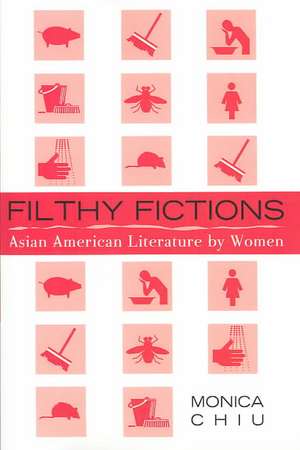
Filthy Fictions: Asian American Literature by Women: Critical Perspectives on Asian Pacific Americans
Autor Monica Chiuen Limba Engleză Paperback – 20 ian 2004
Preț: 282.61 lei
Preț vechi: 367.80 lei
-23%
Puncte Express: 424
Carte tipărită la comandă
Livrare economică 30 noiembrie-14 decembrie
Livrare prin curier în România Termenul estimat este afișat lângă disponibilitate.
Transport gratuit de la 400.00 lei Plată online sau ramburs, în funcție de opțiunile comenzii.
Retur gratuit în 14 zile Comandă securizată și suport în română.
Specificații
ISBN-13: 9780759104563
ISBN-10: 0759104565
Pagini: 210
Dimensiuni: 164 x 229 x 15 mm
Greutate: 0.35 kg
Ediția:New.
Editura: Bloomsbury Publishing
Colecția AltaMira Press
Seria Critical Perspectives on Asian Pacific Americans
Locul publicării:New York, United States
ISBN-10: 0759104565
Pagini: 210
Dimensiuni: 164 x 229 x 15 mm
Greutate: 0.35 kg
Ediția:New.
Editura: Bloomsbury Publishing
Colecția AltaMira Press
Seria Critical Perspectives on Asian Pacific Americans
Locul publicării:New York, United States
V-ar putea interesa
-
 Daphne Du MaurierDaphne Du Maurier-17%Preț: 66.91 lei80.65 lei
 -
 Aesthetics: An Introduction to the Philosophy of ArtAnne Sheppard-12%Preț: 362.65 lei410.01 lei
 -
 The Modern American NovelMalcolm Bradbury-19%Preț: 291.01 lei359.38 lei
 -
 Middleton and Rowley: The ChangelingJay O'BerskiPreț: 155.12 lei
 -
 Eighteenth-Century VitalismC. PackhamPreț: 406.28 lei
 -
 R. S. Thomas: Everyman Poetryrev R.S. Thomas-29%Preț: 64.40 lei90.44 lei
 -
 Poetry Please!: More Poetry PleaseBBC Radio 4-28%Preț: 45.32 lei62.93 lei
 -
 RewritesNeil SimonPreț: 167.38 lei
 -
 Ramsey Campbell: Critical Essays on the Modern Master of HorrorGary William Crawford-36%Preț: 676.37 lei1052.46 lei
 -
 Conversations with Norman MailerNorman MailerPreț: 234.85 lei
 -
 Conversations with Saul BellowSaul BellowPreț: 231.36 lei
 -
 Preț: 86.79 lei
 -
 -34%Preț: 86.31 lei131.14 lei
Cuprins
1 Introduction: Pejorative Matter
2 Abjection, Displacement, and Psychological Dissonance in Crossings
3 Kamani's Crass, Classed, and Incurable Female Bodies
4 Animals and Systems of Dirt in the Works of Lois-Ann Yamanaka
5 Inside the Meat Machine: Food, Filth, and (In)Fertility in My Year of Meats
6 Conclusion: Filth and Asian American Literary Criticism
7 References
2 Abjection, Displacement, and Psychological Dissonance in Crossings
3 Kamani's Crass, Classed, and Incurable Female Bodies
4 Animals and Systems of Dirt in the Works of Lois-Ann Yamanaka
5 Inside the Meat Machine: Food, Filth, and (In)Fertility in My Year of Meats
6 Conclusion: Filth and Asian American Literary Criticism
7 References
Recenzii
In focusing on dirt as a unifying metaphor, Filthy Fictions productively advances our understanding of the processes of racial formation and its enmeshing with sexual difference. Monica Chiu pushes the topic in often unexpected directions: not its literal appearance as trash or contaminant, but as sexual impurity, bestiality, food taboos, and hypochondria. In theorizing race as pathology, her book creates a ground-floor discussion of the political investments of a number of noncanonical Asian American texts. In the end, her concern is not really about filth, but about the transformation of 'nature' into culture and the violence that attends that transformation.
The author's fresh, energetic voice and unique perspective make this volume a pleasure to read. Chiu takes on the subject of filth or dirt in the works of Asian American women writers in order to examine the ways in which these writers are subverting racist stereotypes in some cases and, in others, participating in the perpetuation of a damaging idea. Filth, or as Chiu labels it, 'pejorative matter,' takes many forms but is often connected to sexuality, foodways, ethnic traditions, animals and femininity. The political saliency of this topic is so obvious that one wonders why scholars have ignored it to this point. Chiu looks at a number of writers who have been largely ignored by critics of Asian American literature-Chuang Hua, Ginu Kamani, Lois-Ann Yamanaka, Ruth Ozeki. In framing her study, she pays particular attention to Shirley Geok-lin Lim's work on global feminism, but she also broadly applies interdisciplinary concepts from a number of leading feminist critics of the past 20 years. Highly recommended.
The author's fresh, energetic voice and unique perspective make this volume a pleasure to read. Chiu takes on the subject of filth or dirt in the works of Asian American women writers in order to examine the ways in which these writers are subverting racist stereotypes in some cases and, in others, participating in the perpetuation of a damaging idea. Filth, or as Chiu labels it, 'pejorative matter,' takes many forms but is often connected to sexuality, foodways, ethnic traditions, animals and femininity. The political saliency of this topic is so obvious that one wonders why scholars have ignored it to this point. Chiu looks at a number of writers who have been largely ignored by critics of Asian American literature-Chuang Hua, Ginu Kamani, Lois-Ann Yamanaka, Ruth Ozeki. In framing her study, she pays particular attention to Shirley Geok-lin Lim's work on global feminism, but she also broadly applies interdisciplinary concepts from a number of leading feminist critics of the past 20 years. Highly recommended.