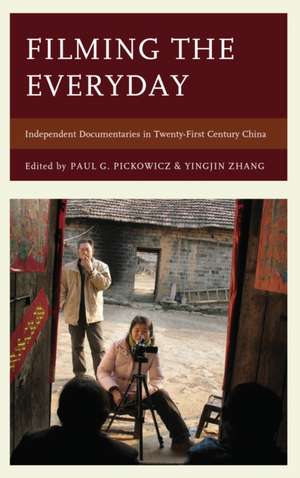
Filming the Everyday: Independent Documentaries in Twenty-First-Century China
Editat de Paul G. Pickowicz, Yingjin Zhangen Limba Engleză Paperback – 15 dec 2016
Preț: 276.77 lei
Preț vechi: 361.21 lei
-23%
Puncte Express: 415
Carte tipărită la comandă
Livrare economică 01-15 decembrie
Livrare prin curier în România Termenul estimat este afișat lângă disponibilitate.
Transport gratuit de la 400.00 lei Plată online sau ramburs, în funcție de opțiunile comenzii.
Retur gratuit în 14 zile Comandă securizată și suport în română.
Specificații
ISBN-13: 9781442270244
ISBN-10: 1442270241
Pagini: 212
Ilustrații: 18 b/w photos
Dimensiuni: 152 x 227 x 11 mm
Greutate: 0.3 kg
Editura: Bloomsbury Publishing
Colecția Rowman & Littlefield
Locul publicării:New York, United States
ISBN-10: 1442270241
Pagini: 212
Ilustrații: 18 b/w photos
Dimensiuni: 152 x 227 x 11 mm
Greutate: 0.3 kg
Editura: Bloomsbury Publishing
Colecția Rowman & Littlefield
Locul publicării:New York, United States
V-ar putea interesa
-
 Pictures at a RevolutionMark HarrisPreț: 105.05 lei
 -
 Leonard Maltin's Classic Movie GuideLeonard MaltinPreț: 219.19 lei
 -
 Contemporary Action CinemaLisa Purse-17%Preț: 179.42 lei215.68 lei
 -
 Post-Classical HollywoodBarry Langford-15%Preț: 207.91 lei245.24 lei
 -
 Psycho in the Shower: The History of Cinema's Most Famous ScenePhilip J. Skerry-41%Preț: 132.03 lei223.35 lei
 -
 Zombie HolocaustDavid Flint-27%Preț: 92.39 lei127.21 lei
 -
 Aim for the Heart: The Films of Clint EastwoodHoward Hughes-18%Preț: 359.84 lei437.13 lei
 -
 Preț: 258.96 lei
 -
 Hollywood's Ancient WorldsJeffrey RichardsPreț: 322.34 lei
 -
 Writings, 1922-1934: Sergei Eisenstein Selected Works, Volume 1Sergei EisensteinPreț: 200.23 lei
 -
 -20%Preț: 99.71 lei124.89 lei
Cuprins
Acknowledgments
Part I: Cultural Context
1. Introduction: Documenting China Independently, by Paul G. Pickowicz and Yingjin Zhang
2. Who's Afraid of the Documentary Camera? Refiguring Reality, Memory, and Power in Chinese Independent Documentary, by Yingjin Zhang
3. For Whom Does the Director Speak? The Ethics of Representation in Documentary Film Criticism, by Yomi Braester,
Part II: Rural Reconfigurations
4. From Root-Searching to Grassroots: Returning to the Countryside in Contemporary Chinese Fiction and Independent Documentary Film, by Angie Chau
5. Zou Xueping's Postsocialist Homecoming, by Paul G. Pickowicz
Part III: Embodied Filmmaking
6. Looking Back while Marching Forward: Reconfiguration of Selfhood in the Folk Memory Project, by Tong Wang
7. The Memory Projectand Other Ways of Knowing: Filmmaking, Affect, and Embodied Knowledge, by Laura Kissel
Part IV: Documentary Enactments
8. Gendering Intersubjectivity in New Chinese Documentary: Feminist Multiplicity and Vulnerable Masculinity in Postsocialist China, by Alvin Wong
9. From Bumming to Roaming: Xu Tong's The Drifters Trilogy, by Yiman Wang
10. Documenting through Reenacting: Revisiting the Performative Mode in Chinese Independent Documentaries, by Hongjian Wang
Appendix: Michael Berry, "Memory/Document: In Dialogue with Wu Wenguang's Memory Project"
Documentary Filmography
About the Contributors
Part I: Cultural Context
1. Introduction: Documenting China Independently, by Paul G. Pickowicz and Yingjin Zhang
2. Who's Afraid of the Documentary Camera? Refiguring Reality, Memory, and Power in Chinese Independent Documentary, by Yingjin Zhang
3. For Whom Does the Director Speak? The Ethics of Representation in Documentary Film Criticism, by Yomi Braester,
Part II: Rural Reconfigurations
4. From Root-Searching to Grassroots: Returning to the Countryside in Contemporary Chinese Fiction and Independent Documentary Film, by Angie Chau
5. Zou Xueping's Postsocialist Homecoming, by Paul G. Pickowicz
Part III: Embodied Filmmaking
6. Looking Back while Marching Forward: Reconfiguration of Selfhood in the Folk Memory Project, by Tong Wang
7. The Memory Projectand Other Ways of Knowing: Filmmaking, Affect, and Embodied Knowledge, by Laura Kissel
Part IV: Documentary Enactments
8. Gendering Intersubjectivity in New Chinese Documentary: Feminist Multiplicity and Vulnerable Masculinity in Postsocialist China, by Alvin Wong
9. From Bumming to Roaming: Xu Tong's The Drifters Trilogy, by Yiman Wang
10. Documenting through Reenacting: Revisiting the Performative Mode in Chinese Independent Documentaries, by Hongjian Wang
Appendix: Michael Berry, "Memory/Document: In Dialogue with Wu Wenguang's Memory Project"
Documentary Filmography
About the Contributors
Recenzii
Praise for From Underground to Independent:
A welcome addition to scholarship on contemporary non-state Chinese filmmaking and its context both in China and globally. . . . This accessible book should appeal to a broad audience. Highly Recommended.
Praise for From Underground to Independent:
A useful collection, with a good balance of established and emerging academic talent amongst its authors. . . . The book offers a readable and stimulating set of thoughts on the meaning of independence in a post-Mao cinematic environment, on the continuities of style and narrational techniques across Chinese film history, and on the ways in which film articulates the delicate play between ideas of freedom and the realities of control in contemporary China.
Given the increasing restrictions on the public sphere in China, the unofficial voices represented by independent documentary filmmakers have become a major source for understanding China's past and present, and they serve as a crucial corrective to the uniformity of state-sanctioned packaging of the historical and everyday realities of grassroots China. In honoring the very considerable achievements of Wu Wenguang's commitment to promoting amateur and community voices that are distinct from 'official China' or elite intellectuals, this volume introduces readers to the richness, diversity, and complexity of a China seldom visible from other sources. It builds upon the previous excellent work by Pickowicz and Zhang and should be of great interest to anyone in Chinese studies or film studies.
If you wanted to understand the actual conditions inside a large American corporation, would you look to an expensive infomercial from the office of the CEO or to amateur footage from the cell phones of dozens of unorganized but concerned employees? There is a parallel in China, where makers of independent documentary films are revealing unrehearsed life that state-sponsored film, by its nature, is obliged to conceal. China-watchers take note.
A welcome addition to scholarship on contemporary non-state Chinese filmmaking and its context both in China and globally. . . . This accessible book should appeal to a broad audience. Highly Recommended.
Praise for From Underground to Independent:
A useful collection, with a good balance of established and emerging academic talent amongst its authors. . . . The book offers a readable and stimulating set of thoughts on the meaning of independence in a post-Mao cinematic environment, on the continuities of style and narrational techniques across Chinese film history, and on the ways in which film articulates the delicate play between ideas of freedom and the realities of control in contemporary China.
Given the increasing restrictions on the public sphere in China, the unofficial voices represented by independent documentary filmmakers have become a major source for understanding China's past and present, and they serve as a crucial corrective to the uniformity of state-sanctioned packaging of the historical and everyday realities of grassroots China. In honoring the very considerable achievements of Wu Wenguang's commitment to promoting amateur and community voices that are distinct from 'official China' or elite intellectuals, this volume introduces readers to the richness, diversity, and complexity of a China seldom visible from other sources. It builds upon the previous excellent work by Pickowicz and Zhang and should be of great interest to anyone in Chinese studies or film studies.
If you wanted to understand the actual conditions inside a large American corporation, would you look to an expensive infomercial from the office of the CEO or to amateur footage from the cell phones of dozens of unorganized but concerned employees? There is a parallel in China, where makers of independent documentary films are revealing unrehearsed life that state-sponsored film, by its nature, is obliged to conceal. China-watchers take note.