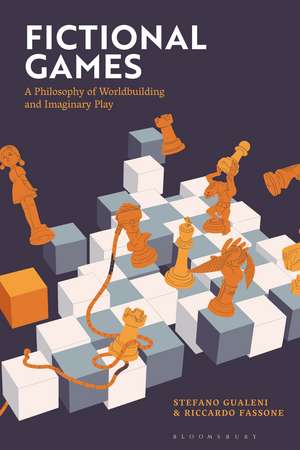
Fictional Games: A Philosophy of Worldbuilding and Imaginary Play
Autor Stefano Gualeni, Dr. Riccardo Fassoneen Limba Engleză Hardback – 12 ian 2023
Drawing from contemporary cinema and literature, from The Hunger Games to the science fiction of Iain M. Banks, Stefano Gualeni and Riccardo Fassone introduce five key functions that different types of imaginary games have in worldbuilding. First, fictional games can emphasize the dominant values and ideologies of the fictional society they belong to. Second, some imaginary games function in fictional worlds as critical, utopian tools, inspiring shifts in the thinking and political orientation of the fictional characters. Third, a few fictional games are conducive to the transcendence of a particular form of being, such as the overcoming of human corporeality. Fourth, imaginary games within works of fiction can deceptively blur the boundaries between the contingency of play and the irrevocable seriousness of "real life", either camouflaging life as a game or disguising a game as something with more permanent consequences. And fifth, they can function as meta-reflexive tools, suggesting critical and/or satirical perspectives on how actual games are designed, played, sold, manipulated, experienced, understood and utilized as part of our culture.
With illustrations in every chapter bringing the imaginary games to life, Gualeni and Fassone creatively inspire us to consider fictional games anew: not as moments of playful reprieve in a storyline, but as significant and multi-layered expressive devices.
Preț: 550.88 lei
Preț vechi: 863.55 lei
-36%
Puncte Express: 826
Carte tipărită la comandă
Livrare economică 10-24 noiembrie
Livrare prin curier în România Termenul estimat este afișat lângă disponibilitate.
Transport gratuit pentru acest produs Plată online sau ramburs, în funcție de opțiunile comenzii.
Retur gratuit în 14 zile Comandă securizată și suport în română.
Specificații
ISBN-13: 9781350277083
ISBN-10: 1350277088
Pagini: 216
Ilustrații: 20 bw illus
Dimensiuni: 154 x 236 x 18 mm
Greutate: 0.48 kg
Editura: Bloomsbury Publishing
Colecția Bloomsbury Academic
Locul publicării:London, United Kingdom
ISBN-10: 1350277088
Pagini: 216
Ilustrații: 20 bw illus
Dimensiuni: 154 x 236 x 18 mm
Greutate: 0.48 kg
Editura: Bloomsbury Publishing
Colecția Bloomsbury Academic
Locul publicării:London, United Kingdom
Cuprins
Foreword, Daniel Vella (University of Malta, Malta)
1. Introduction
2. On Fictional Games
3. Fictional Games and Ideology
4. Fictional Games as Utopian Devices
5. Fictional Games as Deceptions and Hallucinations
6. Fictional Games and Transcendence
7. Conclusion
Bibliography
Index
1. Introduction
2. On Fictional Games
3. Fictional Games and Ideology
4. Fictional Games as Utopian Devices
5. Fictional Games as Deceptions and Hallucinations
6. Fictional Games and Transcendence
7. Conclusion
Bibliography
Index
Recenzii
While Game Studies scholars are surely the privileged interlocutor for this academic endeavor, the wealth of close readings provided by Gualeni and Fassone and the many iterations of fictional games in narrative texts . suggest that such [a] project is worthy of further exploration also in fields such as literary criticism and philosophy
The first in depth examination of games within literature, this book takes us on a critical journey through several well known examples, examining the potential that games have to reflect philosophical and cultural values within fiction, as well as their place as essential moments of reflection, thought and ideologies within literary writing.
Gualeni and Fassone's brilliant volume provides a long-overdue analysis of the fascinating ways in which fictional games structure our understanding of fantastic storyworlds across different media. Their knowledgeable, affectionate, and compulsively readable study offers the reader tremendous insight into a compelling but largely overlooked topic.
Sitting at the intersection of cultural studies, philosophy, and games studies, Gualeni and Fassone provide an overview and preliminary taxonomy of how fictional games function across a range of media. Fictional Games thus opens important new directions in the study of such games, showing how they are more than mere narrative devices.
Fictional Games is a significant contribution to the field of game studies ... Gualeni and Fassone's thoughtful analysis does not just fill existing gaps in literature; it paves new paths for understanding the intricate dynamics of fictional worlds and their impact on our perception of reality.
The first in depth examination of games within literature, this book takes us on a critical journey through several well known examples, examining the potential that games have to reflect philosophical and cultural values within fiction, as well as their place as essential moments of reflection, thought and ideologies within literary writing.
Gualeni and Fassone's brilliant volume provides a long-overdue analysis of the fascinating ways in which fictional games structure our understanding of fantastic storyworlds across different media. Their knowledgeable, affectionate, and compulsively readable study offers the reader tremendous insight into a compelling but largely overlooked topic.
Sitting at the intersection of cultural studies, philosophy, and games studies, Gualeni and Fassone provide an overview and preliminary taxonomy of how fictional games function across a range of media. Fictional Games thus opens important new directions in the study of such games, showing how they are more than mere narrative devices.
Fictional Games is a significant contribution to the field of game studies ... Gualeni and Fassone's thoughtful analysis does not just fill existing gaps in literature; it paves new paths for understanding the intricate dynamics of fictional worlds and their impact on our perception of reality.