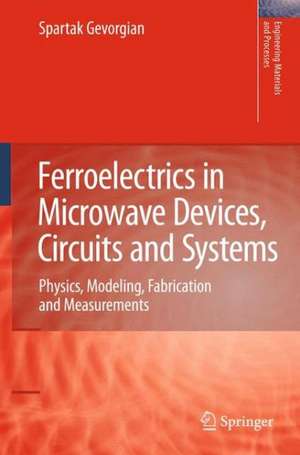
Ferroelectrics in Microwave Devices, Circuits and Systems: Engineering Materials and Processes
Autor Spartak Gevorgianen Limba Engleză Hardback – 12 iun 2009
Din seria Engineering Materials and Processes
- 18%
 Preț: 759.96 lei
- 15%
 Preț: 613.99 lei
- 18%
 Preț: 1344.72 lei
- 20%
 Preț: 349.99 lei
- 18%
 Preț: 1189.03 lei
- 15%
 Preț: 721.26 lei
- 18%
 Preț: 1277.20 lei
- 18%
 Preț: 1155.58 lei
- 18%
 Preț: 946.10 lei
- 18%
 Preț: 963.78 lei
- 18%
 Preț: 1223.23 lei
- 15%
 Preț: 667.86 lei
- 18%
 Preț: 1329.30 lei
- 18%
 Preț: 1715.80 lei
- 30%
 Preț: 868.61 lei
- 18%
 Preț: 986.35 lei
- 15%
 Preț: 667.86 lei
- 23%
 Preț: 832.42 lei
- 18%
 Preț: 980.46 lei
- 18%
 Preț: 950.17 lei
- 15%
 Preț: 619.30 lei
- 18%
 Preț: 920.79 lei
- 18%
 Preț: 1351.48 lei
- 18%
 Preț: 1784.59 lei
- 18%
 Preț: 979.85 lei
- 31%
 Preț: 549.91 lei
-
 Preț: 414.46 lei
- 25%
 Preț: 588.52 lei
- 18%
 Preț: 980.56 lei
- 15%
 Preț: 672.24 lei
- 18%
 Preț: 1277.20 lei
- 15%
 Preț: 669.16 lei
- 15%
 Preț: 663.68 lei
- 15%
 Preț: 635.22 lei
Preț: 1273.64 lei
Preț vechi: 1553.21 lei
-18%
Puncte Express: 1910
Carte tipărită la comandă
Livrare economică 03-17 decembrie
Livrare prin curier în România Termenul estimat este afișat lângă disponibilitate.
Transport gratuit pentru acest produs Plată online sau ramburs, în funcție de opțiunile comenzii.
Retur gratuit în 14 zile Comandă securizată și suport în română.
Specificații
ISBN-13: 9781848825062
ISBN-10: 1848825064
Pagini: 416
Ilustrații: XX, 396 p.
Dimensiuni: 160 x 241 x 28 mm
Greutate: 0.74 kg
Ediția:2009
Editura: Springer
Colecția Engineering Materials and Processes
Seria Engineering Materials and Processes
Locul publicării:London, United Kingdom
ISBN-10: 1848825064
Pagini: 416
Ilustrații: XX, 396 p.
Dimensiuni: 160 x 241 x 28 mm
Greutate: 0.74 kg
Ediția:2009
Editura: Springer
Colecția Engineering Materials and Processes
Seria Engineering Materials and Processes
Locul publicării:London, United Kingdom
V-ar putea interesa
-
 PIC Microcontrollers: An Introduction to MicroelectronicsMartin P. Bates-25%Preț: 207.46 lei277.94 lei
-
 PIC Microcontroller Projects in C: Basic to AdvancedDogan Ibrahim-15%Preț: 368.75 lei434.45 lei
-
 Op Amps for EveryoneBruce Carter-24%Preț: 328.30 lei432.63 lei
-
 -23%Preț: 508.92 lei659.08 lei
-
 -24%Preț: 597.78 lei786.25 lei
-
 Switchmode RF and Microwave Power AmplifiersAndrei Grebennikov-9%Preț: 555.06 lei609.96 lei
-
 Real World Multicore Embedded SystemsBryon Moyer-27%Preț: 382.83 lei527.54 lei
-
 -23%Preț: 734.73 lei954.20 lei
-
 Optical Nano and Micro Actuator TechnologyGeorge K. Knopf-18%Preț: 1637.17 lei1996.55 lei
-
 Lateral Power Transistors in Integrated CircuitsTobias Erlbacher-15%Preț: 666.74 lei784.40 lei
-
 High-Efficiency Solar CellsXiaodong Wang-18%Preț: 1287.16 lei1569.71 lei
-
 Preț: 396.47 lei
Public țintă
ResearchCuprins
Introduction: Overview of Agile Microwave Technologies.- Physics of the Tunable Ferroelectric Devices.- Fabrication of Ferroelectric Components and Devices.- Substrates, Varactors and Passive Components.- Ferroelectric Devices.- Circuit and System Applications of Tunable Ferroelectric Devices.- Modeling.- Measurements of the Dielectric Properties.- Potentials and Perspectives.- Concluding Remarks.
Notă biografică
Spartak Gevorgian has got his M.Sc. degree in radio engineering from Polytechnic Institute, Yerevan, Armenia in 1972, PhD (1977) and Dr. Sci. (1991) degrees from Electrical Engineering University, S. Petersburg , Russia. Currently he is a professor at the Department of Microtechnology and Nanoscience, Chalmers University of Technology, Sweden. He also works at Ericsson Research on part time bases. His research focuses on exploration of new materials and physical phenomena for application in agile microwave devices. He authored and co-authored more than 400 articles, papers and patents in the fields of microwave photonics, integrated optics, passive and agile microwave components. Tuneable microwave devices based on ferroelectrics and microwave integrated circuits have been the main subject in the last 10 years both at Chalmers University and Ericsson Research.
Professor Alexander K. Tagantsev received the B.S degree from St. Petersburg State University, in 1974, and Ph.D. degree from Ioffe Physico-Technical Institute, St. Petersburg, Russia, in 1982 in solid state physics. He joined the Ceramics Laboratory of Swiss Federal Institute of Technology (EPFL), Lausanne, Switzerland in 1993. Tagantsev is a theoretician of a broad domain of expertise from ferroelectricity and phonon physics to electrodynamics of superconductors. He is the author of key results on the theory of microwave dielectrics loss, dielectric polarization in crystalline materials, and relaxor ferroelectricity. He authored or co-authored more than 200 scientific articles and a comprehensive book on domains in ferroics.
Andrei Vorobiev received his M.Sc. degree in physics of semiconductors and dielectrics from the Gorky State University, Gorky, Russia, in 1986 and Ph.D. degree in physics and mathematics from the Institute for Physicsof Microstructures of the Russian Academy of Sciences, Nizhny Novgorod, Russia, in 2000. In 2008 he received title of Associate Professor in physical electronics from the Chalmers University of Technology, Gothenburg, Sweden. He now holds a research chair at the Chalmers University of Technology. His main research interests are in development and application of emerging functional materials and phenomena in microwave devices. Current activities focus on multiferroic and ferroelectric thin films including development of growth processes of thin films, fabrication processes and experimental investigation of microwave devices. Vorobiev and Gevorgian co-authored the book "Ferroelectrics in Microwave Devices, Circuits and Systems". They are the inventors (patented) of tuneable FBARs based on induced piezoelectric effect.
Textul de pe ultima copertă
Today’s wireless communications and information systems are heavily based on microwave technology, as are an increasing number of other industry sectors. Extensive research has been carried out into the development of new technologies to meet the increasingly complex requirements of such systems. Among these new technologies agile (tuneable, reconfigurable, and adaptable) microwave components based on ferroelectric materials, have great potential and are already gaining ground.
Ferroelectrics in Microwave Devices, Circuits and Systems is an introduction to the field. It explores the emergence of new functionalities and components with enhanced performance that can meet the agility and cost requirements of modern microwave-based systems. The book provides the reader with practical knowledge in a range of areas, including:
• physics,
• fabrication technology,
• methods of design,
• modeling, and
• measurement of ferroelectric components and devices.
Ferroelectrics in Microwave Devices, Circuits and Systems is a useful research tool for both graduate and undergraduate students, as well as designers of microwave devices, circuits, and systems.
The Engineering Materials and Processes series focuses on all forms of materials and the processes used to synthesise and formulate them as they relate to the various engineering disciplines. The series deals with a diverse range of materials: ceramics; metals (ferrous and non-ferrous); semiconductors; composites, polymers, biomimetics etc. Each monograph in the series is written by a specialist and demonstrates how enhancements in materials and the processes associated with them can improve performance in the field of engineering in which they are used.
Caracteristici
Provides a practical introduction into the physics, design, modelling, fabrication and measurement methods for ferroelectric components and devices Includes supplementary material: sn.pub/extras