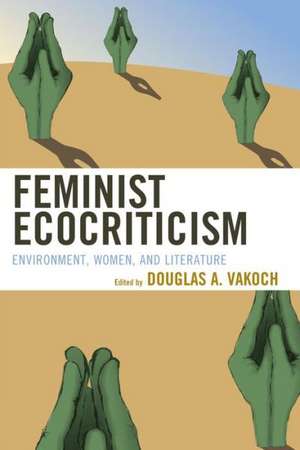
Feminist Ecocriticism: Environment, Women, and Literature: Ecocritical Theory and Practice
Editat de Douglas A. Vakoch Contribuţii de Vicky L. Adams, Marnie M. Sullivan, Theda Wrede, Jeffrey A. Lockwood, Richard M. Magee, Eric Otto, Monique LaRocqueen Limba Engleză Paperback – 23 apr 2014
After uncovering the oppressive dichotomies of male/female and nature/culture that underlie contemporary environmental problems, Feminist Ecocriticism focuses specifically on emancipatory strategies employed by ecofeminist literary critics as antidotes, asking what our lives might be like as those strategies become increasingly successful in overcoming oppression. Thus, ecofeminism is not limited to the critique of literature, but also helps identify and articulate liberatory ideals that can be actualized in the real world, in the process transforming everyday life. Providing an alternative to rugged individualism, for example, ecofeminist literature promotes a more fulfilling sense of interrelationship with both community and the land. In the process of exploring literature from ecofeminist perspectives, the book reveals strategies of emancipation that have already begun to give rise to more hopeful ecological narratives.
Feminist Ecocriticism provides a novel integration of two important strands of contemporary literary criticism that have often failed to make contact: feminist criticism and ecocriticism. The openness of both feminist criticism and ecocriticism to multiple, even incompatible perspectives, without the insistence on unitary definitions of their fields, has given rise to a new hybrid discipline: feminist ecocriticism.
Din seria Ecocritical Theory and Practice
- 33%
 Preț: 525.61 lei
 - 31%
 Preț: 531.25 lei
 - 33%
 Preț: 581.25 lei
 - 26%
 Preț: 291.30 lei
 - 23%
 Preț: 328.98 lei
 -
 Preț: 325.23 lei
 - 26%
 Preț: 286.85 lei
 - 31%
 Preț: 529.58 lei
 - 33%
 Preț: 582.81 lei
 - 27%
 Preț: 284.27 lei
 - 33%
 Preț: 550.43 lei
 - 36%
 Preț: 690.52 lei
 - 29%
 Preț: 344.70 lei
 - 25%
 Preț: 367.77 lei
 - 33%
 Preț: 640.50 lei
 - 33%
 Preț: 550.88 lei
 - 27%
 Preț: 352.24 lei
 - 33%
 Preț: 705.42 lei
 - 34%
 Preț: 569.73 lei
 - 26%
 Preț: 360.79 lei
 - 25%
 Preț: 571.04 lei
 - 36%
 Preț: 679.30 lei
 - 33%
 Preț: 549.31 lei
 - 33%
 Preț: 581.55 lei
 - 32%
 Preț: 616.15 lei
 - 36%
 Preț: 679.30 lei
 - 27%
 Preț: 353.67 lei
 - 29%
 Preț: 343.17 lei
 - 23%
 Preț: 320.61 lei
 - 27%
 Preț: 285.65 lei
 - 33%
 Preț: 614.26 lei
 - 35%
 Preț: 561.12 lei
 - 33%
 Preț: 582.62 lei
 - 34%
 Preț: 574.47 lei
 - 22%
 Preț: 326.87 lei
 - 34%
 Preț: 600.88 lei
 - 26%
 Preț: 286.85 lei
 - 34%
 Preț: 601.74 lei
 - 31%
 Preț: 529.87 lei
 - 28%
 Preț: 347.76 lei
 - 34%
 Preț: 575.01 lei
Preț: 341.92 lei
Preț vechi: 482.08 lei
-29%
Puncte Express: 513
Carte tipărită la comandă
Livrare economică 21 noiembrie-05 decembrie
Livrare prin curier în România Termenul estimat este afișat lângă disponibilitate.
Transport gratuit de la 400.00 lei Plată online sau ramburs, în funcție de opțiunile comenzii.
Retur gratuit în 14 zile Comandă securizată și suport în română.
Specificații
ISBN-13: 9780739193006
ISBN-10: 0739193007
Pagini: 156
Dimensiuni: 152 x 232 x 14 mm
Greutate: 0.26 kg
Editura: Bloomsbury Publishing
Colecția Lexington Books
Seria Ecocritical Theory and Practice
Locul publicării:New York, United States
ISBN-10: 0739193007
Pagini: 156
Dimensiuni: 152 x 232 x 14 mm
Greutate: 0.26 kg
Editura: Bloomsbury Publishing
Colecția Lexington Books
Seria Ecocritical Theory and Practice
Locul publicării:New York, United States
V-ar putea interesa
-
 The Creative EconomyJohn Howkins-31%Preț: 63.00 lei91.48 lei
 -
 Better Day Coming: Blacks and Equality, 1890-2000Adam Fairclough-57%Preț: 57.00 lei131.11 lei
 -
 Postcolonial WitnessingStef CrapsPreț: 381.73 lei
 -
 Preț: 253.41 lei
 -
 Imagined CitiesRobert AlterPreț: 256.13 lei
 -
 Variations on a Theme ParkMichael SorkinPreț: 110.93 lei
 -
 -18%Preț: 1257.60 lei1533.65 lei
 -
 Preț: 363.97 lei
 -
 Postethnic America: Beyond MulticulturalismDavid HollingerPreț: 177.17 lei
 -
 Land/Scape/TheaterElinor FuchsPreț: 324.26 lei
 -
 Memory-Theater and Postmodern DramaJeanette R. Malkin-23%Preț: 457.91 lei594.68 lei
 -
 American Art Since 1945David JoselitPreț: 195.90 lei
 -
 Preț: 310.38 lei
 -
 Preț: 255.99 lei
 -
 Reading Women's MagazinesJoke HermesPreț: 203.43 lei
 -
 Media PolicyEuromedia Research Group-15%Preț: 444.24 lei522.64 lei
 -
 Race, Trauma, and Home in the Novels of Toni MorrisonEvelyn Jaffe SchreiberPreț: 206.52 lei
 -
 The American KaleidoscopeLawrence H. FuchsPreț: 317.39 lei
 -
 Preț: 405.27 lei
 -
 TraumaShoshana Ringel-5%Preț: 1028.24 lei1082.35 lei
 -
 Magazine JournalismTim HolmesPreț: 439.07 lei
Cuprins
Introduction. A Different Story
Douglas A. Vakoch
Chapter 1. Ecofeminist Theories of Liberation in the Science Fiction of Sally Miller Gearhart, Ursula K. Le Guin, and Joan Slonczewski
Eric C. Otto
Chapter 2. Barbara Kingsolver's Animal Dreams: Ecofeminist Subversion of Western Myth
Theda Wrede
Chapter 3. Reintegrating Human and Nature: Modern Sentimental Ecology in Rachel Carson and Barbara Kingsolver
Richard M. Magee
Chapter 4. Shifting Subjects and Marginal Worlds: Revealing the Radical in Rachel Carson's Three Sea Books
Marnie M. Sullivan
Chapter 5. Decadent Desire: The Dream of Disembodiment in J.K. Huysmans' A Rebours
Monique M. LaRocque
Chapter 6. "Discourse Excellent Music": Romantic Rhetoric and Ecofeminism in Mary Shelley's The Last Man
Vicky L. Adams
Afterword. Ecofeminism: The Ironic Philosophy
Jeffrey A. Lockwood
Douglas A. Vakoch
Chapter 1. Ecofeminist Theories of Liberation in the Science Fiction of Sally Miller Gearhart, Ursula K. Le Guin, and Joan Slonczewski
Eric C. Otto
Chapter 2. Barbara Kingsolver's Animal Dreams: Ecofeminist Subversion of Western Myth
Theda Wrede
Chapter 3. Reintegrating Human and Nature: Modern Sentimental Ecology in Rachel Carson and Barbara Kingsolver
Richard M. Magee
Chapter 4. Shifting Subjects and Marginal Worlds: Revealing the Radical in Rachel Carson's Three Sea Books
Marnie M. Sullivan
Chapter 5. Decadent Desire: The Dream of Disembodiment in J.K. Huysmans' A Rebours
Monique M. LaRocque
Chapter 6. "Discourse Excellent Music": Romantic Rhetoric and Ecofeminism in Mary Shelley's The Last Man
Vicky L. Adams
Afterword. Ecofeminism: The Ironic Philosophy
Jeffrey A. Lockwood
Recenzii
This collection of essays considers feminist ecocriticism not only as a mode of analysis and critique but also as a repertoire of liberatory strategies. In his introduction, Vakoch (California Institute of Integral Studies) formulates feminist ecocriticism as a pluralistic field; the collection as a whole calls into question the assumptions of that field as it has developed so far (responding to previous work, e.g., New Essays in Ecofeminist Literary Criticism, ed. by Glynis Carr, 2000)--often by making some unexpected choices, as evidenced in a piece examining J. K. Huysmans's À Rebours. Weaker essays in the collection are those proffering analysis of the usual suspects (Ursula Le Guin, Barbara Kingsolver) for a collection like this. But two essays on Rachel Carson are solid entries, particularly one looking at the trope of sentimentality in Silent Spring. The collection concludes with an epilogue synthesizing the book's general themes and interrogating some of its premises, focusing on values, ethics, and the problem of essentialism (a problem that shows up with some regularity here); this epilogue offers interesting suggestions for future work. Summing Up: Recommended. Upper-division undergraduates through faculty.
In Feminist Ecocriticism: Environment, Women, and Literature several authors attempt to unravel the women-nature connections. They document how women novelists from different epochs had the ability to uncover the Western world's dichotomous conceptual order-masculinity, femininity; control, obedience; detachment, emotion; border, borderless; rational, irrational-well before the development of Ecofeminism as a school of thought, the term must be untangled....[T]his book is an excellent contribution of Post-structuralist Ecofeminist thought on the contemporary liberatory alternatives debate.
In summary this book discusses the different environmental and feminist theories. Feminist and environmental theories have shaped the perspectives of how the current generation understand feminism as well as environmental problems. . . .Ecofeminism seeks to identify the relationship between women and nature. This point is clearly highlighted in all the chapters of the book; women are viewed as nurturing and loving towards the environment while men are shown as being only concerned about dominating the environment and caring about their own well- being.
Feminist Ecocriticism: Women, Environment, and Literature offers readings of a variety of texts, from science fiction to Barbara Kingsolver's novels, from Rachel Carson's nonfiction to the late nineteenth-century French novelist J. K. Huysmans. . . .[Particularly,] Lockwood's contribution provides a constructive view of ecofeminism from the perspective of ecophilosophy and literature, which is furthermore valuable as he places the essays in a more recent critical and scholarly context.
This compelling collection of essays examines the leading edge of contemporary critical thought at the nexus of literature, ecocriticism, and feminist thinking. Doug Vakoch has made a notable contribution to this important emerging 'ecotone' by bringing together a broad range of perspectives while avoiding the potentially damaging artifice of requiring homogeneous stances on these complex, ecologically interwoven issues. The essays are well chosen and provide insights, challenges, and creative approaches that have significant contemporary relevance. This volume should provoke considerable discussion and debate leading to a more nuanced understanding that is essential in our fragile time.
Thorough and insightful, these essays dance with the notion of ecofeminist studies, coming together as a robust hybrid that, while differing in approach and assumption, nonetheless creates a satisfying sense of a unified work. A must read for all ecofeminists and their challengers.
This wide-ranging text invites readers to engage with a feminist ecocritical literary praxis that embraces contradiction and irony, that refuses holismjust as it refuses masculinist assumptions and binaristic thinking, that intersects in new and interesting ways with a variety of theories and methods. Each essay in this collection stands alone as a strong, creative example of ecocritical reading-against-the-grain; taken together, they provide insight into the breadth and depth of ecofeminism's reach across temporal, national, and generic borders. I enjoyed reading this text very much and would use it in graduate and advanced undergraduate courses in literary criticism, feminist theory, and ecofeminist philosophy.
In Feminist Ecocriticism: Environment, Women, and Literature several authors attempt to unravel the women-nature connections. They document how women novelists from different epochs had the ability to uncover the Western world's dichotomous conceptual order-masculinity, femininity; control, obedience; detachment, emotion; border, borderless; rational, irrational-well before the development of Ecofeminism as a school of thought, the term must be untangled....[T]his book is an excellent contribution of Post-structuralist Ecofeminist thought on the contemporary liberatory alternatives debate.
In summary this book discusses the different environmental and feminist theories. Feminist and environmental theories have shaped the perspectives of how the current generation understand feminism as well as environmental problems. . . .Ecofeminism seeks to identify the relationship between women and nature. This point is clearly highlighted in all the chapters of the book; women are viewed as nurturing and loving towards the environment while men are shown as being only concerned about dominating the environment and caring about their own well- being.
Feminist Ecocriticism: Women, Environment, and Literature offers readings of a variety of texts, from science fiction to Barbara Kingsolver's novels, from Rachel Carson's nonfiction to the late nineteenth-century French novelist J. K. Huysmans. . . .[Particularly,] Lockwood's contribution provides a constructive view of ecofeminism from the perspective of ecophilosophy and literature, which is furthermore valuable as he places the essays in a more recent critical and scholarly context.
This compelling collection of essays examines the leading edge of contemporary critical thought at the nexus of literature, ecocriticism, and feminist thinking. Doug Vakoch has made a notable contribution to this important emerging 'ecotone' by bringing together a broad range of perspectives while avoiding the potentially damaging artifice of requiring homogeneous stances on these complex, ecologically interwoven issues. The essays are well chosen and provide insights, challenges, and creative approaches that have significant contemporary relevance. This volume should provoke considerable discussion and debate leading to a more nuanced understanding that is essential in our fragile time.
Thorough and insightful, these essays dance with the notion of ecofeminist studies, coming together as a robust hybrid that, while differing in approach and assumption, nonetheless creates a satisfying sense of a unified work. A must read for all ecofeminists and their challengers.
This wide-ranging text invites readers to engage with a feminist ecocritical literary praxis that embraces contradiction and irony, that refuses holismjust as it refuses masculinist assumptions and binaristic thinking, that intersects in new and interesting ways with a variety of theories and methods. Each essay in this collection stands alone as a strong, creative example of ecocritical reading-against-the-grain; taken together, they provide insight into the breadth and depth of ecofeminism's reach across temporal, national, and generic borders. I enjoyed reading this text very much and would use it in graduate and advanced undergraduate courses in literary criticism, feminist theory, and ecofeminist philosophy.