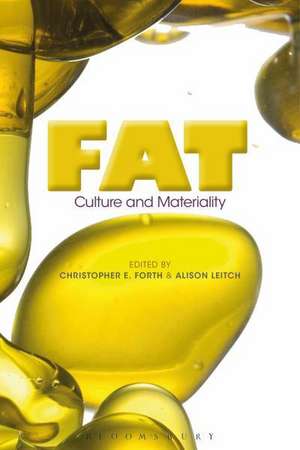
Fat: Culture and Materiality
Editat de Dr Christopher E. Forth, Dr Alison Leitchen Limba Engleză Hardback – 10 apr 2014
With contributions from well-respected international scholars, this innovative and interdisciplinary collection will appeal to a wide range of readers interested in fat and its relationship to culture, materiality and lived experience. The volume addresses the role of fats in a variety of cultural settings. Topics include the politics of Palestinian olive oil; the allure of pig fat in heritage pork; the material sources of fat stereotypes in classical and biblical texts; the use of harvested fat in aesthetic surgery; and the status of fat in the self-narratives of anorexics.
Preț: 961.68 lei
Preț vechi: 1274.11 lei
-25%
Puncte Express: 1443
Carte tipărită la comandă
Livrare economică 17 noiembrie-01 decembrie
Livrare prin curier în România Termenul estimat este afișat lângă disponibilitate.
Transport gratuit pentru acest produs Plată online sau ramburs, în funcție de opțiunile comenzii.
Retur gratuit în 14 zile Comandă securizată și suport în română.
Specificații
ISBN-13: 9780857856166
ISBN-10: 0857856162
Pagini: 208
Dimensiuni: 156 x 234 x 18 mm
Greutate: 0.5 kg
Ediția:New.
Editura: Bloomsbury Publishing
Colecția Bloomsbury Academic
Locul publicării:London, United Kingdom
ISBN-10: 0857856162
Pagini: 208
Dimensiuni: 156 x 234 x 18 mm
Greutate: 0.5 kg
Ediția:New.
Editura: Bloomsbury Publishing
Colecția Bloomsbury Academic
Locul publicării:London, United Kingdom
V-ar putea interesa
-
 FreeKatharine HibbertPreț: 109.83 lei
 -
 The Language of ThingsDeyan SudjicPreț: 92.22 lei
 -
 -21%Preț: 399.11 lei507.26 lei
 -
 Savoring Disgust: The Foul and the Fair in AestheticsCarolyn Korsmeyer-16%Preț: 361.33 lei430.07 lei
 -
 Sound and Safe: A History of Listening Behind the WheelKarin Bijsterveld-22%Preț: 361.35 lei464.82 lei
 -
 A History of the World in 100 ObjectsNeil MacGregor-26%Preț: 101.59 lei137.70 lei
 -
 EthnobiologyDeborah Pearsall-23%Preț: 616.19 lei800.25 lei
 -
 Breakfast at Sotheby'sPhilip Hook-19%Preț: 63.96 lei78.70 lei
 -
 Consumer CultureCelia LuryPreț: 156.98 lei
 -
 Vinyl: The Analogue Record in the Digital AgeDominik BartmanskiPreț: 249.05 lei
 -
 Love Objects: Emotion, Design and Material CultureDr Anna Moran-34%Preț: 850.58 lei1296.71 lei
 -
 Golf BallHarry Brown-32%Preț: 50.78 lei75.11 lei
 -
 Driver's LicenseMeredith Castile-41%Preț: 51.00 lei86.84 lei
 -
 Interior Design: A Critical IntroductionClive Edwards-15%Preț: 284.24 lei332.90 lei
Cuprins
Introduction: Materializing Fat
Christopher E. Forth, University of Kansas, USA and Alison Leitch, Macquarie University, Australia
The Qualities of Palestinian Olive Oil
Anne Meneley, Trent University, Canada
In Tastes, Lost and Found: Remembering the Real Flavor of Fat Pork
Brad Weiss, College of William & Mary, USA
Thinking through Fat: The Materiality of Ancient and Modern Stereotypes
Christopher E. Forth, University of Kansas, USA
Joseph Beuys: Shaman of Fat
Alison Leitch, Macquarie University, Australia
Engrossing Encounters: Materialities and Metaphors of Fat in the Lived Experiences of Individuals with Anorexia
Anna Lavis, Goldsmiths College, University of London, UK
Fat is the Future: Bioprospecting, Fat Stem Cells, and Emergent Breasted Materialities
Nadine Ehlers, University of Wollongong, Australia
Bound Bodies: Navigating the Margins of Fat Bodies and Clothes
Trudie Cain, Kerry Chamberlain and Ann Dupuis, both Massey University, New Zealand
Fatsploitation: Disgust and the Performance of Weight-loss
Jennifer-Scott Mobley, Marymount Manhattan College, USA
Notes
References
Index
Christopher E. Forth, University of Kansas, USA and Alison Leitch, Macquarie University, Australia
The Qualities of Palestinian Olive Oil
Anne Meneley, Trent University, Canada
In Tastes, Lost and Found: Remembering the Real Flavor of Fat Pork
Brad Weiss, College of William & Mary, USA
Thinking through Fat: The Materiality of Ancient and Modern Stereotypes
Christopher E. Forth, University of Kansas, USA
Joseph Beuys: Shaman of Fat
Alison Leitch, Macquarie University, Australia
Engrossing Encounters: Materialities and Metaphors of Fat in the Lived Experiences of Individuals with Anorexia
Anna Lavis, Goldsmiths College, University of London, UK
Fat is the Future: Bioprospecting, Fat Stem Cells, and Emergent Breasted Materialities
Nadine Ehlers, University of Wollongong, Australia
Bound Bodies: Navigating the Margins of Fat Bodies and Clothes
Trudie Cain, Kerry Chamberlain and Ann Dupuis, both Massey University, New Zealand
Fatsploitation: Disgust and the Performance of Weight-loss
Jennifer-Scott Mobley, Marymount Manhattan College, USA
Notes
References
Index
Recenzii
A welcome addition to fat appreciation, the contributions in this book highlight fat as a substance that slides, sizzles, glistens, oozes, lubricates, stains, melts, coats, congeals, and splats. The examples are compelling, the analysis is rich and the writing is entertaining. Upon reading this book, I had an insatiable urge to sip some cleansing olive oil tea and eat a barbequed pork chop.
FAT: Culture and Materiality offers a compelling and insightful interdisciplinary exploration of the complexities, properties and potentialities of fat as a substance located both within and outside of bodies. The authors traverse a fascinating range of themes and, deftly reveal how the materiality of fat and oils interconnects with some of the most pressing issues of our time, from eating disorders, semiotic and religious qualities of oil, to the idea that fat can be productive and has 'biovalue'. It is a timely and unique contribution to related fields such as body studies, fat studies and critical weight studies.
In examining the context of fat in culture, contributing authors present a multitude of fat concepts based on lived experiences; historical underpinnings; sociocultural significance; religious, biblical, and spiritual connections; political implications; societal standards; and health consequences. They explore the role of fat through a global and cultural lens, providing unique and fascinating dimensions that continue to influence human relationships with this shape-shifting substance through language, perceptions, and behavior. Editors Forth and Leitch have successfully brought together a variety of perspectives on how ideas of "fat" as a construct, lived experience, stigmatized identity, and health factor have influenced and continue to shape the manner in which people relate to each other and their environments. This innovative compilation of fat history, attitudes, and narratives will provide an excellent adjunct to upper-level disciplines with sociological, psychological, health science, gender, and cultural foci. Summing Up: Recommended. Upper-division undergraduates and above.
Fat: Culture and Materiality is a valuable volume for portraying a new way to think about a subject that, for most Americans, is only about 'obesity.' In keeping with the current state of the social sciences, it illustrates that we cannot think of fat-or any other substance or object-merely as an idea or symbol (to extend Beuys's point, substances and objects are not purely retinal or mental) but must attend to their felt (including tasted) qualities. To paraphrase (or overturn) Levi-Strauss, fat is not just good to think with but is also good or bad to experience-to have on and under your skin or on your tongue.
FAT: Culture and Materiality offers a compelling and insightful interdisciplinary exploration of the complexities, properties and potentialities of fat as a substance located both within and outside of bodies. The authors traverse a fascinating range of themes and, deftly reveal how the materiality of fat and oils interconnects with some of the most pressing issues of our time, from eating disorders, semiotic and religious qualities of oil, to the idea that fat can be productive and has 'biovalue'. It is a timely and unique contribution to related fields such as body studies, fat studies and critical weight studies.
In examining the context of fat in culture, contributing authors present a multitude of fat concepts based on lived experiences; historical underpinnings; sociocultural significance; religious, biblical, and spiritual connections; political implications; societal standards; and health consequences. They explore the role of fat through a global and cultural lens, providing unique and fascinating dimensions that continue to influence human relationships with this shape-shifting substance through language, perceptions, and behavior. Editors Forth and Leitch have successfully brought together a variety of perspectives on how ideas of "fat" as a construct, lived experience, stigmatized identity, and health factor have influenced and continue to shape the manner in which people relate to each other and their environments. This innovative compilation of fat history, attitudes, and narratives will provide an excellent adjunct to upper-level disciplines with sociological, psychological, health science, gender, and cultural foci. Summing Up: Recommended. Upper-division undergraduates and above.
Fat: Culture and Materiality is a valuable volume for portraying a new way to think about a subject that, for most Americans, is only about 'obesity.' In keeping with the current state of the social sciences, it illustrates that we cannot think of fat-or any other substance or object-merely as an idea or symbol (to extend Beuys's point, substances and objects are not purely retinal or mental) but must attend to their felt (including tasted) qualities. To paraphrase (or overturn) Levi-Strauss, fat is not just good to think with but is also good or bad to experience-to have on and under your skin or on your tongue.