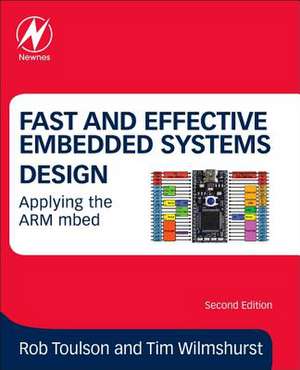
Fast and Effective Embedded Systems Design: Applying the ARM mbed
Autor Tim Wilmshurst, Rob Toulsonen Limba Engleză Paperback – 26 oct 2016
Autorii Tim Wilmshurst și Rob Toulson aduc în această lucrare o vastă experiență practică în ingineria sistemelor integrate, propunând o metodologie de tip „learning through doing”. Ne-a atras atenția modul în care Tim Wilmshurst face tranziția de la arhitecturile de 8 biți, explorate în lucrarea sa anterioară Designing Embedded Systems with PIC Microcontrollers, către puterea de procesare a arhitecturii ARM pe 32 de biți. Această ediție a doua rafinează procesul de învățare prin utilizarea ecosistemului ARM mbed, facilitând o dezvoltare rapidă a codului C/C++ direct în mediul web.
Considerăm structura cărții ca fiind un punct forte pentru mediul academic și profesional, fiind împărțită în două secțiuni majore. Prima parte stabilește fundamentele esențiale — intrări și ieșiri digitale, afișaje LCD și gestiunea întreruperilor — în timp ce a doua parte avansează către aplicații specializate. Cititorul care a aplicat deja conceptele de bază din ARM-based Microcontroller Projects Using mbed de Dogan Ibrahim va găsi aici o aprofundare tehnică superioară, în special în zonele de procesare digitală a semnalului și comunicații complexe. De asemenea, spre deosebire de Designing Embedded Systems and the Internet of Things (Iot) with the Arm Mbed, care se concentrează pe conectivitate, volumul de față oferă o perspectivă rară asupra hardware-ului, discutând în detaliu despre sursele de alimentare, modurile de consum redus și pașii critici către producția de serie.
Subliniem importanța noilor capitole dedicate standardelor Bluetooth, ZigBee și controlului prin Internet, elemente vitale în contextul IoT actual. Prin includerea unor studii de caz comerciale, cartea depășește stadiul de simplu manual tehnic, devenind un ghid pentru inginerul care dorește să transforme un prototip realizat pe ARM mbed într-un produs finit, viabil din punct de vedere economic.
Preț: 333.89 lei
Preț vechi: 436.03 lei
-23%
Carte tipărită la comandă
Livrare economică 01-15 decembrie
Specificații
ISBN-10: 0081008805
Pagini: 510
Dimensiuni: 191 x 235 x 30 mm
Greutate: 0.87 kg
Ediția:2. Auflage.
Editura: ELSEVIER SCIENCE
V-ar putea interesa
-
 -41%Preț: 457.81 lei769.47 lei
 -
 Embedded Systems: ARM Programming and OptimizationJason D. Bakos-34%Preț: 412.11 lei624.90 lei
 -
 ARM System-on-Chip ArchitectureSteve Furber-18%Preț: 646.73 lei788.70 lei
 -
 -40%Preț: 458.81 lei768.90 lei
 -
 -30%Preț: 445.71 lei639.30 lei
 -
 Modern Assembly Language Programming with the ARM ProcessorLarry D Pyeatt-31%Preț: 467.79 lei675.11 lei
 -
 Embedded System Design: Methodologies and IssuesLawrence J. Henschen-39%Preț: 435.38 lei719.49 lei
 -
 Learning the Art of ElectronicsThomas C. Hayes-8%Preț: 579.32 lei629.69 lei
 -
 Preț: 245.96 lei
 -
 -20%Preț: 207.20 lei259.01 lei
 -
 Making Embedded SystemsElecia White-38%Preț: 200.48 lei324.68 lei
 -
 Modern C, Third EditionJens Gustedt-20%Preț: 350.34 lei437.92 lei
 -
 Introduction to Computer Organization: ARM EditionRobert G. Plantz-35%Preț: 303.72 lei468.10 lei
 -
 -35%Preț: 207.86 lei318.48 lei
 -
 The Art of ARM Assembly Volume 1Randall Hyde-34%Preț: 438.12 lei665.69 lei
 -
 -19%Preț: 282.20 lei348.18 lei
 -
 -36%Preț: 295.82 lei462.12 lei
 -
 -36%Preț: 284.35 lei440.95 lei
 -
 Embedded Systems Design using the MSP430FR2355 LaunchPad(TM)Brock J. Lameres-20%Preț: 375.56 lei469.44 lei
 -
 Concise Guide to the Internet of ThingsMichael Mccarthy-20%Preț: 421.74 lei527.18 lei
Public țintă
Students studying embedded systems using ARM technology, Professional embedded systems engineers, and software engineers developing embedded systems.De ce să citești această carte
Această lucrare este esențială pentru studenții și inginerii care doresc să stăpânească platforma ARM mbed. Cititorul câștigă competențe practice imediate, de la programarea de bază în C/C++ până la implementarea interfețelor audio I2S și a protocoalelor wireless. Este recomandarea noastră pentru oricine vizează trecerea de la hobby la design industrial, beneficiind de expertiza unor autori care corelează riguros teoria cu experimentele de laborator.
Descriere scurtă
Written by two experts in the field, this book reflects on the experimental results, develops and matches theory to practice, evaluates the strengths and weaknesses of the technology and techniques introduced, and considers applications in a wider context.
New Chapters on:
- Bluetooth and ZigBee communication
- Internet communication and control, setting the scene for the ‘Internet of Things’
- Digital Audio, with high-fidelity applications and use of the I2S bus
- Power supply, and very low power applications
- The development process of moving from prototyping to small-scale or mass manufacture, with a commercial case study.
- Updates all examples and peripheral devices to use the most recent libraries and peripheral products
- Includes examples with touch screen displays and includes high definition audio input/output with the I2S interface
- Covers the development process of moving from prototyping to small-scale or mass manufacture with commercial case studies
- Covers hot embedded issues such as intelligent instrumentation, networked systems, closed loop control, and digital signal processing
Cuprins
Part I. Essentials of Embedded Systems, Using the mbed
Chapter 2. Introducing the mbed
Chapter 3. Digital Input and Output
Chapter 4. Analog Output
Chapter 5. Analog Input
Chapter 6. Further Programming Techniques
Chapter 7. Starting with Serial Communication
Chapter 8. Liquid Crystal Displays
Chapter 9. Interrupts, Timers, and Tasks
Chapter 10. Memory and Data Management
Part II. Moving to Advanced and Specialist Applications
Chapter 11. Wireless Communication – Bluetooth and Zigbee
Chapter 12. Internet Communication and Control
Chapter 13. Working With Digital Audio
Chapter 14. Letting Go of the mbed Libraries
Chapter 15. Hardware Insights: Clocks, Resets, and Power Supply
Chapter 16. Developing Commercial Products With mbed