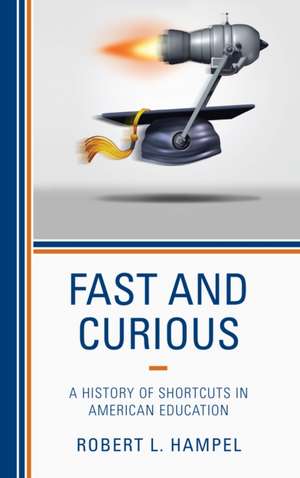
Fast and Curious: A History of Shortcuts in American Education: Rowman & Littlefield Publishers
Autor Robert L. Hampelen Limba Engleză Paperback – 15 dec 2017
Din seria Rowman & Littlefield Publishers
-
 Preț: 113.82 lei
 - 13%
 Preț: 155.38 lei
 -
 Preț: 109.93 lei
 - 20%
 Preț: 370.93 lei
 - 19%
 Preț: 323.76 lei
 - 26%
 Preț: 223.03 lei
 - 19%
 Preț: 321.01 lei
 - 21%
 Preț: 307.35 lei
 - 21%
 Preț: 186.50 lei
 - 24%
 Preț: 255.02 lei
 - 16%
 Preț: 109.26 lei
 - 31%
 Preț: 351.69 lei
 - 15%
 Preț: 127.13 lei
 - 23%
 Preț: 320.61 lei
 - 19%
 Preț: 324.21 lei
 - 30%
 Preț: 355.24 lei
 - 23%
 Preț: 258.39 lei
 -
 Preț: 400.51 lei
 - 23%
 Preț: 275.97 lei
 - 24%
 Preț: 275.28 lei
 - 31%
 Preț: 351.50 lei
 - 22%
 Preț: 323.28 lei
 - 32%
 Preț: 373.39 lei
 - 34%
 Preț: 842.33 lei
 - 19%
 Preț: 314.30 lei
 - 23%
 Preț: 354.68 lei
 - 21%
 Preț: 128.84 lei
 - 30%
 Preț: 774.75 lei
 - 23%
 Preț: 278.65 lei
 - 23%
 Preț: 259.97 lei
 - 19%
 Preț: 344.02 lei
 - 32%
 Preț: 594.45 lei
 - 31%
 Preț: 566.85 lei
 - 22%
 Preț: 358.54 lei
 - 19%
 Preț: 322.03 lei
 - 16%
 Preț: 148.06 lei
 - 22%
 Preț: 360.79 lei
 - 19%
 Preț: 323.37 lei
 - 31%
 Preț: 414.61 lei
 - 25%
 Preț: 344.18 lei
 - 30%
 Preț: 703.64 lei
 - 14%
 Preț: 152.49 lei
 - 30%
 Preț: 827.47 lei
 - 19%
 Preț: 316.66 lei
 - 23%
 Preț: 276.77 lei
 - 29%
 Preț: 709.89 lei
 - 23%
 Preț: 262.16 lei
 - 19%
 Preț: 335.82 lei
Preț: 219.35 lei
Preț vechi: 292.20 lei
-25%
Puncte Express: 329
Carte tipărită la comandă
Livrare economică 20 noiembrie-04 decembrie
Livrare prin curier în România Termenul estimat este afișat lângă disponibilitate.
Transport gratuit de la 400.00 lei Plată online sau ramburs, în funcție de opțiunile comenzii.
Retur gratuit în 14 zile Comandă securizată și suport în română.
Specificații
ISBN-13: 9781475836936
ISBN-10: 1475836937
Pagini: 170
Dimensiuni: 151 x 229 x 15 mm
Greutate: 0.27 kg
Editura: Bloomsbury Publishing
Colecția Rowman & Littlefield
Seria Rowman & Littlefield Publishers
Locul publicării:New York, United States
ISBN-10: 1475836937
Pagini: 170
Dimensiuni: 151 x 229 x 15 mm
Greutate: 0.27 kg
Editura: Bloomsbury Publishing
Colecția Rowman & Littlefield
Seria Rowman & Littlefield Publishers
Locul publicării:New York, United States
Descriere
This book examines four types of shortcuts in the history of American education-streamlined paths to vocational success, cultural sophistication, college credentials, and the efficient use of English. The chapters profile Norman Rockwell, the Harvard Classics, Cliff Notes, speed reading, a Doctor of Arts diploma for college teachers, and other riveting examples of time-savers that attracted millions of ambitious Americans since the late 19th century.
Cuprins
Foreword
Acknowledgements
Introduction
Part One: Faster and Easier
Chapter One: Shortcuts to Success: Correspondence Schools
Chapter Two: Shortcuts to Culture: Self-Education
Part Two: Faster and Harder
Chapter Three: Saving Time in Colleges and Universities
Chapter Four: The Zeal for Brevity: Simplified Spelling, Shorthand, Speed Reading
Epilogue: The Enduring Appeal of Shortcuts
Recommended Readings
Acknowledgements
Introduction
Part One: Faster and Easier
Chapter One: Shortcuts to Success: Correspondence Schools
Chapter Two: Shortcuts to Culture: Self-Education
Part Two: Faster and Harder
Chapter Three: Saving Time in Colleges and Universities
Chapter Four: The Zeal for Brevity: Simplified Spelling, Shorthand, Speed Reading
Epilogue: The Enduring Appeal of Shortcuts
Recommended Readings
Recenzii
Learning is hard. Some people will tell you otherwise, but they are either lying or delusional. Reading this book, however, is a pleasure. You should do so.
Hampel's entertaining tour of education shortcuts glides through an impressive range of developments to demonstrate that Americans embrace some shortcuts because they value self-improvement and culture and eschew others because they understand that some learning cannot be rushed. . . . .Fast and Curious: A History of Shortcutsin American Education will engage historians and nonhistorians alike.
Americans are big believers in the power of education. But they are also a national of hustlers, intent on reaping the rewards of education with minimal expenditure of time and effort. In a series of absorbing and often astonishing case studies, Bob Hampel shows us how the free market responded to popular demand.
Bob Hampel tours a vast range of techniques and institutions that have promised to make learning faster and easier (Part One) or faster and harder (Part Two). He describes how to earn a college degree without attending one, excel on a Shakespeare exam without reading a play, write a prize-winning novel, read 40 books a week, finish college in three years, and make everyone like you. Hampel's remarkably insightful study shows how this apparent underside of education often merged into the academic mainstream and drew on avant garde ideas. Collectively, shortcuts speak volumes about democracy in American education.
Devised by well-intended educators, entrepreneurs, and scoundrels, programs like the Famous Artists School, university based correspondence schools, The Great Books of the Western World, paint-by-numbers kits, Cliff Notes, shorthand, and speedreading have promised make learning faster and/or easier. Hampel's highly original and often entertaining account captures the fascinating history of our perennial quest for shortcuts. I could not put it down!
Hampel takes no shortcuts in his superb history of the fast track. Beautifully written, richly researched, and wryly observed, this book provides vivid examples of the marketplace for fast, fun, easy, cheap and useful credentials. Many have fallen to temptation: university administrators and lazy undergraduates, successful artists and hacks, quacks, and hucksters. Every American should read this delightful and important book.
Hampel's entertaining tour of education shortcuts glides through an impressive range of developments to demonstrate that Americans embrace some shortcuts because they value self-improvement and culture and eschew others because they understand that some learning cannot be rushed. . . . .Fast and Curious: A History of Shortcutsin American Education will engage historians and nonhistorians alike.
Americans are big believers in the power of education. But they are also a national of hustlers, intent on reaping the rewards of education with minimal expenditure of time and effort. In a series of absorbing and often astonishing case studies, Bob Hampel shows us how the free market responded to popular demand.
Bob Hampel tours a vast range of techniques and institutions that have promised to make learning faster and easier (Part One) or faster and harder (Part Two). He describes how to earn a college degree without attending one, excel on a Shakespeare exam without reading a play, write a prize-winning novel, read 40 books a week, finish college in three years, and make everyone like you. Hampel's remarkably insightful study shows how this apparent underside of education often merged into the academic mainstream and drew on avant garde ideas. Collectively, shortcuts speak volumes about democracy in American education.
Devised by well-intended educators, entrepreneurs, and scoundrels, programs like the Famous Artists School, university based correspondence schools, The Great Books of the Western World, paint-by-numbers kits, Cliff Notes, shorthand, and speedreading have promised make learning faster and/or easier. Hampel's highly original and often entertaining account captures the fascinating history of our perennial quest for shortcuts. I could not put it down!
Hampel takes no shortcuts in his superb history of the fast track. Beautifully written, richly researched, and wryly observed, this book provides vivid examples of the marketplace for fast, fun, easy, cheap and useful credentials. Many have fallen to temptation: university administrators and lazy undergraduates, successful artists and hacks, quacks, and hucksters. Every American should read this delightful and important book.