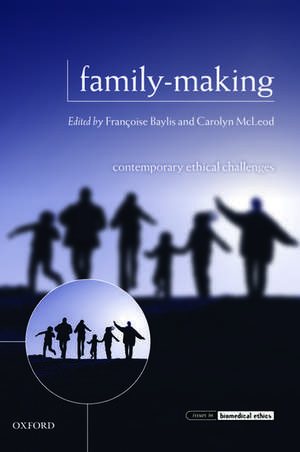
Family-Making: Contemporary Ethical Challenges: Issues in Biomedical Ethics
Editat de Françoise Baylis, Carolyn McLeoden Limba Engleză Paperback – 9 mar 2017
Din seria Issues in Biomedical Ethics
- 29%
 Preț: 553.58 lei
 - 19%
 Preț: 421.79 lei
 - 27%
 Preț: 451.84 lei
 - 22%
 Preț: 380.20 lei
 - 23%
 Preț: 374.96 lei
 - 15%
 Preț: 460.88 lei
 - 24%
 Preț: 470.00 lei
 - 20%
 Preț: 407.13 lei
 - 24%
 Preț: 456.31 lei
 - 20%
 Preț: 376.72 lei
 - 30%
 Preț: 963.15 lei
 - 11%
 Preț: 312.84 lei
 - 10%
 Preț: 341.19 lei
 - 16%
 Preț: 249.33 lei
 - 25%
 Preț: 546.80 lei
 - 31%
 Preț: 533.59 lei
Preț: 295.14 lei
Preț vechi: 360.94 lei
-18%
Puncte Express: 443
Carte tipărită la comandă
Livrare economică 04-15 decembrie
Livrare prin curier în România Termenul estimat este afișat lângă disponibilitate.
Transport gratuit de la 400.00 lei Plată online sau ramburs, în funcție de opțiunile comenzii.
Retur gratuit în 14 zile Comandă securizată și suport în română.
Specificații
ISBN-13: 9780198776581
ISBN-10: 0198776586
Pagini: 332
Dimensiuni: 156 x 231 x 18 mm
Greutate: 0.51 kg
Editura: OUP OXFORD
Colecția OUP Oxford
Seria Issues in Biomedical Ethics
Locul publicării:Oxford, United Kingdom
ISBN-10: 0198776586
Pagini: 332
Dimensiuni: 156 x 231 x 18 mm
Greutate: 0.51 kg
Editura: OUP OXFORD
Colecția OUP Oxford
Seria Issues in Biomedical Ethics
Locul publicării:Oxford, United Kingdom
V-ar putea interesa
-
 METHODS IN MEDICAL ETHICS: Critical PerspectivesTom Tomlinson-25%Preț: 597.85 lei795.95 lei
 -
 -24%Preț: 243.21 lei320.59 lei
 -
 -24%Preț: 453.30 lei600.30 lei
 -
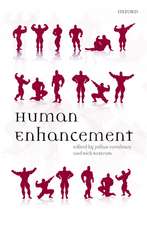 Human EnhancementJulian Savulescu-31%Preț: 777.84 lei1126.02 lei
 -
 The Ethics of Transplants: Why Careless Thought Costs LivesJanet Radcliffe Richards-19%Preț: 126.78 lei156.17 lei
 -
 Careless Thought Costs Lives: The Ethics of TransplantsJanet Radcliffe Richards-16%Preț: 124.82 lei148.26 lei
 -
 The Future of Bioethics: International DialoguesAkira Akabayashi-24%Preț: 851.65 lei1114.10 lei
 -
 -24%Preț: 602.74 lei795.94 lei
 -
 The Ethics of Pediatric ResearchDavid Wendler-24%Preț: 558.43 lei737.55 lei
 -
 -32%Preț: 765.12 lei1119.63 lei
 -
 -25%Preț: 767.01 lei1017.30 lei
 -
 -25%Preț: 764.63 lei1016.03 lei
 -
 -16%Preț: 934.82 lei1112.43 lei
 -
 Ethics Field Guide: Applications to Rehabilitation PsychologyThomas R. Kerkhoff-31%Preț: 480.57 lei692.94 lei
 -
 -5%Preț: 201.17 lei211.75 lei
 -
 Ethics in Speech and Language TherapyRichard Body-8%Preț: 445.05 lei483.76 lei
 -
 The 'Healthy' EmbryoJeff Nisker-5%Preț: 473.97 lei498.91 lei
 -
 PsychosurgeryMarc Lévêque-21%Preț: 620.00 lei785.86 lei
 -
 Clinical Research Involving Pregnant WomenFrançoise Baylis-18%Preț: 1042.61 lei1271.48 lei
 -
 Handbook of Global BioethicsHenk A. M. J. Ten Have-18%Preț: 3223.45 lei3931.03 lei
Recenzii
`Anyone grappling with such questions must immediately welcome this impressively comprehensive collection of essays, artfully edited by Françoise Baylis and Carolyn McLeod. Indeed, anyone who shares at least one of these interests, personally or professionally, will appreciate the volume's breadth of insight. The editors set out to canvas the moral terrain of nontraditional family making, or family making through adoption and/or assisted reproductive technology (ART). And they have brought together papers that shed important light on the various contemporary ethical challenges that couples and individuals face depending on the manner in which they choose to welcome children into their lives.'Vida Panitch, International Journal of Feminist Approaches to Bioethics
Notă biografică
Françoise Baylis is Professor and Canada Research Chair in Bioethics and Philosophy at Dalhousie University, and founder of the NovelTechEthics research team. She is an elected Fellow of the Royal Society of Canada and the Canadian Academy of Health Sciences. Assisted human reproduction, research involving women, public health ethics, relational identity are but a few of the topics on which she works. In addition to her academic research, she contributes to national policy via government research contracts, membership on national committees and public education. This work—all of which is informed by a strong commitment to the common good—focuses largely on issues of justice and community.Carolyn McLeod is Associate Professor of Philosophy, an Affiliate Member of Women's Studies and Feminist Research, and a member of the Rotman Institute of Philosophy at the University of Western Ontario. Most of her research deals with moral dilemmas that occur in reproductive health care and with the moral concepts needed to resolve these dilemmas. She has tackled moral dilemmas having to do, for example, with miscarriage, infertility, contract pregnancy, fertility preservation, and conscientious refusals by health care professionals to provide standard services such as abortions. She has also written about--among other concepts--autonomy, trust, integrity, objectification, and conscience.