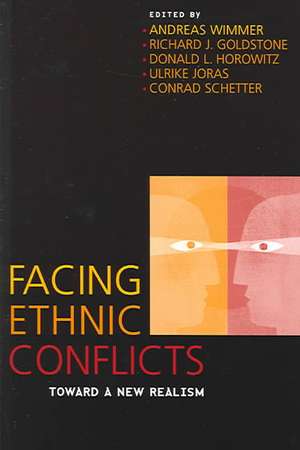
Facing Ethnic Conflicts: Toward a New Realism
Editat de Andreas Wimmer, Richard J. Goldstone, Donald L. Horowitz, Ulrike Joras, Conrad Schetter Contribuţii de Christopher J. Bakwesegha, Rogers Brubaker, Walker Connor, Andrew Ellis, Milton J. Esman, Hurst Hannum, Michael Hechter, Walter Kälin, René Lemarchand, Michael S. Lund, Hugh Miall, Norbert Ropers, Donald Rothchild, Valery A. Tishkov, Max van der Stoel, Angel Viñas, Peter Waldmann, I. William Zartmanen Limba Engleză Paperback – 13 aug 2004
This volume offers a unique overview of research and policy approaches to ethnic conflicts. It is the first book to bring together experienced policymakers and key scholars from all disciplines. They debate how to best understand the rise and escalation of ethnic conflict, assess different strategies for peacemaking, mediation, and reconciliation, and evaluate the prospects for conflict management through institutional design.
In contrast with a more enthusiastic assessment of the willingness and capacity to successfully intervene in ethnic conflict, this volume documents the new realism that has emerged over the past decade. It recognizes the complex and protracted nature of such conflicts and demands a multifaceted, case-by-case approach sustained by long-term political engagement.
Published in co-operation with the Center for Development Research, University of Bonn.
Preț: 355.08 lei
Preț vechi: 508.45 lei
-30%
Puncte Express: 533
Carte tipărită la comandă
Livrare economică 05-19 decembrie
Livrare prin curier în România Termenul estimat este afișat lângă disponibilitate.
Transport gratuit de la 400.00 lei Plată online sau ramburs, în funcție de opțiunile comenzii.
Retur gratuit în 14 zile Comandă securizată și suport în română.
Specificații
ISBN-13: 9780742535855
ISBN-10: 0742535851
Pagini: 384
Dimensiuni: 154 x 228 x 29 mm
Greutate: 0.51 kg
Editura: Bloomsbury Publishing
Colecția Rowman & Littlefield
Locul publicării:New York, United States
ISBN-10: 0742535851
Pagini: 384
Dimensiuni: 154 x 228 x 29 mm
Greutate: 0.51 kg
Editura: Bloomsbury Publishing
Colecția Rowman & Littlefield
Locul publicării:New York, United States
V-ar putea interesa
-
 Places Left Unfinished at the Time of CreationJohn Phillip SantosPreț: 135.83 lei
 -
 OrientalismEdward W. Said-29%Preț: 66.94 lei94.31 lei
 -
 International Law and the Rights of MinoritiesPatrick Thornberry-27%Preț: 465.74 lei636.13 lei
 -
 Ethnicity, Law and Human Rights: The English ExperienceSebastian Poulter-21%Preț: 218.34 lei276.96 lei
 -
 -22%Preț: 392.15 lei502.44 lei
 -
 Racialization: Studies in Theory and PracticeKarim Murji-30%Preț: 562.98 lei803.02 lei
 -
 Cultural Theory: The Key ThinkersAndrew EdgarPreț: 270.14 lei
 -
 The Dark Side of DemocracyMichael MannPreț: 195.54 lei
 -
 Ethnicity without GroupsRogers BrubakerPreț: 251.59 lei
 -
 Chinese CalligraphyYee ChiangPreț: 239.60 lei
 -
 -18%Preț: 791.35 lei965.07 lei
 -
 -31%Preț: 570.45 lei824.15 lei
 -
 The Art of My Neighbor TotoroHayao Miyazaki-20%Preț: 177.51 lei222.88 lei
Cuprins
Chapter 2 Introduction: Facing Ethnic Conflicts
Part 3 I Understanding Ethnic Conflicts
Part 4 The Rise of the Ethnic Question
Chapter 5 A Few Cautionary Notes on the History and Future of Ethnonationalist Conflicts
Chapter 6 Ethnicity without Groups
Chapter 7 Ethnic Conflict and the Colonial Legacy
Part 8 The Dynamics of Escalation
Chapter 9 Exclusion, Marginalization and Political Mobilization: The Road to Hell in the Great Lakes
Chapter 10 Conflicts Start with Words: Fighting Categories in the Chechen Conflict
Chapter 11 The Asymmetry between the Dynamics of Violence and the Dynamics of Peace: The Case of Civil Wars
Part 12 II The Politics of Intervention
Part 13 Prevention and Peacemaking
Chapter 14 Looking Back, Looking Forward: Reflections on Preventing Inter-ethnic Conflict
Chapter 16 Operationalizing the Lessons from Recent Experience in Field-Level Conflict Prevention Strategies
Chapter 17 Sources and Settlements of Ethnic Conflicts
Chapter 18 Transforming Ethnic Conflict: Theories and Practices
Part 19 Mediation and Reconciliation
Chapter 22 From Resolution to Transformation: Assessing the Role and Impact of Dialogue Projects
Chapter 23 Justice and Reconciliation in Fragmented Societies
Part 25 III Institutional Reform
Part 26 Democracy and Electoral Systems
Chapter 27 Ethnic Pluralism: Strategies for Conflict Management
Chapter 28 External Democracy Support: Challenges and Possibilites
Chapter 29 Liberalism, Democracy, and Conflict Management: The African Experience
Chapter 30 Some Realism about Constitutional Engineering
Chapter 32 The Politics of Electoral Systems in Transition
Part 33 Federalism and Autonomy
Chapter 34 Territorial Autonomy: Permanent Solution or Step toward Secession?
Chapter 35 Containing Ethnonationalist Violence
Chapter 36 Decentralized Governance in Fragmented Societies: Solution or Cause of New Evils?
Part 37 IV Conclusion
Chapter 39 Hidden Ties: Similarities between Research and Policy Approaches to Ethnic Conflicts
Chapter 40 Toward a New Realism
Part 3 I Understanding Ethnic Conflicts
Part 4 The Rise of the Ethnic Question
Chapter 5 A Few Cautionary Notes on the History and Future of Ethnonationalist Conflicts
Chapter 6 Ethnicity without Groups
Chapter 7 Ethnic Conflict and the Colonial Legacy
Part 8 The Dynamics of Escalation
Chapter 9 Exclusion, Marginalization and Political Mobilization: The Road to Hell in the Great Lakes
Chapter 10 Conflicts Start with Words: Fighting Categories in the Chechen Conflict
Chapter 11 The Asymmetry between the Dynamics of Violence and the Dynamics of Peace: The Case of Civil Wars
Part 12 II The Politics of Intervention
Part 13 Prevention and Peacemaking
Chapter 14 Looking Back, Looking Forward: Reflections on Preventing Inter-ethnic Conflict
Chapter 16 Operationalizing the Lessons from Recent Experience in Field-Level Conflict Prevention Strategies
Chapter 17 Sources and Settlements of Ethnic Conflicts
Chapter 18 Transforming Ethnic Conflict: Theories and Practices
Part 19 Mediation and Reconciliation
Chapter 22 From Resolution to Transformation: Assessing the Role and Impact of Dialogue Projects
Chapter 23 Justice and Reconciliation in Fragmented Societies
Part 25 III Institutional Reform
Part 26 Democracy and Electoral Systems
Chapter 27 Ethnic Pluralism: Strategies for Conflict Management
Chapter 28 External Democracy Support: Challenges and Possibilites
Chapter 29 Liberalism, Democracy, and Conflict Management: The African Experience
Chapter 30 Some Realism about Constitutional Engineering
Chapter 32 The Politics of Electoral Systems in Transition
Part 33 Federalism and Autonomy
Chapter 34 Territorial Autonomy: Permanent Solution or Step toward Secession?
Chapter 35 Containing Ethnonationalist Violence
Chapter 36 Decentralized Governance in Fragmented Societies: Solution or Cause of New Evils?
Part 37 IV Conclusion
Chapter 39 Hidden Ties: Similarities between Research and Policy Approaches to Ethnic Conflicts
Chapter 40 Toward a New Realism
Recenzii
...Overall this book manages to systematically summarise the research on ethnic conflicts from different academic and practical political perspectives, while also proposing new ways, or a 'new realism', to understand and help resolving ethnic conflicts.
An immensely interesting and valuable volume which should receive much use in upper-level undergraduate and graduate-level courses on ethnic conflict, this edited volume brings together more than a score of contributors to examine the prospects for managing the type of protracted ethnic and national conflicts which have recently proven so destructive to multinational states in the contemporary world, and which have often spilled into the international system.
An important book. It is very rare to find in a scholarly treatise of this nature a wide representation of different voices arguing a range of analytical standpoints as well as reporting empirical data about root causes, dynamics of intensification, and methods of management and resolution of ethnic conflicts.
This volume is a needed addition to the diverse but often incoherent ethnic conflict literature. An impressive list of contributors, for the first time combining accomplished scholars with the expertise of diplomats, NGO officers, and government advisors, shows the entire spectrum of methods, approaches, and worldviews of the various actors concerned about understanding and ultimately preventing ethnic violence. Highly recommended.
An immensely interesting and valuable volume which should receive much use in upper-level undergraduate and graduate-level courses on ethnic conflict, this edited volume brings together more than a score of contributors to examine the prospects for managing the type of protracted ethnic and national conflicts which have recently proven so destructive to multinational states in the contemporary world, and which have often spilled into the international system.
An important book. It is very rare to find in a scholarly treatise of this nature a wide representation of different voices arguing a range of analytical standpoints as well as reporting empirical data about root causes, dynamics of intensification, and methods of management and resolution of ethnic conflicts.
This volume is a needed addition to the diverse but often incoherent ethnic conflict literature. An impressive list of contributors, for the first time combining accomplished scholars with the expertise of diplomats, NGO officers, and government advisors, shows the entire spectrum of methods, approaches, and worldviews of the various actors concerned about understanding and ultimately preventing ethnic violence. Highly recommended.