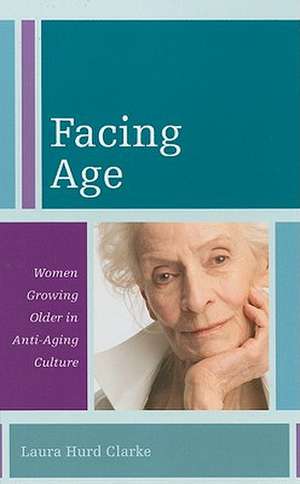
Facing Age: Women Growing Older in Anti-Aging Culture: Diversity and Aging
Autor Laura Hurd Clarkeen Limba Engleză Hardback – 16 dec 2010
Drawing on in-depth interviews conducted over a ten year period, Hurd Clarke brings alive feminist theories about aging, beauty work, femininity, and the body. The book also discusses medicine and the aging appearance, with interviews from medical providers and women about treatments such as Botox injections and injectable fillers. This book makes an important and timely contribution to the discussion of gendered ageism and older women's experiences of growing older in a youth-obsessed culture.

Preț: 619.08 lei
Preț vechi: 913.09 lei
-32%
Puncte Express: 929
Carte tipărită la comandă
Livrare economică 30 noiembrie-14 decembrie
Livrare prin curier în România Termenul estimat este afișat lângă disponibilitate.
Transport gratuit pentru acest produs Plată online sau ramburs, în funcție de opțiunile comenzii.
Retur gratuit în 14 zile Comandă securizată și suport în română.
Specificații
ISBN-13: 9781442207592
ISBN-10: 1442207590
Pagini: 176
Dimensiuni: 164 x 240 x 18 mm
Greutate: 0.42 kg
Editura: Bloomsbury Publishing
Colecția Rowman & Littlefield
Seria Diversity and Aging
Locul publicării:New York, United States
ISBN-10: 1442207590
Pagini: 176
Dimensiuni: 164 x 240 x 18 mm
Greutate: 0.42 kg
Editura: Bloomsbury Publishing
Colecția Rowman & Littlefield
Seria Diversity and Aging
Locul publicării:New York, United States
Cuprins
Acknowledgments
Chapter 1: Introduction
Overview of the Book
Methods and Samples
Strengths and Limitations of the Studies
Chapter 2: Theorizing the Aging and Aged Woman's Face, Body, and Embodied Experience
Women and Body Image
Women and the Feminine Beauty Ideal
Beauty Ideology and Social Positioning
Ageism and Beauty Ideology
Older Women and Embodiment
Medicalization and the Aging Female Body
Theoretically Situating This Book
Chapter 3: Embodied Appearance in Later Life: What Older Women Have to Say
Older Women, Aging Bodied, and Body Image
The Power of the Reflected Image
The Losing Battle of Weight Gain
Grey Matters: Older Women and their Hair
Shifting Priorities and Pragmatic Acceptance
Summary and Conclusions
Chapter 4: Anti-aging Medicine, Wrinkles, and the Moral Imperative to Modify the Aging Face
The Rise of Non-surgical Cosmetic Procedures
Non-surgical Cosmetic Procedures and Aging: The Perspective of Physicians
Interviews with Women before the Rise of Non-surgical Cosmetic Procedures
Interviews with Women after the Development of Non-surgical Cosmetic Procedures
Summary and Conclusions
Chapter 5: Imaging Aging: Media Messages and the Perspectives of Older Women
Beauty and Aging in Print Advertisements
Older Women Reflect on the Body and Face of Beauty in the Media
"Aging is a Serious Problem:" Women, Ageism Discourses, and Beauty Work
Summary and Conclusions
Chapter 6: Women and Aging: The Face of the Future
Conclusion
References
Index
About the Author
Chapter 1: Introduction
Overview of the Book
Methods and Samples
Strengths and Limitations of the Studies
Chapter 2: Theorizing the Aging and Aged Woman's Face, Body, and Embodied Experience
Women and Body Image
Women and the Feminine Beauty Ideal
Beauty Ideology and Social Positioning
Ageism and Beauty Ideology
Older Women and Embodiment
Medicalization and the Aging Female Body
Theoretically Situating This Book
Chapter 3: Embodied Appearance in Later Life: What Older Women Have to Say
Older Women, Aging Bodied, and Body Image
The Power of the Reflected Image
The Losing Battle of Weight Gain
Grey Matters: Older Women and their Hair
Shifting Priorities and Pragmatic Acceptance
Summary and Conclusions
Chapter 4: Anti-aging Medicine, Wrinkles, and the Moral Imperative to Modify the Aging Face
The Rise of Non-surgical Cosmetic Procedures
Non-surgical Cosmetic Procedures and Aging: The Perspective of Physicians
Interviews with Women before the Rise of Non-surgical Cosmetic Procedures
Interviews with Women after the Development of Non-surgical Cosmetic Procedures
Summary and Conclusions
Chapter 5: Imaging Aging: Media Messages and the Perspectives of Older Women
Beauty and Aging in Print Advertisements
Older Women Reflect on the Body and Face of Beauty in the Media
"Aging is a Serious Problem:" Women, Ageism Discourses, and Beauty Work
Summary and Conclusions
Chapter 6: Women and Aging: The Face of the Future
Conclusion
References
Index
About the Author
Recenzii
This book uses interviews from five studies Hurd Clarke (human kinetics, Univ. of British Columbia, Canada) conducted between 1997 and 2007 that focus on women's perceptions of their age and the actions they take in response to their aging. Three studies compile her interview data with older women; another set of interviews concerns physicians' views of their nonsurgical cosmetic procedures; a final study analyzes anti-aging print advertisements in women's magazines. Hurd Clarke conducted over 300 hours of in-depth interviews with 102 women and eight physicians. She draws on her own lengthy history of prior research in the area and makes voluminous reference to relevant scholars in the field about the relationship of age and body image. Her volume richly interweaves many quotations from her interview subjects....Hurd Clarke's brief mentions of her personal response to the interviews are also intriguing. One hopes that this important nod to her private stance and theoretical stake in the research will be further explored in similarly fruitful endeavors. Summing Up: Recommended.
Laura Hurd Clarke masterfully demonstrates that the meanings women attribute to aging, physical and social reality, and cultural gender norms are influenced by their chronological age, genetics, and social location in culture and history. There is no better time for this book than now, as society is on the cusp of a blossoming of the number of older women. With shifting demographics and an aging of society as a whole, Facing Age is an important contribution to understanding the nexus of social norms related to age and gender.
Facing Age includes conversations with physicians who do nonsurgical treatments and an excellent analysis of media portrayals of the aging body as highly undesirable.... Clarke skewers the phony imagery in ads for anti-aging cosmetics, noting their battle metaphors: youthfulness if victorious, 'while agedness is beaten down into submission' and pushed to the bottom of the social hierarchy.
Laura Hurd Clarke's book provides a fascinating insight into the tensions facing women as they age, exploring the impact of the wider ageist culture on their day to day to day practices and experiences. Drawing on a series of research studies that range across the fields of cosmetic surgery, hair dyes, slimming regimes, beauty shops, magazines, Hurd Clarke vividly brings to life the voices and experiences of women as they age, providing a nuanced and politically committed account of their lives. The book is exceptionally well based in the literature.Of relevance not just to ageing, but embodiment, gender and the politics of beauty more generally, it will become a key text in the field.
This novel and insightful book is beautifully written, providing a rare integration of theoretical scholarship with rich empirical research on midlife and older women's beauty work in our anti-aging culture. Facing Age provides a profound analysis of women and ageing, which is destined to become a classic, and will be essential reading for researchers and students interested in ageing, gender studies and sociology of the body.
This is not a book for the faint-hearted, but, then, as Bette Davis once said: 'Old age is no place for sissies.' Laura Hurd Clarke has given us a grimly unsettling, but eminently readable portrayal of growing older in a culture riddled by ageism and fear of the aging female body.
Laura Hurd Clarke masterfully demonstrates that the meanings women attribute to aging, physical and social reality, and cultural gender norms are influenced by their chronological age, genetics, and social location in culture and history. There is no better time for this book than now, as society is on the cusp of a blossoming of the number of older women. With shifting demographics and an aging of society as a whole, Facing Age is an important contribution to understanding the nexus of social norms related to age and gender.
Facing Age includes conversations with physicians who do nonsurgical treatments and an excellent analysis of media portrayals of the aging body as highly undesirable.... Clarke skewers the phony imagery in ads for anti-aging cosmetics, noting their battle metaphors: youthfulness if victorious, 'while agedness is beaten down into submission' and pushed to the bottom of the social hierarchy.
Laura Hurd Clarke's book provides a fascinating insight into the tensions facing women as they age, exploring the impact of the wider ageist culture on their day to day to day practices and experiences. Drawing on a series of research studies that range across the fields of cosmetic surgery, hair dyes, slimming regimes, beauty shops, magazines, Hurd Clarke vividly brings to life the voices and experiences of women as they age, providing a nuanced and politically committed account of their lives. The book is exceptionally well based in the literature.Of relevance not just to ageing, but embodiment, gender and the politics of beauty more generally, it will become a key text in the field.
This novel and insightful book is beautifully written, providing a rare integration of theoretical scholarship with rich empirical research on midlife and older women's beauty work in our anti-aging culture. Facing Age provides a profound analysis of women and ageing, which is destined to become a classic, and will be essential reading for researchers and students interested in ageing, gender studies and sociology of the body.
This is not a book for the faint-hearted, but, then, as Bette Davis once said: 'Old age is no place for sissies.' Laura Hurd Clarke has given us a grimly unsettling, but eminently readable portrayal of growing older in a culture riddled by ageism and fear of the aging female body.