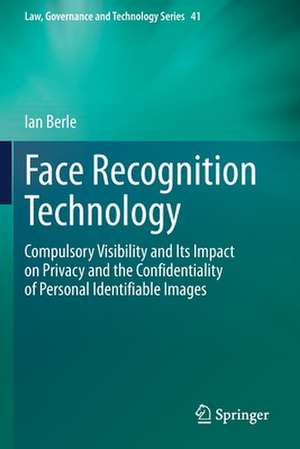
Face Recognition Technology: Law, Governance and Technology Series
Autor Ian Berleen Limba Engleză Paperback – 12 mar 2021
The book reviews American, UK and European case law concerning privacy and confidentiality, the effect each case has had on the developing jurisprudence, and the ethical issues involved. As such, it offers a valuable resource for students of ethico-legal fields, professionals specialising in image rights law, policy-makers, and liberty advocates and activists.
Din seria Law, Governance and Technology Series
- 15%
 Preț: 697.60 lei
 - 18%
 Preț: 1012.84 lei
 - 18%
 Preț: 1086.32 lei
 - 18%
 Preț: 1072.48 lei
 - 18%
 Preț: 857.79 lei
 - 18%
 Preț: 1080.88 lei
 - 18%
 Preț: 913.62 lei
 - 18%
 Preț: 967.04 lei
 - 18%
 Preț: 863.58 lei
 - 18%
 Preț: 1626.18 lei
 - 18%
 Preț: 917.87 lei
 - 23%
 Preț: 774.86 lei
 - 20%
 Preț: 329.43 lei
 - 18%
 Preț: 923.52 lei
 - 20%
 Preț: 515.15 lei
 - 20%
 Preț: 630.36 lei
 - 18%
 Preț: 865.54 lei
 -
 Preț: 388.79 lei
 - 18%
 Preț: 735.90 lei
 - 18%
 Preț: 756.39 lei
 - 15%
 Preț: 621.99 lei
 - 18%
 Preț: 703.09 lei
 - 18%
 Preț: 1079.97 lei
 - 15%
 Preț: 624.20 lei
 - 18%
 Preț: 1121.01 lei
 - 15%
 Preț: 620.95 lei
 - 18%
 Preț: 1075.86 lei
 - 18%
 Preț: 1013.84 lei
 - 18%
 Preț: 1128.99 lei
Preț: 748.76 lei
Preț vechi: 913.12 lei
-18%
Puncte Express: 1123
Carte tipărită la comandă
Livrare economică 27 octombrie-10 noiembrie
Livrare prin curier în România Termenul estimat este afișat lângă disponibilitate.
Transport gratuit pentru acest produs Plată online sau ramburs, în funcție de opțiunile comenzii.
Retur gratuit în 14 zile Comandă securizată și suport în română.
Specificații
ISBN-13: 9783030368890
ISBN-10: 3030368890
Pagini: 228
Ilustrații: XXIII, 202 p. 4 illus.
Dimensiuni: 155 x 235 x 13 mm
Greutate: 0.35 kg
Ediția:1st ed. 2020
Editura: Springer
Seria Law, Governance and Technology Series
Locul publicării:Cham, Switzerland
ISBN-10: 3030368890
Pagini: 228
Ilustrații: XXIII, 202 p. 4 illus.
Dimensiuni: 155 x 235 x 13 mm
Greutate: 0.35 kg
Ediția:1st ed. 2020
Editura: Springer
Seria Law, Governance and Technology Series
Locul publicării:Cham, Switzerland
V-ar putea interesa
-
 Legal Secrets for Independent FilmmakersAkua BoyennePreț: 154.00 lei
 -
 Entertainment Law: Music: (Or, How to Roll in the Rock Industry)Wendy Kemp Akbar EsqPreț: 247.55 lei
 -
 Eaccess to JusticeKarim BenyekhlefPreț: 344.68 lei
 -
 Media LawJules Lobel-27%Preț: 960.54 lei1315.81 lei
 -
 -18%Preț: 1258.66 lei1534.95 lei
 -
 Envisioning Legality: Law, Culture and RepresentationTimothy Peters-18%Preț: 1120.05 lei1365.91 lei
 -
 Alcohol AdvertisingGlobal Advertising Lawyers AlliancePreț: 350.30 lei
 -
 Media LawSallie SpilsburyPreț: 479.60 lei
 -
 EU Internet Law in the Digital Era: Regulation and EnforcementTatiana-Eleni Synodinou-18%Preț: 1076.03 lei1312.23 lei
 -
 The Average Consumer in Confusion-based Disputes in European Trademark Law and Similar FictionsRasmus Dalgaard Laustsen-15%Preț: 633.19 lei744.92 lei
 -
 Imposing Regulation on Advanced AlgorithmsFotios FitsilisPreț: 396.84 lei
 -
 Regulating Artificial IntelligenceThomas Wischmeyer-18%Preț: 866.28 lei1056.43 lei
 -
 The Breeder's Exception to Patent RightsViola Prifti-15%Preț: 619.45 lei728.76 lei
 -
 -15%Preț: 623.59 lei733.63 lei
 -
 -15%Preț: 681.61 lei801.89 lei
 -
 -15%Preț: 613.62 lei721.90 lei
 -
 E-Commerce Law in Europe and the USAGerald Spindler-18%Preț: 979.05 lei1193.97 lei
 -
 MedienrechtMarian PaschkePreț: 301.95 lei
 -
 Online Music Distribution - How Much Exclusivity Is Needed?Nikita Malevanny-18%Preț: 962.31 lei1173.56 lei
 -
 I contenuti digitaliNicola LucchiPreț: 274.47 lei
 -
 Innovation and IPRs in China and IndiaKung-Chung Liu-18%Preț: 758.83 lei925.41 lei
 -
 New Technology, Big Data and the LawMarcelo Corrales-18%Preț: 1120.63 lei1366.62 lei
Cuprins
Introduction.- What is Face Recognition Technology?.- Some Ethical and Legal Issues of FRT.- Surveillance Surveyed.- Autonomy, Liberty and Privacy.- Compulsory Visibility?.- The Law and Data Protection.- The Law and Surveillance.- State Paternalism and Autonomy.- State Paternalism and Data.- The Future of Face Recognition.- Conclusion.
Notă biografică
Ian Berle is the specialist assessor for the ‘Legal & Ethical’ module of Staffordshire University’s medical illustration certificate & diploma course. A former Head of Medical Illustration at Barts NHS Health Trust (1982-2008), he holds post-graduate degrees in bioethics and privacy law, and wrote an MPhil thesis on Face Recognition Technology and its effects on privacy and confidentiality. His recent work concerns how the right to one’s own image might be adequately protected, which this work also seeks to address.
Textul de pe ultima copertă
This book examines how face recognition technology is affecting privacy and confidentiality in an era of enhanced surveillance. Further, it offers a new approach to the complex issues of privacy and confidentiality, by drawing on Joseph K in Kafka’s disturbing novel The Trial, and on Isaiah Berlin’s notion of liberty and freedom. Taking into consideration rights and wrongs, protection from harm associated with compulsory visibility, and the need for effective data protection law, the author promotes ethical practices by reinterpreting privacy as a property right. To protect this right, the author advocates the licensing of personal identifiable images where appropriate.
The book reviews American, UK and European case law concerning privacy and confidentiality, the effect each case has had on the developing jurisprudence, and the ethical issues involved. As such, it offers a valuable resource for students of ethico-legal fields, professionals specialising in image rights law, policy-makers, and liberty advocates and activists.
The book reviews American, UK and European case law concerning privacy and confidentiality, the effect each case has had on the developing jurisprudence, and the ethical issues involved. As such, it offers a valuable resource for students of ethico-legal fields, professionals specialising in image rights law, policy-makers, and liberty advocates and activists.
Caracteristici
Discusses face recognition technology and the need for improved rights to personal identifiable images Draws on a variety of sources from philosophy and law and applies them from a photographer’s unique perspective Offers a reinterpretation of privacy and property rights