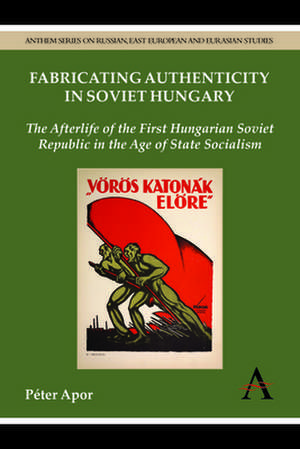
Fabricating Authenticity in Soviet Hungary
Autor Péter Aporen Limba Engleză Paperback – mar 2015
In recent decades the study of memory has become central to the historical discipline as a powerful conceptual tool to assess both the political-ideological implications of social constructions of the past and the writing of history itself. Yet, most of these investigations focus on postdictatorial situations, and suggest ways to understand how these societies confront their controversial and often traumatic pasts. In this volume, P ter Apor takes an in-depth look at a particular phenomenon - the First Hungarian Soviet Republic of 1919 - to illustrate how a dictatorship and a communist state remembers. Unlike other works analysing social memory, this book concentrates on authenticity as the crucial concept in establishing the success or failure of memory constructions, integrating the broad range of processes - political, scholarly, artistic - through which history is sought to be rendered authentic.
Preț: 260.66 lei
Puncte Express: 391
Carte disponibilă
Livrare economică 18 septembrie-02 octombrie
Livrare prin curier în România Termenul estimat este afișat lângă disponibilitate.
Transport gratuit de la 400.00 lei Plată online sau ramburs, în funcție de opțiunile comenzii.
Retur gratuit în 14 zile Comandă securizată și suport în română.
Specificații
ISBN-13: 9781783084197
ISBN-10: 1783084197
Pagini: 228
Dimensiuni: 152 x 229 x 14 mm
Greutate: 0.38 kg
Editura: Wimbledon Publishing
ISBN-10: 1783084197
Pagini: 228
Dimensiuni: 152 x 229 x 14 mm
Greutate: 0.38 kg
Editura: Wimbledon Publishing
V-ar putea interesa
-
 Whatever it TakesSteve RichardsPreț: 109.86 lei
 -
 Sex with the QueenEleanor HermanPreț: 118.74 lei
 -
 Brothers in WarMichael WalshPreț: 118.37 lei
 -
 The Fall of ParisAlistair HornePreț: 123.33 lei
 -
 The Cretan RunnerGeorge PsychoundakisPreț: 85.56 lei
 -
 Ukraine: Birth of a Modern NationSerhy Yekelchyk-16%Preț: 216.07 lei257.82 lei
 -
 The Holy Roman Empire 1495-1806Peter H. Wilson-26%Preț: 183.72 lei248.83 lei
 -
 Bohemia in LondonP. BrookerPreț: 383.15 lei
 -
 Master of the House: Stalin and His Inner CircleOleg Khlevniuk-23%Preț: 568.71 lei738.58 lei
 -
 GuerraJason Webster-27%Preț: 67.07 lei91.44 lei
 -
 Bringing the House DownDavid Profumo-27%Preț: 66.94 lei91.61 lei
 -
 1536Suzannah LipscombPreț: 92.73 lei
 -
 Dancing into Battle: A Social History of the Battle of WaterlooNicholas Foulkes-26%Preț: 57.89 lei78.41 lei
 -
 Royal Marines CommandosJohn ParkerPreț: 92.10 lei
 -
 History of Rome 4eDavid CherryPreț: 331.34 lei
 -
 William WallaceAndrew FisherPreț: 77.78 lei
 -
 Why Europe Was FirstErik RingmarPreț: 188.27 lei
 -
 The Lion and the UnicornRichard Aldous-18%Preț: 112.27 lei136.76 lei
 -
 Killing HitlerRoger MoorhousePreț: 112.17 lei
 -
 The Mercurial EmperorPeter Marshall-19%Preț: 96.48 lei119.78 lei
 -
 To the Victor the SpoilsSean LongdenPreț: 252.49 lei
 -
 -25%Preț: 81.63 lei108.34 lei
Notă biografică
Péter Apor is Research Fellow at the Institute of History, Hungarian Academy of Sciences, Hungary. He is the author of Fabricating Authenticity in Soviet Hungary: The Afterlife of the First Hungarian Soviet Republic in the Age of State Socialism (2014).
Cuprins
Acknowledgements; List of Illustrations; List of Abbreviations; Introduction; Chapter 1: Prefiguration: The First Hungarian Soviet Republic and the Rákosi Dictatorship before 1956; Chapter 2: Resurrection: The Emergence of 1919 and the Counterrevolution after 1956; Chapter 3: Lives: 1919 in the Postwar Trials of War Criminals; Chapter 4: Funeral: The Birth of the Pantheon of the Labour Movement in Budapest; Chapter 5: Narration: History, Fiction and Proof in the Representation of the First Hungarian Soviet Republic, 1959-65; Epilogue: The Agitators and the Armoured Train; Index