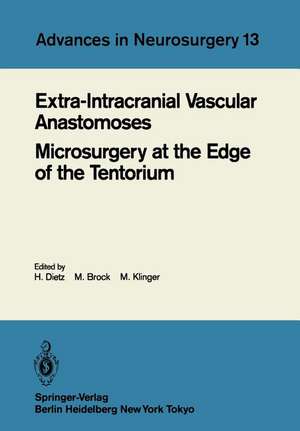
Extra-Intracranial Vascular Anastomoses Microsurgery at the Edge of the Tentorium: Advances in Neurosurgery, cartea 13
Editat de Hermann Dietz, Mario Brock, Margareta Klingeren Limba Engleză Paperback – sep 1985
Din seria Advances in Neurosurgery
- 5%
 Preț: 697.42 lei
 - 5%
 Preț: 699.17 lei
 -
 Preț: 383.75 lei
 - 5%
 Preț: 694.44 lei
 - 5%
 Preț: 696.72 lei
 - 15%
 Preț: 618.99 lei
 - 15%
 Preț: 622.59 lei
 - 5%
 Preț: 693.71 lei
 - 5%
 Preț: 688.44 lei
 - 5%
 Preț: 367.40 lei
 - 5%
 Preț: 694.80 lei
 - 5%
 Preț: 690.59 lei
 - 5%
 Preț: 690.73 lei
 - 5%
 Preț: 368.10 lei
 - 5%
 Preț: 694.59 lei
 - 5%
 Preț: 697.93 lei
 - 5%
 Preț: 688.64 lei
 - 5%
 Preț: 697.93 lei
 - 5%
 Preț: 701.26 lei
 - 5%
 Preț: 705.14 lei
Preț: 694.44 lei
Preț vechi: 730.99 lei
-5% Nou
Puncte Express: 1042
Preț estimativ în valută:
122.89€ • 144.10$ • 107.92£
122.89€ • 144.10$ • 107.92£
Carte tipărită la comandă
Livrare economică 31 ianuarie-14 februarie 26
Preluare comenzi: 021 569.72.76
Specificații
ISBN-13: 9783540156154
ISBN-10: 3540156151
Pagini: 364
Ilustrații: XII, 352 p. 90 illus.
Dimensiuni: 170 x 244 x 19 mm
Greutate: 0.58 kg
Ediția:Softcover reprint of the original 1st ed. 1985
Editura: Springer Berlin, Heidelberg
Colecția Springer
Seria Advances in Neurosurgery
Locul publicării:Berlin, Heidelberg, Germany
ISBN-10: 3540156151
Pagini: 364
Ilustrații: XII, 352 p. 90 illus.
Dimensiuni: 170 x 244 x 19 mm
Greutate: 0.58 kg
Ediția:Softcover reprint of the original 1st ed. 1985
Editura: Springer Berlin, Heidelberg
Colecția Springer
Seria Advances in Neurosurgery
Locul publicării:Berlin, Heidelberg, Germany
V-ar putea interesa
-
 Neurosurgical Management of PainRichard B. North-5%Preț: 1378.38 lei1450.93 lei
 -
 Huguenot Emigration to Virginia . . .Robert Alonzo BrockPreț: 222.97 lei
 -
 Encyclopedia of NeurosurgeryArthur Colfer-5%Preț: 835.13 lei879.09 lei
 -
 NeurosurgeryArthur Colfer-5%Preț: 640.55 lei674.26 lei
 -
 Operative Techniques of Spine SurgeryAngus Sanders-5%Preț: 506.99 lei533.68 lei
 -
 Medical Technologies in NeurosurgeryChristopher Nimsky-5%Preț: 1046.76 lei1101.85 lei
 -
 Cavernous Sinus: Developments and Future PerspectivesVinko V. Dolenc-5%Preț: 1411.39 lei1485.67 lei
 -
 -5%Preț: 1076.91 lei1133.59 lei
 -
 -5%Preț: 694.80 lei731.37 lei
 -
 Brain and Spine Surgery in the ElderlyMoncef Berhouma-5%Preț: 1222.24 lei1286.57 lei
 -
 Atlas of Craniocervical Junction and Cervical Spine SurgeryStefano Boriani-5%Preț: 1817.53 lei1913.18 lei
 -
 Treatment of Cerebral EdemaA. Hartmann-5%Preț: 441.62 lei464.87 lei
 -
 -5%Preț: 2844.73 lei2994.46 lei
 -
 Clinical Echo-EncephalographyWolfgang Schiefer-5%Preț: 747.81 lei787.17 lei
 -
 -5%Preț: 696.54 lei733.20 lei
 -
 Percutaneous Lumbar DiscectomyH. Michael Mayer-5%Preț: 686.69 lei722.83 lei
 -
 The Artificial DiscMario Brock-5%Preț: 678.79 lei714.52 lei
 -
 -5%Preț: 365.81 lei385.06 lei
 -
 -5%Preț: 697.98 lei734.71 lei
Public țintă
ResearchCuprins
Extra-Intracranial Vascular Anastomoses.- Pathophysiological Aspects of Cerebral Blood Flow in Respect of Extracranial-Intracranial Anastomoses.- The STA-MCA Bypass Procedure.- Risk and Benefit of STA/MCA Anastomoses.- Clinical Experience with Anastomoses Between the Superficial Temporal Artery and the Middle Cerebral Artery: A Survey of 15 Years.- Clinical Findings and Operative Results in 250 Patients Who Underwent EIAB Operations.- Late Results of Extra-Intracranial Bypass Surgery — 119 Cases.- Protective EIAB in Intracranial High-Risk Operations.- Recovery After Stroke — Improvement by Extra-Intracranial Arterial Bypass (EIAB)? A 7-Year Follow-up Study.- Rare Indications for EIAB Procedures.- Extra-Intracranial Microvascular Anastomosis with the Arteria Occipitalis: Indications and Operative Technique.- Brain Revascularization Surgery for Vertebrobasilar Insufficiency Due to Obstructive Vertebral Artery Disease.- Experience with CO2-Laser-Assisted Anastomosis in Animal Experiments.- Microsurgical Vascular Anastomoses with Resorbable Suture Material.- Microvascular End-to-Side Anastomoses: The Double Patch Technique.- A New Sutureless Microvascular Anastomosis Procedure for Bypass Operations.- Aneurysm Formation After Suturing or Gluing the Common Carotid Artery in the Rat.- Morphology of Vessel Wall Changes After Microsurgical End-to-Side Anastomosis and Their Pharmacological Prevention.- The Ultrastructure of the Superficial Temporal Artery in Extra-Intracranial Bypass Surgery.- The Functional Defect of Surcically Injured Endothelial Cells and Its Influence on Extra-IHtracranial Arterial Bypass Surgery.- Is the Extra-Intracranial Bypass Patent and Supplying the Brain with Additional Blood?.- Transcranial Doppler Findings in Extracranial-Intracranial BypassSurgery.- Is an Intra-Extracranial Reversal of Flow Possible Following EIAB Operation?.- Regional Cerebral Blood Flow Measurement as a Supportive Indication for Vascular Surgical Procedures.- Long-Term Control of Completed Stroke: rCBF Measurements and Psychological Assessment Before and After Extra-Intracranial Bypass Surgery.- Psychometric Follow-Up Studies in Patients with Transient Ischemic Attacks and Completed Stroke Treated by Extra-Intracranial Arterial Bypass.- Application of 3-Fluoro-Deoxyglucose for the Assessment of Cerebral Perfusion and Glucose Transport in Candidates for EC/IC Bypass Surgery.- Dynamic Single Photon Emission Computerized Tomography in Extra-Intracranial Bypass Patients with Internal Carotid Artery Occlusion.- Magnetic Resonance Imaging of Cerebral Infarcts Before and After Extra-Intracranial Anastomoses.- Microsurgery at the Edge of the Tentorium.- Anatomy of the Tentorial Margin.- Meningiomas at the Tentorial Edge.- Approaches to the Tentorial Edge, Demonstrated by Reference to 30 Cases of Tentorial Edge Meningioma.- Surgical Management of Dysontogenetic Tumors and Cysts in the Region of the Tentorial Incisura and the Ambient Cistern.- Cranial Nerve Lesions Following Operations on Tumors of the Tentorial Edge 195.- The Advantages of Laser Therapy in the Region of the Tentorial Edge.- The Surgical Anatomy of the Cavernous Sinus.- Evoked Potentials for Therapy Control During Operations at the Tentorial Margin.- New Research.- Primary and Secondary Hypothalamus and Brain Stem Lesions.- Receptors of Steroid Hormones, Prolactin, and Somatotropin (Growth Hormone) in Human Pituitary Adenomas.- Adenylate Kinase Isoenzymes in Intracranial Tumors.- Quantitative Immunohistochemical Evaluation of Tumor Edema in Brain Tumors.- Melatonin: A Marker forTumors of the Pineal Region.- Optical Properties of Brain Tissue and Brain Tumors at the Wavelength of the Nd-YAG Laser (? =1060 nm).- Clinical Differential Diagnosis of Cerebral Manifestations of Lymphoma 282.- A Computerized Analysis of ICP for the Determination of Intracranial Tightness: Experimental Results and Clinical Significance.- Motor Activity, Intracranial Pressure, and Vegetative Signs During Decerebration.- Pre- and Postoperative Studies of Sleep Levels in Patients with Normal Pressure Hydrocephalus for an Indication of Operative Treatment.- Influence of Age, Hypertension, Vasospasm, and Other Factors on the Results of Aneurysm Surgery.- Endarterectomy and Angioplasty in Long-Segment or High Located Carotid Stenoses.- nrCBF and EEG Monitoring During Probatory Balloon Occlusion of the Internal Carotid Artery.- Effects of Arachidonic Acid on Blood-Brain Barrier Function.- Blood Flow, Metabolism, and Function of the Brain During Cerebral Administration of Bradykinin.- The Course of Intracranial Pressure During Experimental Long-Time Perfusion with Prostacyclin.- Skin Testing — The First Step to Selective Chemonucleolysis.