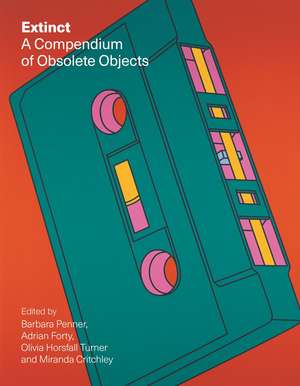
Extinct: A Compendium of Obsolete Objects
Editat de Barbara Penner, Adrian Forty, Olivia Horsfall Turner, Miranda Critchleyen Limba Engleză Hardback – 21 dec 2021
So-called extinct objects are those that were imagined but were never in use, or that existed but are now unused—superseded, unfashionable, or simply forgotten. Extinct gathers together an exceptional range of artists, curators, architects, critics, and academics, including Hal Foster, Barry Bergdoll, Deyan Sudjic, Tacita Dean, Emily Orr, Richard Wentworth, and many more. In eighty-five essays, contributors nominate “extinct” objects and address them in a series of short, vivid, sometimes personal accounts, speaking not only of obsolete technologies, but of other ways of thinking, making, and interacting with the world. Extinct is filled with curious, half-remembered objects, each one evoking a future that never came to pass. It is also a visual treat, full of interest and delight.
Preț: 254.63 lei
Preț vechi: 330.38 lei
-23%
Puncte Express: 382
Carte disponibilă
Livrare economică 06-13 noiembrie
Livrare express 22-28 octombrie pentru 139.99 lei
Livrare prin curier în România Termenul estimat este afișat lângă disponibilitate.
Transport gratuit de la 400.00 lei Plată online sau ramburs, în funcție de opțiunile comenzii.
Retur gratuit în 14 zile Comandă securizată și suport în română.
Specificații
ISBN-13: 9781789144529
ISBN-10: 1789144523
Pagini: 400
Ilustrații: 74 color plates, 46 halftones
Dimensiuni: 171 x 222 x 20 mm
Greutate: 1.13 kg
Editura: REAKTION BOOKS
Colecția Reaktion Books
ISBN-10: 1789144523
Pagini: 400
Ilustrații: 74 color plates, 46 halftones
Dimensiuni: 171 x 222 x 20 mm
Greutate: 1.13 kg
Editura: REAKTION BOOKS
Colecția Reaktion Books
V-ar putea interesa
-
 Preț: 92.36 lei
 -
 Ghosts Behind Glass: Encountering Extinction in MuseumsDolly JørgensenPreț: 124.04 lei
 -
 The Alienation EffectOwen HatherleyPreț: 278.51 lei
 -
 -19%Preț: 265.22 lei325.62 lei
 -
 Things Come Apart 2.0Todd McLellan-17%Preț: 115.74 lei138.85 lei
 -
 AnalogueDeyan Sudjic-15%Preț: 202.02 lei237.90 lei
 -
 New TechnologiesSimon Alderson-11%Preț: 211.16 lei237.91 lei
 -
 The Meaning of Branded ObjectsTom Guarriello-19%Preț: 109.50 lei135.96 lei
 -
 The Madman's OrchestraEdward Brooke-HitchingPreț: 197.06 leiRecomandat
 -
 -23%Preț: 115.82 lei149.63 lei
 -
 Fewer, Better Things: The Hidden Wisdom of ObjectsGlenn Adamson-37%Preț: 58.51 lei93.06 lei
 -
 On ExtinctionMelanie ChallengerPreț: 109.95 lei
 -
 Idea of WasteWilliam O. StephensPreț: 193.51 lei
 -
 Lost Animals, Disappearing Worlds: Stories of ExtinctionBarbara AllenPreț: 148.16 lei
 -
 New HumansMassimiliano Gioni-15%Preț: 597.91 lei703.43 lei
 -
 Lost Banff and BuchanDaniel MaccannellPreț: 123.29 lei
 -
 Panoramas of Lost LondonPhilip DaviesPreț: 333.85 lei
 -
 A Compendium of Curious ContraptionsAnna GoldfieldPreț: 110.80 lei
 -
 Rethinking Obsolete TypologiesAnamarija BatistaPreț: 358.29 lei
 -
 -18%Preț: 354.33 lei432.82 lei
Notă biografică
Barbara Penner is professor of architectural humanities at the Bartlett School of Architecture, University College London. Her books include Bathroom, also published by Reaktion Books, and she is a contributing editor of Places Journal. Adrian Forty is professor emeritus of architectural history at the Bartlett School of Architecture, University College London. He is the author of many books, including Concrete and Culture: A Material History, also published by Reaktion Books. Olivia Horsfall Turner is a historian of architecture and design and senior curator of designs at the Victoria and Albert Museum. Miranda Critchley is completing her PhD at the Bartlett School of Architecture, University College London, on railways and colonial narratives of progress.
Recenzii
"Inventions that calamitously failed or quietly faded into obscurity are brought back to life in Extinct: A Compendium of Obsolete Objects. A team of nearly eighty scholars wrote the eighty-five alphabetical entries, from arsenic-laced wallpaper that poisoned Victorian families to exploding zeppelins. Among the once-humdrum goods that have become collectibles are ashtrays, paper airplane tickets, slide rules and vertical filing cabinets. And there are technologies now predominantly confined to museums, like pneumatic tubes for delivering mail, and pyrophones, musical instruments with piano keys controlling miniature burners inside glass tubes that emit melancholic whispers. The book also profiles follies that never reached the market: anti-gravitation underclothing designed to keep wearers aloft and telegraph mechanisms that relied on snails slithering around zinc bowls to tap out letters."
“Writing, Schalansky theorizes, is not resurrection, ‘but it can enable everything to be experienced.’ The best essays in Extinct manage this, bringing the ashtray and the tragedy of arsenic wallpaper and the strange floodlights of streets lit by moon towers not quite to life but into the realm of our imagined experience. . . . Extinct is also a beautiful object in its own right . . . with a colorful cover illustration of a cassette tape, and rich photographs and drawings that accompany the essays.”
“Extinct takes the long and often absurdist view. There are mad things we don’t miss—arsenic wallpaper (vivid but deadly)—and things we miss every twenty minutes: ashtrays (deadly but vivid). . . . I miss memos. I crave the Polaroid SX-70 . . . and I wish I had a serving hatch in my sitting room because then I’d feel properly middle class.”
“This fascinating book covers 85 extinct objects, small and large, with a short essay on each by academics, architects and curators. Highly informative and very entertaining.”
“Extinct: A Compendium of Obsolete Objects is a book so far up our street it might as well move in. . . . Across 85 illustrated essays it tells the stories of ‘extinct’ inventions. . . . Buy this brilliant book now.”
“A delight to peruse. Rather than mocking the failed, superseded or outmoded, it is more of a celebration of 85 extinct objects and the visions that drove them, as nominated by a range of historians, curators, architects, academics and artists. . . . The featured objects are a wonderful selection.”
"The Clapper, literal snail mail, anti-gravity underwear—there are reasons why all of these objects are extinct. But now, a new book is exhuming them from the trash heap of history. In Extinct: A Compendium of Obsolete Objects, a team of professors, historians, artists, and curators seeks to understand why various objects became 'obsolete,' and what this tells us about the worlds they existed in. Modern technology now moves at a lightning pace, with endless updates to phones, cameras, and other gadgets. But the book's authors hope to challenge the assumption that things disappear due to 'inadequacy' or 'unsuitedness to their conditions.' From the defunct to the superseded, from the failed to the visionary, there can be many reasons why an invention no longer serves a purpose."
“Writing, Schalansky theorizes, is not resurrection, ‘but it can enable everything to be experienced.’ The best essays in Extinct manage this, bringing the ashtray and the tragedy of arsenic wallpaper and the strange floodlights of streets lit by moon towers not quite to life but into the realm of our imagined experience. . . . Extinct is also a beautiful object in its own right . . . with a colorful cover illustration of a cassette tape, and rich photographs and drawings that accompany the essays.”
"An innovation that seemed life changing in one era might seem ridiculous or useless—or even deadly—in another. This illustrated cavalcade of inventions highlights the rise (and fall) of such things as the Concorde, arsenic wallpaper, pneumatic tubes, and flying cars."
“Extinct takes the long and often absurdist view. There are mad things we don’t miss—arsenic wallpaper (vivid but deadly)—and things we miss every twenty minutes: ashtrays (deadly but vivid). . . . I miss memos. I crave the Polaroid SX-70 . . . and I wish I had a serving hatch in my sitting room because then I’d feel properly middle class.”
“This fascinating book covers 85 extinct objects, small and large, with a short essay on each by academics, architects and curators. Highly informative and very entertaining.”
“Extinct: A Compendium of Obsolete Objects is a book so far up our street it might as well move in. . . . Across 85 illustrated essays it tells the stories of ‘extinct’ inventions. . . . Buy this brilliant book now.”
"A fascinating and curious read. It is host to accounts, conclusions, and warnings from the ghosts of deceased inventions and their often-haunting lives that float on beyond the grave. The authors use natural selection and evolution as an analogy to the birth, death, mutation, and rebirth of designed or ideated objects as they cycle through their usefulness and ultimate obsolescence."
"Remember audio cassettes, paper airline tickets, Polaroid cameras and fountain pens? Extinct is a wonderful compendium of objects that are past their prime, but evoke nostalgia not derision. The four editors discuss eighty-five objects and the visions that drove them. The book leaves you wondering which of the objects we use today will be part of a book like this in the near future."
“A delight to peruse. Rather than mocking the failed, superseded or outmoded, it is more of a celebration of 85 extinct objects and the visions that drove them, as nominated by a range of historians, curators, architects, academics and artists. . . . The featured objects are a wonderful selection.”
“A truly fascinating and consistently unexpected account of a forgotten landscape of lost futures. This richly original work chronicles the designed world of the undead and, at the same time, challenges today’s easy consensus of progress and modernization. Entertaining, jolting, and scholarly, it is a superb counterblast to our own age of relentless upgrades and product improvements.”
“Objects have come and gone from our lives throughout history, mostly because something new has been designed to fulfill their functions more efficiently, appealingly, economically, or sustainably. Never before has this happened with such speed or on the same scale as in the digital age. Extinct is both a thoughtful and incisive analysis of the phenomenon and an engaging tribute to some of the intriguing or eccentric objects we have lost in design’s equivalent of natural selection.”
“This is a wonderfully curious book about how the ghosts of extinct inventions live on, not just in our minds but in the world around us. It is strangely addictive to discover how the epitaphs of these technologies form the blueprints of our future.”
"Extinct is an intoxicating exploration of a host of objects, systems, and protocols that are no longer in use or never made it. They are design ghosts, actively haunting the present and conjuring up alternative nested futures. Each short story becomes epic. This brilliant book is a survey of the future rather than of the past."