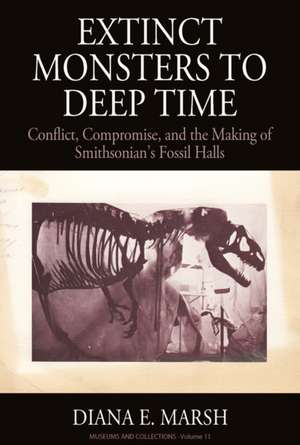
Extinct Monsters to Deep Time: Museums and Collections, cartea 11
Autor Diana E. Marshen Limba Engleză Paperback – 13 sep 2022
Din seria Museums and Collections
- 23%
 Preț: 758.83 lei
 -
 Preț: 158.96 lei
 -
 Preț: 184.88 lei
 -
 Preț: 231.48 lei
 -
 Preț: 253.17 lei
 - 23%
 Preț: 760.03 lei
 - 23%
 Preț: 758.15 lei
 -
 Preț: 266.39 lei
 - 23%
 Preț: 763.88 lei
 -
 Preț: 261.24 lei
 - 23%
 Preț: 762.38 lei
 - 23%
 Preț: 758.17 lei
 - 23%
 Preț: 758.97 lei
 -
 Preț: 263.60 lei
 - 23%
 Preț: 754.77 lei
 -
 Preț: 252.35 lei
 -
 Preț: 199.82 lei
Preț: 198.29 lei
Puncte Express: 297
Carte tipărită la comandă
Livrare economică 02-16 decembrie
Livrare prin curier în România Termenul estimat este afișat lângă disponibilitate.
Transport gratuit de la 400.00 lei Plată online sau ramburs, în funcție de opțiunile comenzii.
Retur gratuit în 14 zile Comandă securizată și suport în română.
Specificații
ISBN-13: 9781800732018
ISBN-10: 1800732015
Pagini: 334
Dimensiuni: 152 x 229 x 18 mm
Greutate: 0.49 kg
Editura: BERGHAHN BOOKS
Colecția Museums and Collections
Seria Museums and Collections
ISBN-10: 1800732015
Pagini: 334
Dimensiuni: 152 x 229 x 18 mm
Greutate: 0.49 kg
Editura: BERGHAHN BOOKS
Colecția Museums and Collections
Seria Museums and Collections
Notă biografică
Diana E. Marsh is an Assistant Professor of archives and digital curation at the University of Maryland's College of Information Studies (iSchool) who studies how heritage institutions share knowledge with communities and the public. Her current work focuses on improving discovery and access to colonially-held archives for Native American and Indigenous communities.
Cuprins
List of Illustrations and Table
Foreward
Jennifer Shannon
Prologue: Fieldnotes from the Badlands
Acknowledgments
List of Abbreviations
Chronology A: Lists of Relevant Leadership
Chronology B: Geologic Time Scale
Chronology C: Fossil Exhibits Timeline
Introduction
Chapter 1. Increase and Diffusion: Early Fossil Exhibits and a History of Institutional Culture
Chapter 2. Group Dynamics: Exhibit Meetings and Expertise
Chapter 3. Group Dynamics: The Roots of Team Frictions and Complementarities
Chapter 4. Content Development: Debates about Interconnected Processes and Static Things
Chapter 5. Content Development: The Roots of Interpretive Frictions and Complementarities
Chapter 6. Diffusion and Increase: Shifts in Institutional Culture from Modernization to Now
Chapter 7. Conclusion
Chapter 8. Coda: The Nation's T-rex
Appendix A: Consent Form
Appendix B: Interview Questionnaires
Sample Team Interview Questionnaire
Sample Oral History Interview Questionnaire
Glossary
Bibliography
Index
Foreward
Jennifer Shannon
Prologue: Fieldnotes from the Badlands
Acknowledgments
List of Abbreviations
Chronology A: Lists of Relevant Leadership
Chronology B: Geologic Time Scale
Chronology C: Fossil Exhibits Timeline
Introduction
Chapter 1. Increase and Diffusion: Early Fossil Exhibits and a History of Institutional Culture
Chapter 2. Group Dynamics: Exhibit Meetings and Expertise
Chapter 3. Group Dynamics: The Roots of Team Frictions and Complementarities
Chapter 4. Content Development: Debates about Interconnected Processes and Static Things
Chapter 5. Content Development: The Roots of Interpretive Frictions and Complementarities
Chapter 6. Diffusion and Increase: Shifts in Institutional Culture from Modernization to Now
Chapter 7. Conclusion
Chapter 8. Coda: The Nation's T-rex
Appendix A: Consent Form
Appendix B: Interview Questionnaires
Sample Team Interview Questionnaire
Sample Oral History Interview Questionnaire
Glossary
Bibliography
Index
Descriere
Descriere de la o altă ediție sau format:
From Extinct Monsters to Deep Time is an ethnography that documents the growing friction between the research and outreach functions of the museum in the 21st century.
From Extinct Monsters to Deep Time is an ethnography that documents the growing friction between the research and outreach functions of the museum in the 21st century.