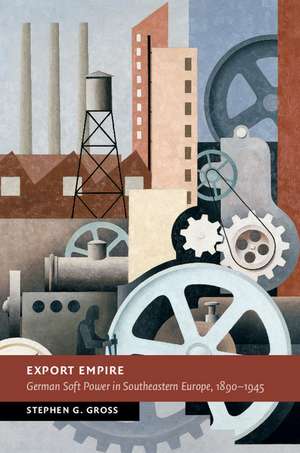
Export Empire
Autor Stephen G. Grossen Limba Engleză Hardback – 7 ian 2016
Preț: 788.60 lei
Preț vechi: 916.97 lei
-14%
Puncte Express: 1183
Carte tipărită la comandă
Livrare economică 16-30 noiembrie
Livrare prin curier în România Termenul estimat este afișat lângă disponibilitate.
Transport gratuit pentru acest produs Plată online sau ramburs, în funcție de opțiunile comenzii.
Retur gratuit în 14 zile Comandă securizată și suport în română.
Specificații
ISBN-13: 9781107112254
ISBN-10: 1107112257
Pagini: 402
Ilustrații: 5 b/w illus. 1 map 32 tables
Dimensiuni: 157 x 235 x 26 mm
Greutate: 0.73 kg
Editura: Cambridge University Press
Locul publicării:New York, United States
ISBN-10: 1107112257
Pagini: 402
Ilustrații: 5 b/w illus. 1 map 32 tables
Dimensiuni: 157 x 235 x 26 mm
Greutate: 0.73 kg
Editura: Cambridge University Press
Locul publicării:New York, United States
V-ar putea interesa
-
 Medicine Before ScienceRoger FrenchPreț: 352.24 lei
 -
 Camb Companion to Age of JustinianMichael MaasPreț: 380.79 lei
 -
 Revolution and ReactionAndrews MatthewsPreț: 186.39 lei
 -
 The Franco-Prussian WarGeoffrey WawroPreț: 211.00 lei
 -
 The Measure of RealityAlfred W. CrosbyPreț: 175.14 lei
 -
 Ancient RomeChristopher. S MackayPreț: 221.42 lei
 -
 The Forging of RacesColin KiddPreț: 200.10 lei
 -
 The LighthouseKeith MccloskeyPreț: 92.33 lei
 -
 Written in BloodPaul Adams-17%Preț: 111.56 lei134.77 lei
 -
 Paddy FinucaneDoug StokesPreț: 80.53 lei
 -
 The Blue ArenaBob SpurdlePreț: 70.81 lei
 -
 The Men Who Lost AmericaAndrew O'Shaughnessy-55%Preț: 125.72 lei276.76 lei
Cuprins
Introduction: the foundations of soft power and informal empire; Part I. German Power in the Wilhelmine Empire and the Weimar Republic: 1. The legacy of Wilhelmine imperialism and the First World War, 1890–1920; 2. The economics of trade: building commercial networks in southeastern Europe, 1925–30; 3. The culture of trade: cultural diplomacy and area studies in southeastern Europe, 1925–30; 4. The politics of trade: Paneuropa, Mitteleuropa, and the Great Depression, 1929–33; Part II. Nazi Imperialism: 5. Stabilising the Reichsmark bloc: commercial networks in the Third Reich, 1933–9; 6. Economic pioneers or missionaries of the Third Reich? Cultural diplomacy in southeastern Europe, 1933–9; 7. Forging a hinterland: German development aid in the Balkans, 1934–40; 8. The Second World War: informal empire transformed, 1939–45; Conclusion: imperialism realised?
Recenzii
'Overall, this is an extremely valuable book for economic historians as it underlines that the study of international trade and economic development cannot be separated from the broader power struggle during the period 1890–1945. In doing so, the book sheds light on the previously unknown mechanisms that contributed to the rise of German empire at the heart of Europe, a process which eventually led to the Second World War. In this regard, it is likely to remain a key reference work for years to come on German imperial and economic history.' A. Coşkun Tunçer, Economic History Review
'An absorbing portrait of German interest in Yugoslavia and Romania during the first half of the long twentieth century.' Patricia Clavin, The Journal of Modern History
'An absorbing portrait of German interest in Yugoslavia and Romania during the first half of the long twentieth century.' Patricia Clavin, The Journal of Modern History
Descriere
A major new interpretation of Nazi influence in southeastern Europe through the concepts of soft power and informal empire.