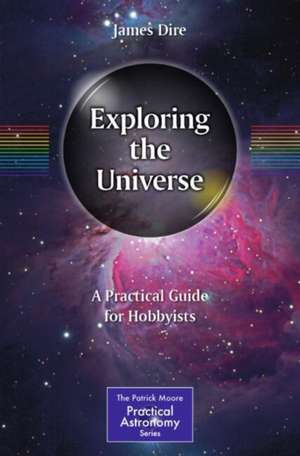
Exploring the Universe: The Patrick Moore Practical Astronomy Series
Autor James Direen Limba Engleză Paperback – 27 sep 2024
În peisajul educațional al astronomiei practice, Exploring the Universe se poziționează ca un instrument hibrid esențial, integrându-se perfect în bibliografia cursurilor introductive de observație cerească. Publicată în 2024 sub egida The Patrick Moore Practical Astronomy Series, lucrarea semnată de James Dire reușește să transforme teoria proceselor fizice universale într-o experiență vizuală palpabilă pentru studenți și amatori. Reținem că, spre deosebire de manualele care utilizează imagini de la telescoape spațiale precum Hubble sau James Webb, această ediție se bazează pe capturi realizate cu echipamente modeste, demonstrând ce poate obține un pasionat cu resurse accesibile. Structura este riguros organizată în 14 capitole care ghidează cititorul de la bazele tehnice — tipuri de telescoape, filtre și nomenclature cerească — până la explorarea profundă a obiectelor de cer profund. Merită menționat că progresia narativă este una logică: primele patru capitole pun bazele metodologice (astrofotografie și optică), în timp ce restul volumului oferă un tur ghidat prin sistemul solar și dincolo de el, abordând teme complexe precum nebuloasele planetare și roiurile globulare. Credem că valoarea adăugată rezidă în cele aproape 300 de ilustrații care însoțesc explicațiile despre lumină și materie. Ca alternativă la An Amateur's Guide to Observing and Imaging the Heavens pentru cursurile de astronomie practică, volumul lui James Dire are avantajul de a fi mai ancorat în realitatea tehnologică a anului 2024 și de a oferi o perspectivă pedagogică mai strâns legată de rezultatul vizual direct. În timp ce A Buyer's and User's Guide to Astronomical Telescopes and Binoculars se concentrează pe achiziție, Exploring the Universe face pasul următor, explicând nu doar cum să privești, ci și ce anume înțelegem din punct de vedere fizic prin acea observație.
Din seria The Patrick Moore Practical Astronomy Series
-
 Preț: 436.11 lei
 -
 Preț: 314.71 lei
 -
 Preț: 277.52 lei
 -
 Preț: 213.41 lei
 -
 Preț: 282.88 lei
 -
 Preț: 273.10 lei
 -
 Preț: 405.61 lei
 -
 Preț: 272.38 lei
 -
 Preț: 224.90 lei
 -
 Preț: 263.19 lei
 -
 Preț: 214.14 lei
 -
 Preț: 329.73 lei
 -
 Preț: 221.60 lei
 -
 Preț: 304.67 lei
 -
 Preț: 224.06 lei
 -
 Preț: 316.36 lei
 -
 Preț: 268.75 lei
 -
 Preț: 291.13 lei
 -
 Preț: 230.13 lei
 -
 Preț: 327.23 lei
 -
 Preț: 348.71 lei
 -
 Preț: 252.09 lei
 -
 Preț: 181.15 lei
 -
 Preț: 375.55 lei
 -
 Preț: 261.18 lei
 -
 Preț: 206.17 lei
 -
 Preț: 210.79 lei
 -
 Preț: 215.71 lei
 -
 Preț: 255.50 lei
 -
 Preț: 300.59 lei
 -
 Preț: 192.70 lei
 -
 Preț: 215.80 lei
 -
 Preț: 326.80 lei
 -
 Preț: 207.33 lei
 -
 Preț: 329.33 lei
 -
 Preț: 304.01 lei
 -
 Preț: 208.50 lei
 - 15%
 Preț: 676.73 lei
 -
 Preț: 349.34 lei
 -
 Preț: 242.32 lei
 -
 Preț: 302.01 lei
 -
 Preț: 150.27 lei
 -
 Preț: 267.37 lei
 -
 Preț: 280.62 lei
 -
 Preț: 254.09 lei
 -
 Preț: 317.82 lei
 -
 Preț: 284.03 lei
 -
 Preț: 304.84 lei
 -
 Preț: 213.61 lei
 -
 Preț: 326.80 lei
Preț: 355.22 lei
Carte tipărită la comandă
Livrare economică 26 noiembrie-02 decembrie
Specificații
ISBN-10: 3031653459
Pagini: 312
Ilustrații: Approx. 300 p. 289 illus., 144 illus. in color.
Dimensiuni: 155 x 235 x 13 mm
Greutate: 0.53 kg
Ediția:2024
Editura: Springer
Colecția The Patrick Moore Practical Astronomy Series
Seria The Patrick Moore Practical Astronomy Series
Locul publicării:Cham, Switzerland
V-ar putea interesa
-
 Northern LightsCollins AstronomyPreț: 74.36 lei
 -
 Unknown UniverseCollins AstronomyPreț: 126.50 lei
 -
 Webb's CosmosMarcin SawickiPreț: 350.72 lei
 -
 -15%Preț: 126.92 lei149.10 lei
 -
 -14%Preț: 251.02 lei293.43 leiRecomandat
 -
 -14%Preț: 129.98 lei151.59 lei
 -
 -28%Preț: 157.30 lei218.69 lei
 -
 Turn Left at OrionGuy ConsolmagnoPreț: 263.97 lei
 -
 The Astronomy HandbookWilliam PotterPreț: 50.44 lei
 -
 Imaging the Southern SkyStephen ChadwickPreț: 344.88 lei
 -
 Patrick Moore's Astronomy: A Complete Introduction: Teach YourselfSir Patrick Moore-27%Preț: 78.19 lei107.04 lei
 -
 101 Amazing Sights of the Night SkyGeorge MoromisatoPreț: 97.01 lei
 -
 AstronomyDinah L MochéPreț: 178.77 lei
 -
 TelescopesDalton RainsPreț: 51.85 lei
 -
 110 Things to See with a TelescopeJohn ReadPreț: 111.93 lei
 -
 Preț: 109.04 lei
 -
 Preț: 87.90 lei
 -
 Exploring the UniverseIsabel ThomasPreț: 143.50 lei
 -
 AstrophotographyThierry Legault-18%Preț: 288.31 lei352.00 lei
 -
 A Deep Sky Astrophotography PrimerMichael O'BrienPreț: 272.38 lei
De ce să citești această carte
Recomandăm această carte oricărui pasionat care dorește să treacă de la simpla observare la înțelegerea fenomenelor cosmice. Cititorul câștigă o bază solidă de cunoștințe teoretice susținută de exemple practice de astrofotografie realizabile cu echipamente proprii. Este un ghid complet care elimină bariera dintre amatorism și rigoarea științifică, oferind claritate asupra modului în care lumina și materia interacționează pentru a forma spectacolul nocturn.
Despre autor
James Dire este un reputat profesor de astronomie cu o carieră academică îndelungată, dar și un astronom amator pasionat, deținător al unui arsenal variat de telescoape mici optimizate pentru imagistica CCD. Expertiza sa dublă îi permite să traducă concepte astrofizice complexe într-un limbaj accesibil, adaptat comunității de observatori. Prin activitatea sa în cadrul The Patrick Moore Practical Astronomy Series la editura Springer, Dire a devenit o voce de referință în educarea noilor generații de astronomi, promovând ideea că explorarea universului nu necesită acces la observatoare de pe vârfuri de munte, ci doar curiozitate și echipament corect utilizat.
Descriere scurtă
The author is both a career astronomy professor and an avid amateur astronomer who owns an arsenal of small telescopes for observing and conducting CCD imaging. The author’s descriptions are at a level any reader can follow. Using his own images, mostly taken with smaller telescopes as opposed to Hubble, James Webb, or multi-meter mountain top observatories, show amateur astronomers and hobbyists what can be accomplished by using modest and affordable equipment. The book begins with a primer on telescopes and the myriad types on the market today. You'll read about why there are so many models as well as the advantages and disadvantages of each. This is followed by an introduction to astrophotography, a complete description of paper and digital start atlases available today, and a discussion on celestial nomenclature – why are celestial objects named what they are named! You'll learn about light, and how it interacts with matter to create what we see in the night sky. Finally, you'll go on a grand tour of the Universe, from the Moon and Sun to comets, nebulae, star clusters and galaxies.