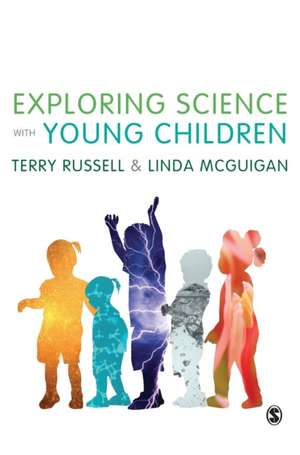
Exploring Science with Young Children
Autor Terry Russell, Linda McGuiganen Limba Engleză Hardback – 15 mar 2016
Science in the early years is about more than developing understanding of key scientific concepts, it is about encouraging imagination, creativity and curiosity and nurturing key scientific skills to form a firm base for learning. Understanding how best to do this for young children aged 3-7 is the focus of the book.
By concentrating on practical and naturally occurring experiences the authors look at meeting the needs of the curriculum with children at the centre of their own learning.
Chapters look at how to work with children to:
- Find out and develop their own ideas
- Get them inquiring scientifically
- Use evidence to support their views
Preț: 894.57 lei
Preț vechi: 1225.44 lei
-27%
Carte tipărită la comandă
Livrare economică 07-21 decembrie
Specificații
ISBN-10: 1473912504
Pagini: 208
Dimensiuni: 175 x 250 x 16 mm
Greutate: 0.5 kg
Ediția:First Edition
Editura: SAGE Publications
Locul publicării:London, United Kingdom
V-ar putea interesa
-
 Exploring Play for Early Childhood StudiesMandy AndrewsPreț: 270.74 lei
 -
 The Reflective Early Years PractitionerElaine HalletPreț: 356.72 lei
 -
 Gifted and Talented in the Early YearsMargaret SutherlandPreț: 397.14 lei
 -
 Preț: 361.14 lei
 -
 Preț: 387.77 lei
 -
 Contemporary Issues in the Early YearsGillian PughPreț: 331.24 lei
 -
 Preț: 273.84 lei
Recenzii
It has been very rewarding reading this book. It has provoked some new thinking on my part, and consolidated some existing ideas. I am sure many readers will also gain so much from reading it.
This is a super book which will be useful for practitioners working with children in the Early Years, but also useful for Primary teachers and science co-ordinators looking to develop their understanding of how science can be explored with young children.
The text is very accessible; theory is integrated well into the text and fully explained, with ample opportunities throughout for the reader to pause and reflect on what they have read and consider how it relates to their own practice or the practice discussed in the text. The 'Pauses for thought' and 'Reflection' boxes were ideally placed to facilitate this.
The photographs and samples of children's work throughout, again provided ideal opportunities for reflection on practice in the early years setting
Science has been explored in a holistic manner in the book and I very much liked how the subject is seen as an integral part of the early years classroom and also an essential part of children's development
It is clear that the authors have a wealth of experience and knowledge in the field and although the territory has been covered by many such texts over the years, the book presents key theories, approaches and advice in a readable an up-to-date way.
A text that could prove itself to be very useful to anyone concerned with the exploration and development of the science understandings of young people (age range: 3–7 years). The information provided, combines current theory with practice and is based on up-to date research and the authors’ extensive background knowledge and experience. It would be an excellent addition to the library of anyone concerned with the science education of children in the early years.
Cuprins
CHAPTER 2: The Nature of Early Years Science
CHAPTER 3: Finding Out Children's Ideas
CHAPTER 4: Developing Conceptual Understanding in Science
CHAPTER 5: Working Scientifically and Developing Science Inquiry Skills
CHAPTER 6: Encouraging the Expression of Ideas
CHAPTER 7: The Uses of Technology to Support Learning
CHAPTER 8: Planning, Assessment and Record Keeping
Notă biografică
Terry Russell is emeritus professor at the University of Liverpool. He is a psychologist by background and training with a special interest in cognitive development as applied to the learning of science at all ages, but especially the younger age range. He taught in primary and secondary special needs schools and worked as an educational psychologist before finding opportunities into move into research. He has worked in Southeast Asia and Africa and at King's College, London and directed the Centre for Research in Primary Science and Technology at the University of Liverpool for over twenty years. He has directed national and international projects and published extensively. This book reflects his commitment to evidence-based activity that improves teachers' and pupils' educational experiences, where theory informs practice through practical and accessible applications.