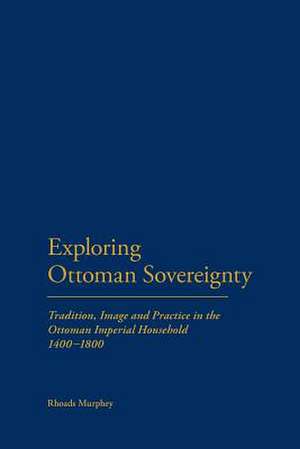
Exploring Ottoman Sovereignty: Tradition, Image and Practice in the Ottoman Imperial Household, 1400-1800
Autor Dr Rhoads Murpheyen Limba Engleză Paperback – 20 oct 2011
Sovereignty was attached to the person of the sultan who moved (with his court) both often and for prolonged stays away from his principal residence. In the period between 1360 and 1453 there were dual capitals at Bursa and Edirne (Adrianople) and even after 1453 several Ottoman sultans showed a preference for Edirne over Istanbul. Even Sultan Suleyman the Magnificent - held by the Ottomans, western contemporaries and modern analysts alike to be the pinnacle and paragon of Ottoman kingship - spent far more time away from his residence at the Topkapi Palace than in it. This book explores the growing complexity of the empire as it absorbed cultural influences and imperial legacies from a wide diversity of sources each in turn engendering a further interpretation of existing notions of kingship and definitions of the role and function of the ruler.
Preț: 340.25 lei
Preț vechi: 381.96 lei
-11%
Puncte Express: 510
Carte tipărită la comandă
Livrare economică 07-21 decembrie
Livrare prin curier în România Termenul estimat este afișat lângă disponibilitate.
Transport gratuit de la 400.00 lei Plată online sau ramburs, în funcție de opțiunile comenzii.
Retur gratuit în 14 zile Comandă securizată și suport în română.
Specificații
ISBN-13: 9781441120083
ISBN-10: 1441120084
Pagini: 370
Ilustrații: black & white illustrations
Dimensiuni: 154 x 232 x 22 mm
Greutate: 0.52 kg
Editura: Bloomsbury Publishing
Colecția Continuum
Locul publicării:London, United Kingdom
ISBN-10: 1441120084
Pagini: 370
Ilustrații: black & white illustrations
Dimensiuni: 154 x 232 x 22 mm
Greutate: 0.52 kg
Editura: Bloomsbury Publishing
Colecția Continuum
Locul publicării:London, United Kingdom
V-ar putea interesa
-
 -31%Preț: 787.55 lei1145.49 lei
 -
 -19%Preț: 105.47 lei129.56 lei
 -
 -30%Preț: 929.43 lei1331.27 lei
 -
 Iran: A Very Short IntroductionAli Ansari-20%Preț: 56.69 lei70.53 lei
 -
 Preț: 390.48 lei
 -
 Jews and Islamic Law in Early 20th-Century YemenMark S WagnerPreț: 191.55 lei
 -
 GenesisJohn B. JudisPreț: 187.05 lei
 -
 CuneiformIrving Finkel-17%Preț: 77.97 lei94.17 lei
 -
 Preț: 209.81 lei
 -
 Attlee's Great ContemporariesFrank Field-39%Preț: 106.85 lei176.47 lei
 -
 Antarctic Destinies: Scott, Shackleton, and the Changing Face of HeroismStephanie Barczewski-40%Preț: 148.93 lei246.90 lei
 -
 Suicide of the WestRichard Koch-38%Preț: 241.59 lei388.14 lei
 -
 Sir Walter Raleigh: In Life and LegendDr Mark Nicholls-40%Preț: 309.61 lei515.35 lei
 -
 The Tudors: History of a DynastyDavid Loades-38%Preț: 235.82 lei378.64 lei
 -
 -25%Preț: 76.28 lei101.40 lei
 -
 Preț: 79.58 lei
 -
 Mamluk ‘Askari 1250–1517Dr David Nicolle-32%Preț: 77.62 lei114.43 lei
 -
 Egypt`s African Empire – Samuel Baker, Charles Gordon & the Creation of EquatoriaDr Alice Moore–harellPreț: 375.93 lei
 -
 Cardinal Wolsey: A Life in Renaissance EuropeDr Stella Fletcher-41%Preț: 304.20 lei512.53 lei
 -
 -37%Preț: 858.09 lei1362.28 lei
 -
 Revolt in SyriaStephen Starr-16%Preț: 102.41 lei122.58 lei
Cuprins
Maps, Dynastic, Genealogical and Chronological Charts
Introduction
1. Dynastic Origins: Medieval Inheritances and Major Influences on Ottoman Concepts of Sovereignty
2. Dynastic Identity: Ottoman Political Values and the Quest for an Imperial Identity in the Proto-Imperial Era, 1300-1450
3. Dynastic Image: An Investigation of the Ottoman's Use of Titulature in Coins and Chancellery Documents
4. The Dynasty as Family Enterprise: Sibling Rivalry, Struggles for Succession to the Throne and Incipient Creation of the 'Political Household'
5. Consolidation of the Political Household in the Immediate Post Accession Phase of Rule
6. Formation of the Wider Palace Household: A People-centered Glimpse at the Institution of the Sultanate and an Account of the Composition, Growth and Development of the Imperial Administrative Corps, ca. 1470 to ca. 1670
7. Celebrating the Coming of Age of an Ottoman Prince: Exclusivity versus Inclusiveness in Ottoman Court Ceremonial
Introduction
1. Dynastic Origins: Medieval Inheritances and Major Influences on Ottoman Concepts of Sovereignty
2. Dynastic Identity: Ottoman Political Values and the Quest for an Imperial Identity in the Proto-Imperial Era, 1300-1450
3. Dynastic Image: An Investigation of the Ottoman's Use of Titulature in Coins and Chancellery Documents
4. The Dynasty as Family Enterprise: Sibling Rivalry, Struggles for Succession to the Throne and Incipient Creation of the 'Political Household'
5. Consolidation of the Political Household in the Immediate Post Accession Phase of Rule
6. Formation of the Wider Palace Household: A People-centered Glimpse at the Institution of the Sultanate and an Account of the Composition, Growth and Development of the Imperial Administrative Corps, ca. 1470 to ca. 1670
7. Celebrating the Coming of Age of an Ottoman Prince: Exclusivity versus Inclusiveness in Ottoman Court Ceremonial
Recenzii
Mention -Book News, February 2009
'This book is a lively political anthropology of Ottoman sovereignty, an account of the rituals, ceremonies, and projection of the sultans' power over the period 1480-1820.'
'This book is a lively political anthropology of Ottoman sovereignty, an account of the rituals, ceremonies, and projection of the sultans' power over the period 1480-1820.'