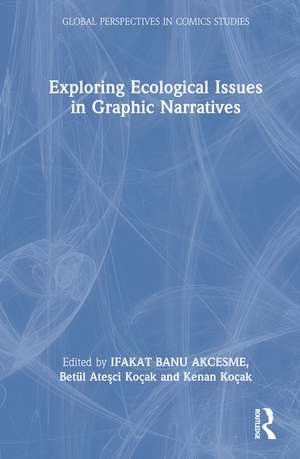
Exploring Ecological Issues in Graphic Narratives: Global Perspectives in Comics Studies
Editat de İfakat Banu Akçesme, Betül Ateşci Koçak, Kenan Koçaken Limba Engleză Hardback – 11 sep 2026
While ecocriticism has expanded significantly, this book largely focuses on canonical prose, overlooking the multimodal and spatial possibilities of graphic narratives. It critically engages with the Anthropocene, highlighting the deep connections between environmental degradation and colonialism, capitalism, caste oppression, and gendered exploitation. Through global case studies—including Indigenous resistance in Canada’s oil sands, Dalit environmental aesthetics in India, Japanese eco-dystopian manga, and urban human-animal reconfigurations—it explores how graphic narratives depict “slow violence,” express nonhuman agency, and challenge anthropocentric binaries.
Part of the Global Perspectives in Comics Studies series, this book addresses the multilingual dimensions of the comics medium, often overlooked in ecocriticism, making it a valuable resource for scholars and enthusiasts alike. With its international scope, it will appeal to academics, students, activists, artists, educators, policy-makers, and graphic novel enthusiasts exploring ecological issues, environmental justice, and the interdisciplinary potential of graphic narratives, particularly in regions where comics and graphic novels thrive.




Preț: 1406.26 lei
Preț vechi: 1757.82 lei
-20% Nou
Puncte Express: 2109
Carte tipărită la comandă
Livrare economică 30 noiembrie-14 decembrie
Livrare prin curier în România Termenul estimat este afișat lângă disponibilitate.
Transport gratuit pentru acest produs Plată online sau ramburs, în funcție de opțiunile comenzii.
Retur gratuit în 14 zile Comandă securizată și suport în română.
Specificații
ISBN-13: 9781041303053
ISBN-10: 104130305X
Pagini: 208
Ilustrații: 30
Dimensiuni: 156 x 234 mm
Greutate: 0.54 kg
Ediția:1
Editura: Taylor & Francis
Colecția Routledge
Seria Global Perspectives in Comics Studies
Locul publicării:Oxford, United Kingdom
ISBN-10: 104130305X
Pagini: 208
Ilustrații: 30
Dimensiuni: 156 x 234 mm
Greutate: 0.54 kg
Ediția:1
Editura: Taylor & Francis
Colecția Routledge
Seria Global Perspectives in Comics Studies
Locul publicării:Oxford, United Kingdom
Public țintă
General and PostgraduateCuprins
Lists of figures. List of contributors. Series Preface. Introduction 1. Ecological Art Practice and Cultural Ecology in/of Bhimayana: Incidents in the Life of Bhimrao Ramji Ambedkar (2011) 2. Postcolonial Ecocriticism in Joe Sacco’s Paying the Land 3. Ecology & Memory – Hayao Miyazaki’s Nausicaä and Gébé’s L’an 01 as case studies 4. An Ecofeminist Analysis of Kate Beaton’s Ducks 5. Humanised Environments for Dehumanised Humans in Yūichi Yokoyama’s Travel 6. Unsettling the Space: Spatiality and Human/Animal Dualism in Shaun Tan’s Tales from the Inner City (2018) 7. “The Green is Dying”: A Study of Ecological Dystopia in Appupen’s Graphic Novel, The Snake and The Lotus 8. To See a World in a Drop of Water: Children of the Sea and a Biosemiotic Narrative of Affective Attunement. Index
Notă biografică
İfakat Banu Akçesme is Professor of English Language and Literature at Erciyes University, Kayseri, Türkiye. She received her BA in English Language Teaching from Dokuz Eylul University (2000) and her MA in English Language and Literature from Erciyes University (2003). She completed her PhD in English Literature at METU in 2010. Her research interests include modern and postmodern fiction, feminism, gender studies, and ecocriticism.
Betül Ateşci Koçak earned her BA in American Culture and Literature from Istanbul University in 2006. She subsequently completed her MA and PhD in Advanced English Studies: Languages and Cultures in Contact at the University of Salamanca, Spain. She is currently an assistant professor in the Department of English Language and Literature at Erciyes University, Kayseri, Türkiye. Her research interests include women’s studies, American literature, migration studies, and film studies.
Kenan Koçak completed his BA in English Language and Literature at Ankara University in 2007. He earned his MA in Modern and Contemporary Literature, Culture, and Thought from the University of Sussex in 2010, followed by a PhD in Comparative Literature from the University of Glasgow in 2015. He is currently an associate professor in the Department of English Language and Literature at Erciyes University, Kayseri, Türkiye. His research interests include comics and visual narratives, travel writing, and Turkish cultural and visual history.
Betül Ateşci Koçak earned her BA in American Culture and Literature from Istanbul University in 2006. She subsequently completed her MA and PhD in Advanced English Studies: Languages and Cultures in Contact at the University of Salamanca, Spain. She is currently an assistant professor in the Department of English Language and Literature at Erciyes University, Kayseri, Türkiye. Her research interests include women’s studies, American literature, migration studies, and film studies.
Kenan Koçak completed his BA in English Language and Literature at Ankara University in 2007. He earned his MA in Modern and Contemporary Literature, Culture, and Thought from the University of Sussex in 2010, followed by a PhD in Comparative Literature from the University of Glasgow in 2015. He is currently an associate professor in the Department of English Language and Literature at Erciyes University, Kayseri, Türkiye. His research interests include comics and visual narratives, travel writing, and Turkish cultural and visual history.
Descriere
This book positions graphic storytelling at the intersection of ecocriticism, environmental justice, and Comics Studies. It argues that ecological catastrophe is not only a scientific or policy crisis but also a crisis of representation, set against the backdrop of climate change, biodiversity loss, and systemic environmental inequity.