
Exploring Cognitive Grammar in English
Autor Dr Zeki Hamawanden Limba Engleză Hardback – 10 ian 2026
În cadrul programelor de studii filologice superioare, studiul gramaticii a evoluat dincolo de simpla memorare a regulilor, orientându-se către înțelegerea modului în care mintea noastră structurează realitatea. Exploring Cognitive Grammar in English se încadrează precis în această paradigmă, oferind studenților un instrument de lucru care transformă teoria abstractă în analiză aplicată. Considerăm că forța acestui volum rezidă în capacitatea Dr Zeki Hamawand de a demistifica sintaxa cognitivă, prezentând limba nu ca un set arbitrar de semne, ci ca o reflexie a experiențelor noastre socio-culturale și mentale.
Structura cursului este riguros eșalonată în patru părți. Primele secțiuni pun bazele organizării semantice, în timp ce ultimele segmente explorează complexitatea relațiilor temporale în propoziții compuse și fraze. Această progresie logică permite o înțelegere profundă a modului în care unitățile gramaticale — de la prepoziții și gerunziu până la structuri sintactice complexe — sunt modelate de procese cognitive precum focalizarea sau perspectiva. Această lucrare continuă direcția stabilită de autor în English Lexical Semantics și Morphology in English, unde Dr Zeki Hamawand a demonstrat deja eficiența aplicării lingvisticii cognitive în studiul sensului cuvintelor și al formării acestora.
Din punct de vedere comparativ, Exploring Cognitive Grammar in English completează perspectiva teoretică oferită de lucrarea fundamentală Cognitive Grammar de Ronald Langacker. În timp ce textul lui Langacker rămâne reperul teoretic dens pentru fundamentarea disciplinei, volumul de față adaugă o componentă didactică esențială prin exercițiile și instrumentele analitice menite să faciliteze tranziția către analiza de text. De asemenea, spre deosebire de Cognitive Grammar in Stylistics de Dr Marcello Giovanelli, care se concentrează pe aplicarea acestor principii în analiza literară, lucrarea lui Hamawand rămâne ancorată în descrierea sistematică a structurilor fundamentale ale limbii engleze contemporane.
Preț: 564.41 lei
Preț vechi: 750.98 lei
-25%
Carte disponibilă
Livrare economică 15-29 mai
Specificații
ISBN-10: 1350567086
Pagini: 416
Dimensiuni: 156 x 234 mm
Editura: Bloomsbury Publishing
Colecția Bloomsbury Academic
Locul publicării:London, United Kingdom
V-ar putea interesa
-
 -25%Preț: 263.35 lei350.70 lei
 -
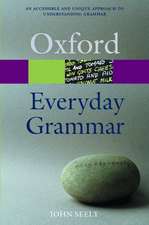 Everyday GrammarJohn Seely-21%Preț: 69.51 lei88.07 lei
 -
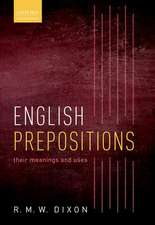 English Prepositions: Their Meanings and UsesR. M. W. Dixon-11%Preț: 328.67 lei369.65 lei
 -
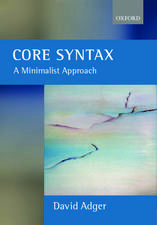 Core Syntax: A Minimalist ApproachDavid Adger-12%Preț: 245.01 lei279.41 lei
 -
 Preț: 59.26 lei
 -
 Essential Portuguese GrammarAlexander Da R. Prista-21%Preț: 45.73 lei57.73 lei
 -
 Grammar for English Language TeachersMartin ParrottPreț: 330.88 lei
 -
 Preț: 362.83 lei
 -
 Chinese Grammar Q&AZhu Dexi-15%Preț: 416.69 lei490.23 lei
 -
 Understanding Sentence StructureChristina TortoraPreț: 366.60 lei
 -
 English Syntax and ArgumentationBas Aarts-19%Preț: 203.61 lei252.85 lei
 -
 Cognitive Grammar in Stylistics: A Practical GuideDr Marcello Giovanelli-20%Preț: 199.26 lei250.04 lei
 -
 -17%Preț: 173.64 lei209.72 lei
 -
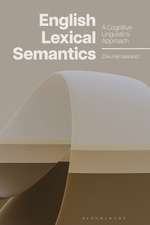 English Lexical Semantics: A Cognitive Linguistics ApproachDr Zeki Hamawand-18%Preț: 191.66 lei233.08 lei
 -
 Basic English Grammar for DummiesGeraldine WoodsPreț: 112.39 lei
 -
 The Truth about English GrammarGeoffrey K. PullumPreț: 131.91 lei
 -
 -22%Preț: 352.81 lei452.09 lei
 -
 Compendium of Cognitive Linguistics: Volume 3Thomas Fuyin Li-30%Preț: 1118.52 lei1603.86 lei
 -
 Cognitive English GrammarGunter RaddenPreț: 236.92 lei
De ce să citești această carte
Recomandăm această carte studenților și cercetătorilor care doresc să depășească abordările formale ale gramaticii. Prin parcurgerea volumului, cititorul câștigă capacitatea de a analiza structurile limbii engleze ca procese mentale vii. Este o resursă esențială pentru cei care vor să înțeleagă legătura indisolubilă dintre sintaxă, context cultural și cogniție, oferind în același timp exerciții practice pentru consolidarea tehnicilor de interpretare lingvistică.
Descriere
The author delves into the fundamental concepts of cognitive grammar, such as conceptual semantics and construal, and analyses various aspects of language structure, including simple and complex temporal and atemporal relations. He offers an in-depth exploration of how language structure is shaped by our cognitive processes, investigating how language reflects general aspects of cognition and is influenced by our mental and sociocultural experiences. As well as engaging with examples and exercises that reinforce key concepts and encourage critical thinking, this comprehensive guide:
· explains the principles of cognitive grammar and how they are applied to understand language structure and meaning
· familiarises students with key concepts in cognitive grammar
· introduces the theories behind language cognition
· elaborates on principles for effective analysis of grammatical structures
· equips students with the tools to analyse language structures and understand the techniques used to interpret them.
Exploring Cognitive Grammar in English is an essential resource for mastering cognitive grammar, offering students a comprehensive and practical guide to understanding the cognitive underpinnings of language.
Cuprins
1. Grammatical Organisation
2. Semantic Organisation
Part II: Grammatical Classes: Things
3. Nouns
4. Noun Phrases
Part III: Relations: Atemporal Relations
5. Simple Atemporal Relations: Adjectives, Adverbs, Prepositions
6. Simple Atemporal Relations: Gerunds, Participles, Infinitives
Part IV: Relations: Temporal Relations
7. Simple Temporal Relations: Verbs
8. Simple Temporal Relations: Verb Phrases
9. Simple Temporal Relations: Simple Sentences
10. Complex Temporal Relations: Compound Sentences
11. Complex Temporal Relations: Correlative Sentences
12. Complex Temporal Relations: Complex Sentences
Final Thoughts
References
Index