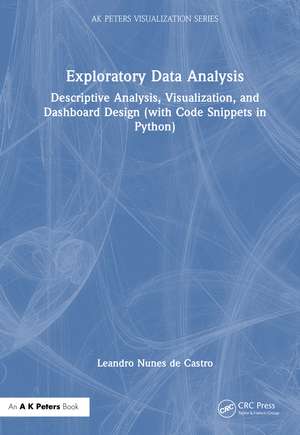
Exploratory Data Analysis: Descriptive Analysis, Visualization, and Dashboard Design (with Code Snippets in Python): AK Peters Visualization Series
Autor Leandro Nunes de Castroen Limba Engleză Hardback – 6 noi 2025
Din seria AK Peters Visualization Series
- 20%
 Preț: 350.13 lei
 - 20%
 Preț: 211.32 lei
 - 20%
 Preț: 207.28 lei
 - 20%
 Preț: 358.90 lei
 - 20%
 Preț: 217.25 lei
 - 20%
 Preț: 574.27 lei
 -
 Preț: 468.26 lei
 - 20%
 Preț: 359.97 lei
 - 20%
 Preț: 385.01 lei
 - 20%
 Preț: 487.33 lei
 - 20%
 Preț: 371.21 lei
 - 8%
 Preț: 430.18 lei
 - 20%
 Preț: 379.16 lei
 - 31%
 Preț: 920.80 lei
 - 30%
 Preț: 929.24 lei
 - 32%
 Preț: 256.42 lei
Preț: 1085.00 lei
Preț vechi: 1356.25 lei
-20%
Puncte Express: 1628
Carte indisponibilă temporar
Livrare prin curier în România Termenul estimat este afișat lângă disponibilitate.
Transport gratuit pentru acest produs Plată online sau ramburs, în funcție de opțiunile comenzii.
Retur gratuit în 14 zile Comandă securizată și suport în română.
Specificații
ISBN-13: 9781032944302
ISBN-10: 1032944307
Pagini: 350
Ilustrații: 182
Dimensiuni: 178 x 254 mm
Greutate: 0.82 kg
Ediția:1
Editura: CRC Press
Colecția A K Peters/CRC Press
Seria AK Peters Visualization Series
ISBN-10: 1032944307
Pagini: 350
Ilustrații: 182
Dimensiuni: 178 x 254 mm
Greutate: 0.82 kg
Ediția:1
Editura: CRC Press
Colecția A K Peters/CRC Press
Seria AK Peters Visualization Series
V-ar putea interesa
-
 Data Science and Big Data AnalyticsEmc Education Services-20%Preț: 405.57 lei506.97 lei
 -
 Preț: 314.69 lei
 -
 Python for Data Science For DummiesJohn Paul Mueller-20%Preț: 180.04 lei225.05 lei
 -
 Visualize ThisNathan Yau-20%Preț: 233.34 lei291.67 lei
 -
 Data Analytics & Visualization All-in-One For DummiesJack A. HymanPreț: 307.59 lei
 -
 Storytelling with DataCole Nussbaumer KnaflicPreț: 250.36 lei
 -
 The Data Hero PlaybookMalcolm HawkerPreț: 202.67 lei
 -
 Statistical Analysis with Python For DummiesJoseph SchmullerPreț: 197.44 lei
 -
 The Book of RTilman M. Davies-34%Preț: 311.42 lei473.44 lei
 -
 Data Storytelling with Altair and AIAngelica Lo Duca-20%Preț: 291.60 lei364.49 lei
 -
 The Book of Dash: Build Dashboards with Python and PlotlyChristian Mayer-36%Preț: 177.47 lei279.28 lei
 -
 -34%Preț: 291.41 lei444.24 lei
 -
 Python for Excel Users: Know Excel? You Can Learn PythonTracy Stephens-35%Preț: 238.55 lei369.12 lei
 -
 PythonMartin Czygan-23%Preț: 644.95 lei837.61 lei
 -
 The Data Science Design ManualSteven S. Skiena-20%Preț: 417.78 lei522.22 lei
 -
 Business Analytics with R and PythonDavid L. Olson-20%Preț: 433.90 lei542.38 lei
 -
 Multivariate Analysis and Machine Learning TechniquesSrikrishnan Sundararajan-20%Preț: 569.31 lei711.63 lei
 -
 Visual Analytics for DashboardsArshad Khan-20%Preț: 163.70 lei204.63 lei
 -
 Data Insight FoundationsNikita Tkachenko-20%Preț: 209.75 lei262.18 lei
Public țintă
Academic, Postgraduate, Professional Practice & Development, and Undergraduate AdvancedRecenzii
"With the ever-growing masses of data and their inherent diversity encountered, Professor’s Leandro Nunes de Castro book is an excellent and timely contribution to the body of knowledge of Exploratory Data Analysis (EDA). This treatise, written in an authoritative and lucid way, navigates the audience through a systematic process of EDA by starting from data description, progressing through their descriptive analysis, data visualization, and culminating in storytelling design."
--Witold Pedrycz, Professor and Canada Research Chair (CRC), University of Alberta, Canada
--Witold Pedrycz, Professor and Canada Research Chair (CRC), University of Alberta, Canada
Notă biografică
Leandro Nunes de Castro is an Electrical Engineer by the Federal University of Goiás (1996), holds a Master’s degree in Electrical Engineering (1998) and a Ph.D. in Computer Engineering (2001), both from Unicamp, Brazil. He also has an MBA in Strategic Business Management from the Catholic University of Santos (2008). He was a Research Associate at the Computing Laboratory of the University of Kent in Canterbury from June 2001 to May 2002, a Visiting Professor at the Technological University of Malaysia in September 2005, a Visiting Specialist Professor at Unicamp between March and June 2012, and a Visiting Researcher at the University of Salamanca between January and July 2014. Leandro was a professor and researcher with the Master’s Program in Informatics at Unisantos from 2003 to 2008, and a professor and researcher with the Graduate Program in Electrical Engineering and Computing at Mackenzie Presbyterian University from 2008 to 2022. His main lines of research are Natural Computing and Machine Learning, with applications in Intelligent Data Analysis and Optimization. Leandro N. de Castro is the main author of the book “Artificial Immune Systems: A New Computational Intelligence Approach” (Springer-Verlag, 2002); one of the organizers of “Recent Developments in Biologically Inspired Computing” (Idea Group Publishing, 2004); author of “Fundamentals of Natural Computing: Basic Concepts, Algorithms, and Applications” (CRC Press, 2006), author of the book “Natural Computing: An Illustrated Journey” (Livraria da Física, 2010), organizer of the book “Nature-Inspired Computing Design, Development, and Application” (IGI-Global, 2012) and main author of the book “Introduction to Data Mining: Basic Concepts, Algorithms and Applications” (In Portuguese, Saraiva, 2016). He was the proponent and Editor-in-Chief of the International Journal of Natural Computing Research (IJNCR) between 2010 and 2015, published by IGI-Global. His research work has been recognized globally since 2020 as among the 2% most influential researchers in the world based on scientific impact indices monitored by PLoS Biology. Leandro has published over 250 papers in journals and conferences. His scholarly contributions also include founding two research laboratories and serving as Research Chair and as the Chief Innovation and Entrepreneurship Officer at Mackenzie. In addition to his academic achievements, Leandro is also a successful entrepreneur. He has participated in the founding of three Artificial Intelligence startups and invested, as an angel investor, in other three. Some of the notable startups he has been involved with include Tuilux, a company that offered intelligent recommendation services to e-commerce, and Somma.ai, a low/no code data science platform that allows the building of highly complex analytical applications without having to program. Currently, Leandro is a Full Professor at the Florida Gulf Coast University (FGCU) in the Department of Computing & Software Engineering, US, and the Director of DENDRITIC: A Human-Centered Artificial Intelligence and Data Science Institute at FGCU.
Cuprins
Preface. Acknowledgements. About the Author. Chapter 1. An Introduction to Exploratory Data Analysis. Chapter 2. Data Description and Preparation. Chapter 3. Descriptive Analysis. Chapter 4. Principles of Data Visualization. Chapter 5. Data Visualization Methods. Chapter 6. Special Types of Data. Chapter 7. Data Storytelling and Dashboard Design. Appendices.
Descriere
The book explores real-world datasets, uncovering hidden patterns and gaining insights along the way. The book is filled with illustrations using practical examples, Python codes, and different types of exercises designed to reinforce the concepts and processes discussed.