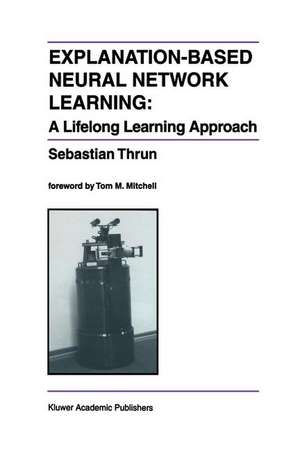
Explanation-Based Neural Network Learning: The Springer International Series in Engineering and Computer Science, cartea 357
Autor Sebastian Thrunen Limba Engleză Paperback – 17 oct 2011
`The paradigm of lifelong learning - using earlier learned knowledge to improve subsequent learning - is a promising direction for a new generation of machine learning algorithms. Given the need for more accurate learning methods, it is difficult to imagine a future for machine learning that does not include this paradigm.'
From the Foreword by Tom M. Mitchell.
Din seria The Springer International Series in Engineering and Computer Science
- 18%
 Preț: 1263.85 lei
 - 18%
 Preț: 921.36 lei
 - 20%
 Preț: 633.65 lei
 - 20%
 Preț: 665.64 lei
 - 20%
 Preț: 662.69 lei
 - 24%
 Preț: 876.97 lei
 - 20%
 Preț: 663.58 lei
 - 20%
 Preț: 950.07 lei
 - 20%
 Preț: 665.12 lei
 - 18%
 Preț: 903.90 lei
 - 20%
 Preț: 950.72 lei
 - 18%
 Preț: 985.84 lei
 - 15%
 Preț: 621.23 lei
 - 18%
 Preț: 979.41 lei
 - 18%
 Preț: 907.54 lei
 - 18%
 Preț: 1173.85 lei
 - 15%
 Preț: 663.24 lei
 - 18%
 Preț: 976.26 lei
 - 18%
 Preț: 904.83 lei
 - 18%
 Preț: 904.83 lei
 - 20%
 Preț: 1325.05 lei
 - 20%
 Preț: 1725.82 lei
 - 20%
 Preț: 1326.15 lei
 - 20%
 Preț: 989.14 lei
 -
 Preț: 381.30 lei
 - 20%
 Preț: 635.71 lei
 - 18%
 Preț: 1193.58 lei
 - 20%
 Preț: 622.65 lei
 - 20%
 Preț: 1319.14 lei
 - 18%
 Preț: 974.15 lei
 - 20%
 Preț: 670.15 lei
 - 15%
 Preț: 664.58 lei
 - 18%
 Preț: 1179.97 lei
 - 15%
 Preț: 670.25 lei
 - 15%
 Preț: 663.36 lei
 - 20%
 Preț: 620.83 lei
 - 18%
 Preț: 990.04 lei
 - 15%
 Preț: 660.75 lei
 - 18%
 Preț: 1266.48 lei
Preț: 990.60 lei
Preț vechi: 1238.25 lei
-20%
Puncte Express: 1486
Carte tipărită la comandă
Livrare economică 30 noiembrie-14 decembrie
Livrare prin curier în România Termenul estimat este afișat lângă disponibilitate.
Transport gratuit pentru acest produs Plată online sau ramburs, în funcție de opțiunile comenzii.
Retur gratuit în 14 zile Comandă securizată și suport în română.
Specificații
ISBN-13: 9781461285977
ISBN-10: 1461285976
Pagini: 284
Ilustrații: XVI, 264 p.
Dimensiuni: 155 x 235 x 16 mm
Greutate: 0.44 kg
Ediția:Softcover reprint of the original 1st ed. 1996
Editura: Springer
Colecția The Springer International Series in Engineering and Computer Science
Seria The Springer International Series in Engineering and Computer Science
Locul publicării:New York, NY, United States
ISBN-10: 1461285976
Pagini: 284
Ilustrații: XVI, 264 p.
Dimensiuni: 155 x 235 x 16 mm
Greutate: 0.44 kg
Ediția:Softcover reprint of the original 1st ed. 1996
Editura: Springer
Colecția The Springer International Series in Engineering and Computer Science
Seria The Springer International Series in Engineering and Computer Science
Locul publicării:New York, NY, United States
V-ar putea interesa
-
 -19%Preț: 92.16 lei114.22 lei
 -
 Learning to LearnSebastian Thrun-20%Preț: 1497.97 lei1872.46 lei
 -
 Computer VisionSimon J. D. Prince-20%Preț: 582.72 lei728.39 lei
 -
 Machine LearningPeter Flach-20%Preț: 386.84 lei483.55 lei
 -
 Multi-Agent Machine LearningSchwartz-20%Preț: 675.81 lei844.77 lei
 -
 Wavelet Neural NetworksAntonis K Alexandridis-20%Preț: 634.18 lei792.72 lei
 -
 Practical Introduction to CompDawson-Howe-20%Preț: 518.21 lei647.76 lei
 -
 Recent Advances in Robot LearningJudy A. Franklin-20%Preț: 988.30 lei1235.37 lei
 -
 Machine Learning: An Algorithmic Perspective, Second EditionStephen Marsland-20%Preț: 625.22 lei781.53 lei
 -
 -9%Preț: 987.33 lei1084.98 lei
 -
 Econometrics of RiskVan-Nam Huynh-20%Preț: 686.62 lei858.29 lei
 -
 Ubiquitous Computing in the WorkplaceKatharina Kinder-Kurlanda-20%Preț: 313.18 lei391.47 lei
 -
 PRICAI 2014: Trends in Artificial IntelligenceDuc-Nghia Pham-20%Preț: 666.08 lei832.60 lei
 -
 Boosted Statistical Relational LearnersSriraam Natarajan-20%Preț: 310.17 lei387.71 lei
 -
 -20%Preț: 314.81 lei393.51 lei
 -
 Field and Service RoboticsShin'ichi Yuta-18%Preț: 1282.29 lei1563.78 lei
 -
 FastSLAMMichael Montemerlo-15%Preț: 661.59 lei778.34 lei
 -
 -18%Preț: 1765.26 lei2152.75 lei
 -
 Believable BotsPhilip Hingston-20%Preț: 676.70 lei845.88 lei
 -
 Believable BotsPhilip Hingston-20%Preț: 650.45 lei813.06 lei
 -
 Feature Selection for Data and Pattern RecognitionUrszula Sta¿czyk-20%Preț: 1210.70 lei1513.37 lei
 -
 ReadyRoberto Dillon-20%Preț: 668.29 lei835.35 lei
Public țintă
ResearchCuprins
1 Introduction.- 1.1 Motivation.- 1.2 Lifelong Learning.- 1.3 A Simple Complexity Consideration.- 1.4 The EBNN Approach to Lifelong Learning.- 1.5 Overview.- 2 Explanation-Based Neural Network Learning.- 2.1 Inductive Neural Network Learning.- 2.2 Analytical Learning.- 2.3 Why Integrate Induction and Analysis?.- 2.4 The EBNN Learning Algorithm.- 2.5 A Simple Example.- 2.6 The Relation of Neural and Symbolic Explanation-Based Learning.- 2.7 Other Approaches that Combine Induction and Analysis.- 2.8 EBNN and Lifelong Learning.- 3 The Invariance Approach.- 3.1 Introduction.- 3.2 Lifelong Supervised Learning.- 3.3 The Invariance Approach.- 3.4 Example: Learning to Recognize Objects.- 3.5 Alternative Methods.- 3.6 Remarks.- 4 Reinforcement Learning.- 4.1 Learning Control.- 4.2 Lifelong Control Learning.- 4.3 Q-Learning.- 4.4 Generalizing Function Approximators and Q-Learning.- 4.5 Remarks.- 5 Empirical Results.- 5.1 Learning Robot Control.- 5.2 Navigation.- 5.3 Simulation.- 5.4 Approaching and Grasping a Cup.- 5.5 NeuroChess.- 5.6 Remarks.- 6 Discussion.- 6.1 Summary.- 6.2 Open Problems.- 6.3 Related Work.- 6.4 Concluding Remarks.- A An Algorithm for Approximating Values and Slopes with Artificial Neural Networks.- A.1 Definitions.- A.2 Network Forward Propagation.- A.3 Forward Propagation of Auxiliary Gradients.- A.4 Error Functions.- A.5 Minimizing the Value Error.- A.6 Minimizing the Slope Error.- A.7 The Squashing Function and its Derivatives.- A.8 Updating the Network Weights and Biases.- B Proofs of the Theorems.- C Example Chess Games.- C.1 Game 1.- C.2 Game 2.- References.- List of Symbols.