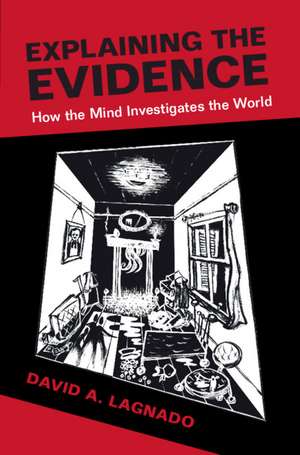
Explaining the Evidence
Autor David A. Lagnadoen Limba Engleză Hardback – 17 sep 2021
Adresată studenților la psihologie, cercetătorilor din științe cognitive și practicienilor din domeniul judiciar, Explaining the Evidence oferă o perspectivă riguroasă asupra modului în care mintea umană procesează informațiile fragmentate pentru a reconstrui realitatea. Observăm modul în care David A. Lagnado transformă procesul intuitiv de rezolvare a problemelor într-un sistem structurat de inferență rațională, subliniind faptul că, deși suntem „programați” să gândim cauzal, adesea eșuăm în etapa critică a evaluării dovezilor. Remarcăm o evoluție clară față de lucrarea sa anterioară, Straight Choices, unde autorul punea bazele înțelegerii deciziilor în condiții de incertitudine. În acest volum publicat de Cambridge University Press, atenția se mută pe mecanismele de construcție a modelelor mentale, utilizând rețelele bayesiene pentru a oferi claritate acolo unde intuiția ne poate înșela. Cartea este comparabilă cu Arguments, Stories and Criminal Evidence de Floris J Bex în ceea ce privește rigoarea analizei dovezilor în context penal, dar Explaining the Evidence se distinge prin actualizarea cadrului teoretic cu ultimele descoperiri din psihologia empirică și prin aplicabilitatea sa mai largă, dincolo de sfera juridică. Apreciem stilul autorului de a integra exemple din criminalistică pentru a ilustra concepte statistice complexe, făcând textul accesibil fără a sacrifica profunzimea academică. Structura cărții ghidează cititorul de la înțelegerea tiparelor de cauză și efect până la utilizarea metodelor logice care pot îmbunătăți substanțial acuratețea judecăților noastre cotidiene sau profesionale.
Preț: 770.78 lei
Preț vechi: 896.26 lei
-14%
Carte tipărită la comandă
Livrare economică 08-22 decembrie
Specificații
ISBN-10: 1107006007
Pagini: 328
Dimensiuni: 157 x 235 x 22 mm
Greutate: 0.58 kg
Editura: Cambridge University Press
Locul publicării:New York, United States
De ce să citești această carte
Recomandăm această carte oricărui profesionist care lucrează cu dovezi complexe, de la detectivi la juriști sau analiști de date. Cititorul va dobândi un set de instrumente formale pentru a-și disciplina procesul de gândire, învățând să testeze validitatea propriilor explicații prin modele mentale structurate. Este o resursă esențială pentru a înțelege de ce mintea noastră sare uneori la concluzii greșite și cum putem corecta aceste erori cognitive folosind logica și probabilitățile.
Descriere scurtă
Cuprins
Recenzii
'This is a remarkable achievement. Explaining the Evidence provides a wonderfully clear, entertaining and erudite introduction to one of humanity's most important, yet unreliable, abilities: building explanations of the world, and the people, around us.' Nick Chater, Professor of Behavioural Science, University of Warwick, UK
'Entertainingly illustrated with examples of legal cases, Lagnado's impressive book brings together insights from experimental psychology with modern tools for formal causal reasoning. We use causal stories to try to make sense of evidence, but these can all too easily mislead; this book should help us to overcome these cognitive biases.' A. P. Dawid, Emeritus Professor of Statistics, University of Cambridge, UK
'Using causal models and psychology, this work presents a systematic approach to modelling and evaluating evidence. The real criminal cases make for fascinating reading and help to ground the material. This book should be of interest to those in psychology, law and law enforcement, or those wanting to better understand and apply reasoning about evidence.' Joseph Y. Halpern, Professor of Computer Science, Cornell University, USA
'In this fascinating book, one of the world's leading experts in causal cognition uses criminal cases and their legal context to show how people seek explanations of the evidence by building causal mental models of the world. So clearly articulated in this book, these ideas are at the forefront of current thinking in this area. It will be of inestimable value to undergraduate and postgraduate students and researchers alike. I also would highly recommend it to psychologists, legal scholars and computer scientists.' Mike Oaksford, Professor of Psychology and Head of the Department of Psychological Sciences, Birkbeck College, UK
'This book provides a flowing, compelling and lucid account of how computational models of mental states are changing the face of cognitive psychology and decision-making sciences. It is a must for students of mind, cognition, behavioural sciences and law, especially data scientists who labour to emulate human behaviour on digital machines.' Judea Pearl, Professor of Computer Science, UCLA, USA
'How people respond to evidence (and how they don't) is one of the burning questions of our time. Yet one hardly expects a book on the psychology of evidence to be a page-turner. But that's exactly what Dave Lagnado has produced in this authoritative text on the cognition of crime, investigation and verdict.' Steven A. Sloman, Professor of Cognitive, Linguistic and Psychological Sciences, Brown University, USA
'Explaining the Evidence is especially compelling reading for anyone involved in law. Through crime investigations, it explores our human capacity for reasoning and exposes the challenges in evaluating evidence that confront decision-makers in criminal cases. Most excitingly, it provides new tools that could ensure sounder judgments and prevent miscarriages of justice.' Cheryl Thomas, Professor of Judicial Studies and Director of the Jury Project and Judicial Institute, UCL, UK
'This very readable book will help to make evidence, as a subject, an important focus of cross-disciplinary attention.' William Twining, Emeritus Quain Professor of Jurisprudence, UCL, UK
'This book is a terrific read. It is engaging on every level. Using examples of reasoning about crimes, Lagnado skilfully applies theories from empirical psychology. The result is a highly readable introduction to statistical reasoning, Bayes nets representations of causal relationships, heuristically useful reasoning strategies and much more. I strongly recommend it.' James F. Woodward, Distinguished Professor of History and Philosophy of Science, University of Pittsburgh, USA