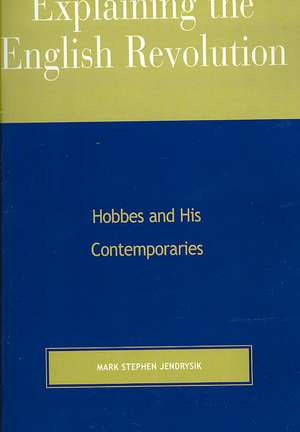
Explaining the English Revolution: Hobbes and His Contemporaries
Autor Mark Stephen Jendrysiken Limba Engleză Paperback – 18 apr 2007
Preț: 335.38 lei
Preț vechi: 435.16 lei
-23%
Puncte Express: 503
Carte tipărită la comandă
Livrare economică 30 noiembrie-14 decembrie
Livrare prin curier în România Termenul estimat este afișat lângă disponibilitate.
Transport gratuit de la 400.00 lei Plată online sau ramburs, în funcție de opțiunile comenzii.
Retur gratuit în 14 zile Comandă securizată și suport în română.
Specificații
ISBN-13: 9780739121818
ISBN-10: 0739121812
Pagini: 182
Dimensiuni: 154 x 229 x 15 mm
Greutate: 0.3 kg
Editura: Bloomsbury Publishing
Colecția Lexington Books
Locul publicării:New York, United States
ISBN-10: 0739121812
Pagini: 182
Dimensiuni: 154 x 229 x 15 mm
Greutate: 0.3 kg
Editura: Bloomsbury Publishing
Colecția Lexington Books
Locul publicării:New York, United States
V-ar putea interesa
-
 State of EmergencyDominic Sandbrook-21%Preț: 115.33 lei146.13 lei
 -
 The Letters of Richard Cobden: Volume II: 1848-1853Anthony Howe-33%Preț: 1211.05 lei1794.76 lei
 -
 The English ConstitutionWalter Bagehot-19%Preț: 52.70 lei64.76 lei
 -
 A Dictionary of British HistoryJohn Cannon-18%Preț: 105.35 lei128.73 lei
 -
 -32%Preț: 1438.37 lei2130.03 lei
 -
 -24%Preț: 596.50 lei788.04 lei
 -
 War in England 1642-1649Barbara Donagan-22%Preț: 413.02 lei528.66 lei
 -
 -22%Preț: 341.54 lei439.36 lei
 -
 -23%Preț: 146.63 lei190.92 lei
 -
 -28%Preț: 425.16 lei593.93 lei
 -
 Preț: 372.96 lei
 -
 EclipseNicholas CleePreț: 118.16 lei
 -
 The Tudor Queens of EnglandDavid Loades-48%Preț: 133.07 lei255.80 lei
 -
 Mary TudorAnna Whitelock-27%Preț: 98.79 lei135.48 lei
Cuprins
Chapter 1 Introduction: The Disordering of Order
Chapter 2 Gerrard Winstanley: The Oppression of Covetousness
Chapter 3 John Milton: Tyranny and Revolution
Chapter 4 Oliver Cromwell: Factions, Forcers of Conscience and Civil War
Chapter 5 Robert Filmer: The Anarchy of Natural Liberty
Chapter 6 Thomas Hobbes: Divided Sovereignty and Civil War
Chapter 7 Conclusion: The Ordering of Disorder
Chapter 2 Gerrard Winstanley: The Oppression of Covetousness
Chapter 3 John Milton: Tyranny and Revolution
Chapter 4 Oliver Cromwell: Factions, Forcers of Conscience and Civil War
Chapter 5 Robert Filmer: The Anarchy of Natural Liberty
Chapter 6 Thomas Hobbes: Divided Sovereignty and Civil War
Chapter 7 Conclusion: The Ordering of Disorder
Recenzii
Explaining the English Revolution is both an accessible and engaging introduction to the political thought of the period and a lively challenge to the scholarship on Winstanley, Milton, Cromwell, Filmer, and Hobbes. Professor Jendrysik skillfully explicates the varieties of disorder perceived and propagated from 1649-1653. His careful analysis of contested concepts such as kingship, faction, freedom, and hierarchy insightfully adds to our understanding of the individual authors and to comparative studies in the field.