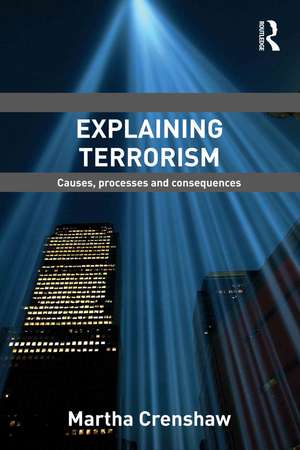
Explaining Terrorism: Causes, Processes and Consequences: Political Violence
Autor Martha Crenshawen Limba Engleză Paperback – 8 oct 2010
Since the early 1970s, scholars and practitioners have tried to explain terrorism and to assess the effectiveness of government responses to the threat. From its beginnings in a small handful of analytical studies, the research field has expanded to thousands of entries, with an enormous spike following the 9/11 attacks. The field of terrorism studies is now impressive in terms of quantity, scope, and variety. Professor Crenshaw had studied terrorism since the late 1960s, well before it was topical, and this selection of her work represents the development of her thought over time in four areas:
- defining terrorism and identifying its causes
- the different methods used to explain terrorism, including strategic, organisational and psychological approaches
- how campaigns of terrorism end
- how governments can effectively contribute to the ending of terrorism.
Din seria Political Violence
- 8%
 Preț: 443.93 lei
 -
 Preț: 442.46 lei
 -
 Preț: 342.57 lei
 -
 Preț: 458.47 lei
 - 15%
 Preț: 442.92 lei
 - 15%
 Preț: 434.86 lei
 -
 Preț: 480.33 lei
 - 15%
 Preț: 466.64 lei
 - 9%
 Preț: 1456.91 lei
 -
 Preț: 490.94 lei
 -
 Preț: 459.02 lei
 - 18%
 Preț: 1415.84 lei
 - 15%
 Preț: 464.98 lei
 -
 Preț: 471.36 lei
 - 15%
 Preț: 463.52 lei
 - 15%
 Preț: 434.24 lei
 - 18%
 Preț: 1296.70 lei
 -
 Preț: 410.99 lei
 - 15%
 Preț: 485.00 lei
 - 18%
 Preț: 1252.71 lei
 -
 Preț: 481.51 lei
 -
 Preț: 239.96 lei
 -
 Preț: 439.56 lei
 - 18%
 Preț: 1252.71 lei
 -
 Preț: 467.54 lei
 -
 Preț: 440.34 lei
 -
 Preț: 354.06 lei
 -
 Preț: 437.53 lei
 - 18%
 Preț: 1256.91 lei
 - 18%
 Preț: 1248.18 lei
 - 15%
 Preț: 452.74 lei
 - 18%
 Preț: 1250.55 lei
 - 18%
 Preț: 1306.27 lei
 -
 Preț: 319.79 lei
Preț: 428.14 lei
Preț vechi: 465.37 lei
-8%
Puncte Express: 642
Carte disponibilă
Livrare economică 09-23 noiembrie
Livrare express 23-29 octombrie pentru 32.90 lei
Livrare prin curier în România Termenul estimat este afișat lângă disponibilitate.
Transport gratuit pentru acest produs Plată online sau ramburs, în funcție de opțiunile comenzii.
Retur gratuit în 14 zile Comandă securizată și suport în română.
Specificații
ISBN-13: 9780415780513
ISBN-10: 0415780519
Pagini: 284
Ilustrații: 1 black & white tables
Dimensiuni: 156 x 234 x 15 mm
Greutate: 0.45 kg
Ediția:1
Editura: Taylor & Francis
Colecția Routledge
Seria Political Violence
Locul publicării:Oxford, United Kingdom
ISBN-10: 0415780519
Pagini: 284
Ilustrații: 1 black & white tables
Dimensiuni: 156 x 234 x 15 mm
Greutate: 0.45 kg
Ediția:1
Editura: Taylor & Francis
Colecția Routledge
Seria Political Violence
Locul publicării:Oxford, United Kingdom
V-ar putea interesa
-
 -16%Preț: 908.60 lei1081.67 lei
 -
 Preț: 486.48 lei
 -
 Terrorism Studies: A ReaderJohn G. Horgan-15%Preț: 479.44 lei564.05 lei
 -
 Political Islam: A Critical ReaderFrederic Volpi-15%Preț: 490.03 lei576.51 lei
 -
 Preț: 439.90 lei
 -
 -15%Preț: 451.48 lei531.16 lei
 -
 -15%Preț: 495.58 lei583.04 lei
 -
 The Roots of TerrorismLouise Richardson-15%Preț: 432.33 lei508.62 lei
 -
 Culture of TerrorismNoam Chomsky-8%Preț: 643.74 lei699.72 lei
 -
 Pirates and Emperors, Old and NewNoam ChomskyPreț: 135.92 lei
 -
 Boko Haram: Inside Nigeria's Unholy WarMike SmithPreț: 295.23 lei
 -
 Dirty Wars: The world is a battlefieldJeremy ScahillPreț: 102.58 lei
 -
 Boko HaramVirginia ComolliPreț: 169.95 lei
 -
 Eat the Heart of the InfidelAndrew Walker-16%Preț: 132.28 lei157.66 lei
Public țintă
Postgraduate, Professional, and UndergraduateCuprins
Introduction: Definitions, Approaches, Trajectories, and Responses Part 1: What and Why? 1. The Concept of Terrorism 2. The Causes of Terrorism 3. "Old" vs. "New" Terrorism Part 2: Explaining Terrorism: Organizations, Strategies, and Psychology 4. The Organizational Approach 5. Subjective Realities 6. The Logic of Terrorism 7. Psychological Constraints on Instrumental Reasoning Part 3: Responding to Terrorism 8. Coercive Diplomacy 9. Strategies and Grand Strategies 10. Counterterrorism Policy and the Political Process Part 4: How Terrorism Ends 11. How Terrorism Declines 12. Why Terrorism is Rejected or Renounced
Notă biografică
Martha Crenshaw is a Senior Fellow at the Center for International Security and Cooperation (CISAC) and the Freeman Spogli Institute for International Studies, and Professor of Political Science, by courtesy, at Stanford University. She is also Professor of Government Emerita at Wesleyan University. She is a lead investigator with the National Consortium for the Study of Terrorism and Responses to Terrorism (START) at the University of Maryland.
Recenzii
'The leading global thinker on the study of terrorism, Martha Crenshaw has for thirty years produced the most creative, rigorous and important contributions our field has known. And now these can all be found in one place. This book is simply the one indispensable text that every student, scholar and researcher of terrorism and political violence must have. Literally the best of the best.' - John Horgan, Pennsylvania State University
‘Explaining terrorism requires an interdisciplinary approach able to address contextual causes, organizational dynamics and individual motifs. This combination of different levels of the analysis has been at the core of Martha Crenshaw's influential contributions to the field of terrorism study, the best of which are now collected in this precious volume.’ - Donatella della Porta, European University Institute, Florence
'When it comes to the study of terrorism from a genuine social science perspective, professor Martha Crenshaw is the scholar of reference and became so long before the field gained academic centrality worldwide after 9/11.' - Fernando Reinares, Universidad Rey Juan Carlos, Madrid
'The leading global thinker on the study of terrorism, Martha Crenshaw has for thirty years produced the most creative, rigorous and important contributions our field has known. And now these can all be found in one place. This book is simply the one indispensable text that every student, scholar and researcher of terrorism and political violence must have. Literally the best of the best.' - John Horgan, Pennsylvania State University, USA
‘Explaining terrorism requires an interdisciplinary approach able to address contextual causes, organizational dynamics and individual motifs. This combination of different levels of the analysis has been at the core of Martha Crenshaw's influential contributions to the field of terrorism study, the best of which are now collected in this precious volume.’ - Donatella della Porta, European University Institute, Florence, Italy
'When it comes to the study of terrorism from a genuine social science perspective, professor Martha Crenshaw is the scholar of reference and became so long before the field gained academic centrality worldwide after 9/11.' - Fernando Reinares, Universidad Rey Juan Carlos, Madrid, Spain
"In this important volume, the author, a prominent academic expert on terrorism, has assembled her articles, many of which were previously published in the 1980s and 1990s, with a few published after 2001. The result is a comprehensive compilation that is divided into four parts" - Joshua Sinai, ‘Terrorism Bookshelf: Top 150 Books on Terrorism and Counterterrorism’, Perspectives on Terrorism, Vol. 6, No. 2 (2012)
‘Explaining terrorism requires an interdisciplinary approach able to address contextual causes, organizational dynamics and individual motifs. This combination of different levels of the analysis has been at the core of Martha Crenshaw's influential contributions to the field of terrorism study, the best of which are now collected in this precious volume.’ - Donatella della Porta, European University Institute, Florence
'When it comes to the study of terrorism from a genuine social science perspective, professor Martha Crenshaw is the scholar of reference and became so long before the field gained academic centrality worldwide after 9/11.' - Fernando Reinares, Universidad Rey Juan Carlos, Madrid
'The leading global thinker on the study of terrorism, Martha Crenshaw has for thirty years produced the most creative, rigorous and important contributions our field has known. And now these can all be found in one place. This book is simply the one indispensable text that every student, scholar and researcher of terrorism and political violence must have. Literally the best of the best.' - John Horgan, Pennsylvania State University, USA
‘Explaining terrorism requires an interdisciplinary approach able to address contextual causes, organizational dynamics and individual motifs. This combination of different levels of the analysis has been at the core of Martha Crenshaw's influential contributions to the field of terrorism study, the best of which are now collected in this precious volume.’ - Donatella della Porta, European University Institute, Florence, Italy
'When it comes to the study of terrorism from a genuine social science perspective, professor Martha Crenshaw is the scholar of reference and became so long before the field gained academic centrality worldwide after 9/11.' - Fernando Reinares, Universidad Rey Juan Carlos, Madrid, Spain
"In this important volume, the author, a prominent academic expert on terrorism, has assembled her articles, many of which were previously published in the 1980s and 1990s, with a few published after 2001. The result is a comprehensive compilation that is divided into four parts" - Joshua Sinai, ‘Terrorism Bookshelf: Top 150 Books on Terrorism and Counterterrorism’, Perspectives on Terrorism, Vol. 6, No. 2 (2012)
Descriere
This volume comprises some of the key essays by Professor Crenshaw, from 1972 to the present-day, on the causes, processes and consequences of terrorism .