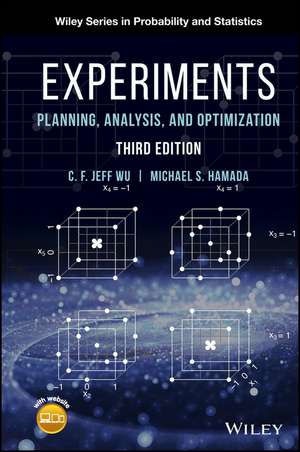
Experiments
Autor C F Jeff Wu, Michael S Hamadaen Limba Engleză Hardback – 30 mar 2021
Găsim în această a treia ediție a lucrării Experiments un instrument indispensabil pentru aplicabilitatea practică a statisticii în optimizarea proceselor industriale și de cercetare. Structura volumului este concepută pentru a elimina bariera dintre teorie și execuție: fiecare secțiune debutează cu o problemă reală de experimentare, oferind ulterior cadrul matematic necesar pentru rezolvarea acesteia. Suntem de părere că forța acestui text rezidă în capacitatea autorilor C F Jeff Wu și Michael S Hamada de a integra metodele clasice cu abordări de ultimă oră, precum designul de screening definitiv (DSD) și analiza efectului principal condiționat (CME). Volumul extinde cadrul propus de Experiments – Planning, Analysis, and Optimization 2e cu date noi din domeniul simulărilor computerizate, tratate acum ca o alternativă viabilă la experimentele fizice costisitoare. Față de edițiile anterioare, această iterație pune un accent sporit pe designul optim practic, oferind soluții pentru situațiile complexe de aliere și designurile pe mai multe niveluri. Ritmul expunerii este unul riguros, specific unui manual universitar de nivel avansat, dar rămâne accesibil prin includerea unor rezumate clare la final de capitol și a unor seturi de date ce pot fi accesate extern pentru exercițiu. Recomandăm această ediție pentru modul în care tratează optimizarea robusteții și compararea tratamentelor în domenii diverse, de la medicină la științele fizice. Prin comparație cu Design of Experiments de Bradley Jones, care se concentrează pe o abordare bazată pe optimizarea designului pentru începători, lucrarea de față oferă o profunzime teoretică superioară, fiind o referință completă pentru cei care gestionează experimente cu variabile multiple și constrângeri tehnice ridicate.
Preț: 829.71 lei
Preț vechi: 1011.84 lei
-18%
Carte tipărită la comandă
Livrare economică 01-15 decembrie
Specificații
ISBN-10: 1119470102
Pagini: 736
Dimensiuni: 160 x 231 x 33 mm
Greutate: 0.96 kg
Ediția:3rd edition
Editura: Wiley
Locul publicării:Hoboken, United States
V-ar putea interesa
-
 -27%Preț: 1103.62 lei1511.80 lei
 -
 Notes on ComplexityNeil TheisePreț: 152.07 lei
 -
 Group TheoryDinesh Khattar-19%Preț: 649.02 lei801.25 lei
 -
 Ring TheoryDinesh Khattar-15%Preț: 614.03 lei722.39 lei
 -
 Some Fundamentals of Mathematics of BlockchainJulien Riposo-18%Preț: 781.42 lei952.95 lei
 -
 Introduction to Applications of Modular FormsZafer Selcuk Aygin-15%Preț: 555.88 lei653.97 lei
 -
 Understanding Structural Equation ModelingJ. P. VermaPreț: 373.10 lei
 -
 Preț: 259.30 lei
 -
 Preț: 411.37 lei
 -
 Odd Order Group Actions and Witt Classification of InnerproductsJohn P. AlexanderPreț: 311.23 lei
 -
 Quadratic Forms Over Semilocal RingsR. BaezaPreț: 267.53 lei
 -
 Preț: 476.99 lei
 -
 Preț: 266.60 lei
 -
 Bessel PolynomialsE. GrosswaldPreț: 266.80 lei
 -
 Preț: 261.90 lei
 -
 Seminormal OperatorsK. ClanceyPreț: 263.09 lei
 -
 Degrees of Unsolvability: Structure and TheoryR. L. EpsteinPreț: 371.37 lei
 -
 Ebene Trigonometrie & Analytische GeometrieMichael JungPreț: 480.81 lei
 -
 -15%Preț: 668.97 lei787.03 lei
 -
 Das MAI-Tool als Untersuchungsinstrument von Lösungsprozessen beim mathematischen ModellierenLisa Christina SchneiderPreț: 453.48 lei
 -
 Einstieg in die beweisorientierte MathematikFelix GöblerPreț: 275.70 lei
 -
 Handbuch der MathematikdidaktikRegina Bruder-13%Preț: 680.63 lei782.34 lei
 -
 Mathematik-Vorbereitung für das Studium eines MINT-FachsBarbara HuguesPreț: 295.88 lei
 -
 So viel Mathe muss sein!Klaus DürrschnabelPreț: 251.58 lei
 -
 Kunterbunte MathematikHeinz Klaus StrickPreț: 211.00 lei
 -
 Zero and PiAmalkumar MukhopadhyayPreț: 170.33 lei
De ce să citești această carte
Recomandăm această carte profesioniștilor și studenților la masterat sau doctorat care au nevoie de o metodologie clară pentru planificarea experimentelor complexe. Cititorul câștigă acces la tehnici moderne de simulare pe calculator și optimizare a proceselor, esențiale pentru îmbunătățirea calității produselor în inginerie. Este un ghid practic ce transformă statistica teoretică într-un instrument de decizie precis, oferind soluții pentru date non-normale și sisteme cu interacțiuni complicate.
Despre autor
C F Jeff Wu este un statistician de renume mondial, membru al Academiei Naționale de Inginerie din SUA, cunoscut pentru contribuțiile sale fundamentale în designul experimentelor și statistica industrială. Michael S Hamada este cercetător la Laboratorul Național Los Alamos, specializat în îmbunătățirea proceselor prin metode statistice. Împreună, autorii au decenii de experiență în consultanță pentru clienți industriali, expertiză care se reflectă în studiile de caz și exemplele practice ce fundamentează această lucrare publicată de Wiley.
Notă biografică
Descriere scurtă
Cuprins
Preface to the Second Edition xix
Preface to the First Edition xxi
Suggestions of Topics for Instructors xxv
List of Experiments and Data Sets xxvii
About the Companion Website xxxiii
1 Basic Concepts for Experimental Design and Introductory Regression Analysis 1
1.1 Introduction and Historical Perspective 1
1.2 A Systematic Approach to the Planning and Implementation of Experiments 4
1.3 Fundamental Principles: Replication, Randomization, and Blocking 8
1.4 Simple Linear Regression 11
1.5 Testing of Hypothesis and Interval Estimation 14
1.6 Multiple Linear Regression 20
1.7 Variable Selection in Regression Analysis 26
1.8 Analysis of Air Pollution Data 28
1.9 Practical Summary 34
2 Experiments with a Single Factor 45
2.1 One-Way Layout 45
2.2 Multiple Comparisons 52
2.3 Quantitative Factors and Orthogonal Polynomials 56
2.4 Expected Mean Squares and Sample Size Determination 61
2.5 One-Way Random Effects Model 68
2.6 Residual Analysis: Assessment of Model Assumptions 71
2.7 Practical Summary 76
3 Experiments with More than One Factor 85
3.1 Paired Comparison Designs 85
3.2 Randomized Block Designs 88
3.3 Two-Way Layout: Factors with Fixed Levels 92
*3.4 Two-Way Layout: Factors with Random Levels 98
3.5 Multi-Way Layouts 105
3.6 Latin Square Designs: Two Blocking Variables 108
3.7 Graeco-Latin Square Designs 112
*3.8 Balanced Incomplete Block Designs 113
*3.9 Split-Plot Designs 118
3.10 Analysis of Covariance: Incorporating Auxiliary Information 126
*3.11 Transformation of the Response 130
3.12 Practical Summary 134
4 Full Factorial Experiments at Two Levels 151
4.1 An Epitaxial Layer Growth Experiment 151
4.2 Full Factorial Designs at Two Levels: A General Discussion 153
4.3 Factorial Effects and Plots 157
4.4 Using Regression to Compute Factorial Effects 165
*4.5 ANOVA Treatment of Factorial Effects 167
4.6 Fundamental Principles for Factorial Effects: Effect Hierarchy, Effect Sparsity, and Effect Heredity 168
4.7 Comparisons with the "One-Factor-at-a-Time" Approach 169
4.8 Normal and Half-Normal Plots for Judging Effect Significance 172
4.9 Lenth's Method: Testing Effect Significance for Experiments Without Variance Estimates 174
4.10 Nominal-the-Best Problem and Quadratic Loss Function 178
4.11 Use of Log Sample Variance for Dispersion Analysis 179
4.12 Analysis of Location and Dispersion: Revisiting the Epitaxial Layer Growth Experiment 181
*4.13 Test of Variance Homogeneity and Pooled Estimate of Variance 184
*4.14 Studentized Maximum Modulus Test: Testing Effect Significance for Experiments With Variance Estimates 185
4.15 Blocking and Optimal Arrangement of 2k Factorial Designs in 2q Blocks 188
4.16 Practical Summary 193
5 Fractional Factorial Experiments at Two Levels 205
5.1 A Leaf Spring Experiment 205
5.2 Fractional Factorial Designs: Effect Aliasing and the Criteria of Resolution and Minimum Aberration 206
5.3 Analysis of Fractional Factorial Experiments 212
5.4 Techniques for Resolving the Ambiguities in Aliased Effects 217
5.5 Conditional Main Effect (CME) Analysis: A Method to Unravel Aliased Interactions 227
5.6 Selection of 2k ¿p Designs Using Minimum Aberration and Related Criteria 232
5.7 Blocking in Fractional Factorial Designs 236
5.8 Practical Summary 238
6 Full Factorial and Fractional Factorial Experiments at Three Levels 265
6.1 A Seat-Belt Experiment 265
6.2 Larger-the-Better and Smaller-the-Better Problems 267
6.3 3k Full Factorial Designs 268
6.4 3k ¿p Fractional Factorial Designs 273
6.5 Simple Analysis Methods: Plots and Analysis of Variance 277
6.6 An Alternative Analysis Method 282
6.7 Analysis Strategies for Multiple Responses I: Out-Of-Spec Probabilities 291
6.8 Blocking in 3k and 3k ¿p Designs 299
6.9 Practical Summary 301
7 Other Design and Analysis Techniques for Experiments at More than Two Levels 315
7.1 A Router Bit Experiment Based on a Mixed Two-Level and Four-Level Design 315
7.2 Method of Replacement and Construction of 2m 4n Designs 318
7.3 Minimum Aberration 2m 4n Designs with n = 1, 2, 321
7.4 An Analysis Strategy for 2m 4n Experiments 324
7.5 Analysis of the Router Bit Experiment 326
7.6 A Paint Experiment Based on a Mixed Two-Level and Three-Level Design 329
7.7 Design and Analysis of 36-Run Experiments at Two And Three Levels 332
7.8 rk ¿p Fractional Factorial Designs for any Prime Number r 337
7.9 Definitive Screening Designs 341
*7.10 Related Factors: Method of Sliding Levels, Nested Effects Analysis, and Response Surface Modeling 343
7.11 Practical Summary 352
8 Nonregular Designs: Construction and Properties 369
8.1 Two Experiments: Weld-Repaired Castings and Blood Glucose Testing 369
8.2 Some Advantages of Nonregular Designs Over the 2k ¿p AND 3k ¿p Series of Designs 370
8.3 A Lemma on Orthogonal Arrays 372
8.4 Plackett-Burman Designs and Hall's Designs 373
8.5 A Collection of Useful Mixed-Level Orthogonal Arrays 377
*8.6 Construction of Mixed-Level Orthogonal Arrays Based on Difference Matrices 379
*8.7 Construction of Mixed-Level Orthogonal Arrays Through the Method of Replacement 382
8.8 Orthogonal Main-Effect Plans Through Collapsing Factors 384
8.9 Practical Summary 388
9 Experiments with Complex Aliasing 417
9.1 Partial Aliasing of Effects and the Alias Matrix 417
9.2 Traditional Analysis Strategy: Screening Design and Main Effect Analysis 420
9.3 Simplification of Complex Aliasing via Effect Sparsity 421
9.4 An Analysis Strategy for Designs with Complex Aliasing 422
*9.5 A Bayesian Variable Selection Strategy for Designs with Complex Aliasing 429
*9.6 Supersaturated Designs: Design Construction and Analysis 437
9.7 Practical Summary 441
10 Response Surface Methodology 455
10.1 A Ranitidine Separation Experiment 455
10.2 Sequential Nature of Response Surface Methodology 457
10.3 From First-Order Experiments to Second-Order Experiments: Steepest Ascent Search and Rectangular Grid Search 460
10.4 Analysis of Second-Order Response Surfaces 469
10.5 Analysis of the Ranitidine Experiment 472
10.6 Analysis Strategies for Multiple Responses II: Contour Plots and the Use of Desirability Functions 475
10.7 Central Composite Designs 478
10.8 Box-Behnken Designs and Uniform Shell Designs 483
10.9 Practical Summary 486
11 Introduction to Robust Parameter Design 503
11.1 A Robust Parameter Design Perspective of the Layer Growth and Leaf Spring Experiments 503
11.2 Strategies for Reducing Variation 506
11.3 Noise (Hard-to-Control) Factors 508
11.4 Variation Reduction Through Robust Parameter Design 510
11.5 Experimentation and Modeling Strategies I: Cross Array 512
11.6 Experimentation and Modeling Strategies II: Single Array and Response Modeling 523
11.7 Cross Arrays: Estimation Capacity and Optimal Selection 526
11.8 Choosing Between Cross Arrays and Single Arrays 529
11.9 Signal-to-Noise Ratio and Its Limitations for Parameter Design Optimization 534
*11.10 Further Topics 537
11.11 Practical Summary 539
12 Analysis of Experiments with Nonnormal Data 553
12.1 A Wave Soldering Experiment with Count Data 553
12.2 Generalized Linear Models 554
12.3 Likelihood-Based Analysis of Generalized Linear Models 558
12.4 Likelihood-Based Analysis of the Wave Soldering Experiment 562
12.5 Bayesian Analysis of Generalized Linear Models 564
12.6 Bayesian Analysis of the Wave Soldering Experiment 565
12.7 Other Uses and Extensions of Generalized Linear Models and Regression Models for Nonnormal Data 567
*12.8 Modeling and Analysis for Ordinal Data 567
*12.9 Analysis of Foam Molding Experiment 572
12.10 Scoring: A Simple Method for Analyzing Ordinal Data 575
12.11 Practical Summary 576
13 Practical Optimal Design 589
13.1 Introduction 589
13.2 A Design Criterion 590
13.3 Continuous and Exact Design 590
13.4 Some Design Criteria 592
13.5 Design Algorithms 595
13.6 Examples 598
13.7 Practical Summary 606
14 Computer Experiments 611
14.1 An Airfoil Simulation Experiment 611
14.2 Latin Hypercube Designs (LHDs) 613
14.3 Latin Hypercube Designs with Maximin Distance or Maximum Projection Properties 619
14.4 Kriging: The Gaussian Process Model 622
14.5 Kriging: Prediction and Uncertainty Quantification 625
14.6 Expected Improvement 631
14.7 Further Topics 634
14.8 Practical Summary 636
Author Index 689
Subject Index 693