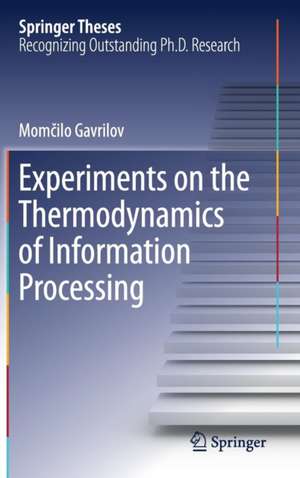
Experiments on the Thermodynamics of Information Processing: Springer Theses
Autor Mom¿ilo Gavriloven Limba Engleză Hardback – 10 aug 2017
The second law of thermodynamics should make that impossible, but how? That question has stymied physicists and provoked debate for a century and a half. The experiments in this thesis confirm a hypothesis proposed by Rolf Landauer over fifty years ago: that Maxwell’s demon would need to erase information, and that erasing information—resetting the measuring device to a standard starting state—requires dissipating as much energy as is gained.
For his thesis work, the author used a “feedback trap” to study the motion of colloidal particles in “v
irtual potentials” that may be manipulated arbitrarily. The feedback trap confines a freely diffusing particle in liquid by periodically measuring its position and applying an electric field to move it back to the origin.
Din seria Springer Theses
- 18%
 Preț: 960.54 lei
 - 15%
 Preț: 617.28 lei
 -
 Preț: 373.68 lei
 - 18%
 Preț: 749.08 lei
 -
 Preț: 372.05 lei
 - 18%
 Preț: 1336.71 lei
 - 15%
 Preț: 618.91 lei
 - 18%
 Preț: 962.00 lei
 -
 Preț: 379.10 lei
 -
 Preț: 375.86 lei
 - 18%
 Preț: 909.08 lei
 -
 Preț: 384.20 lei
 - 18%
 Preț: 1060.72 lei
 - 18%
 Preț: 1064.50 lei
 - 18%
 Preț: 1067.54 lei
 - 15%
 Preț: 618.91 lei
 - 18%
 Preț: 908.31 lei
 - 15%
 Preț: 621.42 lei
 - 18%
 Preț: 1061.89 lei
 -
 Preț: 373.40 lei
 - 15%
 Preț: 623.27 lei
 -
 Preț: 374.23 lei
 - 15%
 Preț: 614.78 lei
 - 15%
 Preț: 619.58 lei
 - 15%
 Preț: 620.03 lei
 - 18%
 Preț: 1065.27 lei
 - 15%
 Preț: 619.14 lei
 - 18%
 Preț: 961.40 lei
 - 18%
 Preț: 1067.54 lei
 - 18%
 Preț: 1329.13 lei
 - 18%
 Preț: 964.49 lei
 - 18%
 Preț: 1172.17 lei
 - 18%
 Preț: 1068.71 lei
 - 18%
 Preț: 966.67 lei
 - 18%
 Preț: 1172.94 lei
 - 18%
 Preț: 906.80 lei
 - 18%
 Preț: 959.13 lei
 - 15%
 Preț: 617.77 lei
 - 15%
 Preț: 620.73 lei
 - 18%
 Preț: 1169.91 lei
 - 15%
 Preț: 615.93 lei
 - 18%
 Preț: 853.71 lei
 -
 Preț: 375.86 lei
 - 18%
 Preț: 1063.77 lei
 -
 Preț: 407.71 lei
 - 15%
 Preț: 614.32 lei
 - 15%
 Preț: 618.21 lei
 - 15%
 Preț: 615.02 lei
 - 15%
 Preț: 615.68 lei
Preț: 618.09 lei
Preț vechi: 727.16 lei
-15%
Puncte Express: 927
Carte tipărită la comandă
Livrare economică 08-22 iunie
Specificații
ISBN-13: 9783319636931
ISBN-10: 3319636936
Pagini: 164
Ilustrații: XVI, 147 p. 55 illus., 53 illus. in color.
Dimensiuni: 160 x 241 x 15 mm
Greutate: 0.42 kg
Ediția:1st edition 2017
Editura: Springer
Colecția Springer Theses
Seria Springer Theses
Locul publicării:Cham, Switzerland
ISBN-10: 3319636936
Pagini: 164
Ilustrații: XVI, 147 p. 55 illus., 53 illus. in color.
Dimensiuni: 160 x 241 x 15 mm
Greutate: 0.42 kg
Ediția:1st edition 2017
Editura: Springer
Colecția Springer Theses
Seria Springer Theses
Locul publicării:Cham, Switzerland
Cuprins
Introduction.- Feedback Trap.- Real-time Calibration of a Feedback Trap.- High-Precision Test of Landauer’s Principle.- Erasure without Work in an Asymmetric, Double-well Potential.- Thermodynamical and Logical Irreversibility.- Arbitrarily Slow, Non-quasistatic, Isothermal Transformations.- Partial Memory Erasure: Testing Shannon’s Entropy Function.- Conclusion.
Notă biografică
Dr. Momčilo Gavrilov grew up in Belgrade, Serbia, where he also received his bachelor degree in physics from Belgrade University in 2010. He completed his PhD in physics under supervision of Prof. John Bechhoefer at Simon Fraser University in Vancouver, Canada in 2016. Dr. Gavrilov is currently a biophysics postdoctoral fellow in Prof. Taekjip Ha lab at Johns Hopkins University in Baltimore, United States. He is using nanopore methods to explore the helicase activity of motor proteins and understand how biological systems process information.
Textul de pe ultima copertă
This thesis reveals how the feedback trap technique, developed to trap small objects for biophysical measurement, could be adapted for the quantitative study of the thermodynamic properties of small systems. The experiments in this thesis are related to Maxwell’s demon, a hypothetical intelligent, “neat fingered” being that uses information to extract work from heat, apparently creating a perpetual-motion machine.
The second law of thermodynamics should make that impossible, but how? That question has stymied physicists and provoked debate for a century and a half. The experiments in this thesis confirm a hypothesis proposed by Rolf Landauer over fifty years ago: that Maxwell’s demon would need to erase information, and that erasing information—resetting the measuring device to a standard starting state—requires dissipating as much energy as is gained.
For his thesis work, the author used a “feedback trap” to study the motion of colloidal particles in “v
irtual potentials” that may be manipulated arbitrarily. The feedback trap confines a freely diffusing particle in liquid by periodically measuring its position and applying an electric field to move it back to the origin.
The second law of thermodynamics should make that impossible, but how? That question has stymied physicists and provoked debate for a century and a half. The experiments in this thesis confirm a hypothesis proposed by Rolf Landauer over fifty years ago: that Maxwell’s demon would need to erase information, and that erasing information—resetting the measuring device to a standard starting state—requires dissipating as much energy as is gained.
For his thesis work, the author used a “feedback trap” to study the motion of colloidal particles in “v
irtual potentials” that may be manipulated arbitrarily. The feedback trap confines a freely diffusing particle in liquid by periodically measuring its position and applying an electric field to move it back to the origin.
Caracteristici
Nominated as an outstanding Ph.D. thesis by Simon Fraser University, Vancouver, Canada Demonstrates experimentally that Maxwell's Demon does not violate the second law of thermodynamics Shows how a "feedback trap" can be adapted to study the thermodynamics of small systems Includes supplementary material: sn.pub/extras