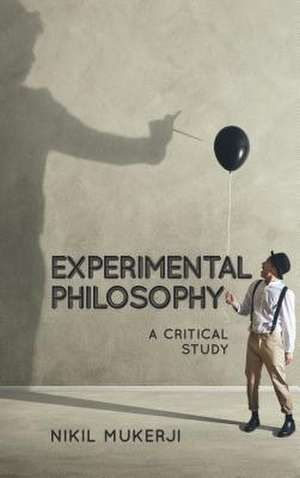
Experimental Philosophy: A Critical Study
Autor Nikil Mukerjien Limba Engleză Paperback – 13 mar 2019
Preț: 257.10 lei
Preț vechi: 335.18 lei
-23%
Puncte Express: 386
Carte tipărită la comandă
Livrare economică 28 noiembrie-12 decembrie
Livrare prin curier în România Termenul estimat este afișat lângă disponibilitate.
Transport gratuit de la 400.00 lei Plată online sau ramburs, în funcție de opțiunile comenzii.
Retur gratuit în 14 zile Comandă securizată și suport în română.
Specificații
ISBN-13: 9781786611253
ISBN-10: 1786611252
Pagini: 190
Ilustrații: 5 tables; 9 textboxes
Dimensiuni: 150 x 224 x 19 mm
Greutate: 0.37 kg
Editura: Bloomsbury Publishing
Colecția Rowman & Littlefield
Locul publicării:New York, United States
ISBN-10: 1786611252
Pagini: 190
Ilustrații: 5 tables; 9 textboxes
Dimensiuni: 150 x 224 x 19 mm
Greutate: 0.37 kg
Editura: Bloomsbury Publishing
Colecția Rowman & Littlefield
Locul publicării:New York, United States
Cuprins
Preface / Acknowledgements / Introduction / 1. The Armchair and the Laboratory / 2. Experimentally Informed Arguments / 3. Experimental Studies / 4. Objections / 5. Conclusion / References / Index
Recenzii
Fifteen years ago, experimental philosophy shook the foundations of philosophy: century-old methods were challenged; revolutionary ideas were discussed; and a new future for philosophy was sketched. In his outstanding book, Experimental Philosophy: A Critical Study, Nikil Mukerji provides a compelling, insightful , and accessible assessment of the experimental-philosophy revolution. Experimental Philosophy: A Critical Study should be required reading for anyone interested in the cutting edge of contemporary philosophy.
This is a very valuable introduction into experimental philosophy which clarifies both the scope and the limits of this highly relevant field. The book deserves to be widely read.
In this new introduction to experimental philosophy, Nikil Mukerji locates the field in relation to traditional philosophy, and he does this via a favorite tool of traditional philosophy - distinctions. Mukerji distinguishes several different programs within experimental philosophy, and he shows how the different programs bear on traditional philosophical debates and methods. The book is a manifestly illuminating introduction to the field, which also serves admirably to sharpen debates for researchers working in the field.
This is a very valuable introduction into experimental philosophy which clarifies both the scope and the limits of this highly relevant field. The book deserves to be widely read.
In this new introduction to experimental philosophy, Nikil Mukerji locates the field in relation to traditional philosophy, and he does this via a favorite tool of traditional philosophy - distinctions. Mukerji distinguishes several different programs within experimental philosophy, and he shows how the different programs bear on traditional philosophical debates and methods. The book is a manifestly illuminating introduction to the field, which also serves admirably to sharpen debates for researchers working in the field.