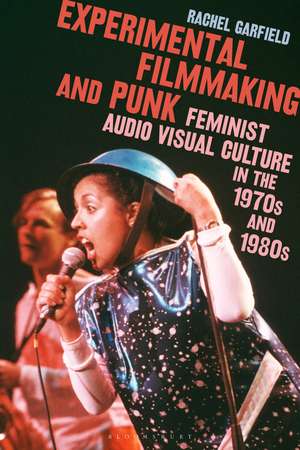
Experimental Filmmaking and Punk: Feminist Audio Visual Culture in the 1970s and 1980s
Autor Dr Rachel Garfielden Limba Engleză Paperback – 18 noi 2021
In this book, Rachel Garfield breaks new ground in exploring the rebellious, feminist punk audio-visual culture of the 1970s, tracing its roots and its legacies. In their filmmaking and their performed personae, film and video artists such as Vivienne Dick, Sandra Lahire, Betzy Bromberg, Ruth Novaczek, Sadie Benning, Leslie Thornton, Abigail Child and Anne Robinson offered a powerful, deliberately awkward alternative to hegemonic conformist femininity, creating a new "punk audio visual aesthetic". A vital aspect of our vibrant contemporary digital audio visual culture, Garfield argues, can be traced back to the techniques and forms of these feminist pioneers, who like their musical contemporaries worked in a pre-digital, analogue modality that nevertheless influenced the emergent digital audio visual culture of the 1990s and 2000s.
Preț: 189.00 lei
Preț vechi: 249.85 lei
-24%
Puncte Express: 284
Carte disponibilă
Livrare economică 27 octombrie-10 noiembrie
Livrare express 10-16 octombrie pentru 94.19 lei
Livrare prin curier în România Termenul estimat este afișat lângă disponibilitate.
Transport gratuit de la 400.00 lei Plată online sau ramburs, în funcție de opțiunile comenzii.
Retur gratuit în 14 zile Comandă securizată și suport în română.
Specificații
ISBN-13: 9781350293083
ISBN-10: 1350293083
Pagini: 288
Ilustrații: 40 bw illus
Dimensiuni: 156 x 232 x 16 mm
Greutate: 0.48 kg
Editura: Bloomsbury Publishing
Colecția Bloomsbury Academic
Locul publicării:London, United Kingdom
ISBN-10: 1350293083
Pagini: 288
Ilustrații: 40 bw illus
Dimensiuni: 156 x 232 x 16 mm
Greutate: 0.48 kg
Editura: Bloomsbury Publishing
Colecția Bloomsbury Academic
Locul publicării:London, United Kingdom
Cuprins
Introduction
1. Do it Yourself and the Amateur
2. The Last of the Modern Two - Visualizing Women, Otherness and the Cosmopolitan Punk
3. Feminism, Visualising the Kitchen Table and Do-It-Yourself: in Praise of the Fragment Part 1
4. Kracauer Disintegration and Punk: In Praise of the Fragment Part 2
5. Representation and the Inability to Situate: the Undecidability of Women's Punk
Conclusion
Bibliography
1. Do it Yourself and the Amateur
2. The Last of the Modern Two - Visualizing Women, Otherness and the Cosmopolitan Punk
3. Feminism, Visualising the Kitchen Table and Do-It-Yourself: in Praise of the Fragment Part 1
4. Kracauer Disintegration and Punk: In Praise of the Fragment Part 2
5. Representation and the Inability to Situate: the Undecidability of Women's Punk
Conclusion
Bibliography
Recenzii
Girls to the front! Garfield's book places female filmmakers at the forefront of experimental film and video. Reclaiming the energy of punk, DIY, deflation, the kitchen table aesthetic and the amateur to enthuse a new generation of filmmakers, where the emphasis is on making and being heard rather than slick production values and aspiring to mainstream monotony. Oh bondage! Up yours! I wish I'd had this book growing up.
Densely research, fiercely argued, Garfield's book goes a good way toward toggling our view of punk and No Wave film toward the exhilaration of feminist autonomy.
Experimental Filmmaking and Punk is the rare study that not only captures subcultural counter-histories (in this case, of music and film) but traces social, political, and aesthetic interconnections that have never fully been acknowledged, simultaneously offering a completely new way of thinking about life and creativity in this place and time.
Garfield writes a new lineage of experimental film, convincingly rendering the filmmakers' shared stance of "oppositional modernism". Celebrating edgy incompleteness, rhythm rather than plot, multiplicity instead of unity, DIY instead of glossy production values, Garfield sides with the heady, messy and personal.
Experimental Filmmaking and Punk restores complexity and nuance to an inspiring body of work that has, until now, been under-known and under-valued. Rachel Garfield draws on her deep knowledge of the punk movement to shed light on a generation of important yet marginalised female filmmakers. Exploring the impact of punk's anti-authoritarian spirit, she discusses how women refused gender norms in 'art' as well as 'life.' The DIY and kitchen table aesthetics described here are bound to resonate with the prosumer tactics of contemporary artists and cultural producers.
Rachel Garfield searches out the scuzzy filmic scenarios, kitchen table aesthetics and DIY approaches that characterise the "punk films" of overlooked feminist artists in the 1970s and 1980s. In doing so, Experimental Filmmaking and Punk convinces us to look beyond the avant-garde milieux of the day and instead towards punk rock to understand why these women made the films they did. Whilst not forgetting the importance of pioneering filmmakers that came before, Garfield shows how punk exemplars of gender non-conformity like Poly Styrene of X-Ray Spex and Ari Up of The Slits demonstrated a riotous new ethic of self-fashioning for feminist filmmaking. As Styrene herself sang: "Anti-art was the start"!
In her joining of the dots between the key subject matter and the 'contextualising scaffold' of punk, as well as her situating of the filmmakers' art practices within the wider economic, cultural and political contexts, Garfield's work is a thoroughly informative, entertaining and riveting book.
Densely research, fiercely argued, Garfield's book goes a good way toward toggling our view of punk and No Wave film toward the exhilaration of feminist autonomy.
Experimental Filmmaking and Punk is the rare study that not only captures subcultural counter-histories (in this case, of music and film) but traces social, political, and aesthetic interconnections that have never fully been acknowledged, simultaneously offering a completely new way of thinking about life and creativity in this place and time.
Garfield writes a new lineage of experimental film, convincingly rendering the filmmakers' shared stance of "oppositional modernism". Celebrating edgy incompleteness, rhythm rather than plot, multiplicity instead of unity, DIY instead of glossy production values, Garfield sides with the heady, messy and personal.
Experimental Filmmaking and Punk restores complexity and nuance to an inspiring body of work that has, until now, been under-known and under-valued. Rachel Garfield draws on her deep knowledge of the punk movement to shed light on a generation of important yet marginalised female filmmakers. Exploring the impact of punk's anti-authoritarian spirit, she discusses how women refused gender norms in 'art' as well as 'life.' The DIY and kitchen table aesthetics described here are bound to resonate with the prosumer tactics of contemporary artists and cultural producers.
Rachel Garfield searches out the scuzzy filmic scenarios, kitchen table aesthetics and DIY approaches that characterise the "punk films" of overlooked feminist artists in the 1970s and 1980s. In doing so, Experimental Filmmaking and Punk convinces us to look beyond the avant-garde milieux of the day and instead towards punk rock to understand why these women made the films they did. Whilst not forgetting the importance of pioneering filmmakers that came before, Garfield shows how punk exemplars of gender non-conformity like Poly Styrene of X-Ray Spex and Ari Up of The Slits demonstrated a riotous new ethic of self-fashioning for feminist filmmaking. As Styrene herself sang: "Anti-art was the start"!
In her joining of the dots between the key subject matter and the 'contextualising scaffold' of punk, as well as her situating of the filmmakers' art practices within the wider economic, cultural and political contexts, Garfield's work is a thoroughly informative, entertaining and riveting book.