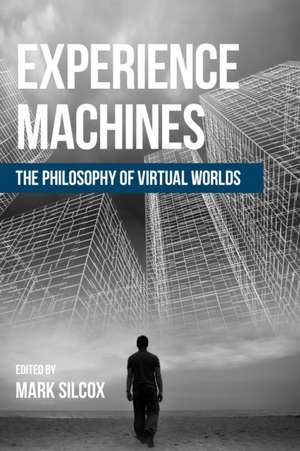
Experience Machines: The Philosophy of Virtual Worlds
Editat de Mark Silcoxen Limba Engleză Paperback – 17 iul 2017
Nozick's argument was made in 1974, about a decade before the personal computer revolution in Europe and North America. Since then, opportunities for the citizens of industrialized societies to experience virtual worlds and simulated environments have multiplied to an extent that no philosopher could have predicted. The authors in this volume re-evaluate the merits of Nozick's argument, and use it as a jumping-off point for the philosophical examination of subsequent developments in culture and technology, including a variety of experience-altering cybernetic technologies such as computer games, social media networks, HCI devices, and neuro-prostheses.
Preț: 314.90 lei
Preț vechi: 409.05 lei
-23%
Puncte Express: 472
Carte tipărită la comandă
Livrare economică 27 noiembrie-11 decembrie
Livrare prin curier în România Termenul estimat este afișat lângă disponibilitate.
Transport gratuit de la 400.00 lei Plată online sau ramburs, în funcție de opțiunile comenzii.
Retur gratuit în 14 zile Comandă securizată și suport în română.
Specificații
ISBN-13: 9781786600684
ISBN-10: 1786600684
Pagini: 240
Dimensiuni: 149 x 230 x 19 mm
Greutate: 0.37 kg
Editura: Bloomsbury Publishing
Colecția Rowman & Littlefield
Locul publicării:New York, United States
ISBN-10: 1786600684
Pagini: 240
Dimensiuni: 149 x 230 x 19 mm
Greutate: 0.37 kg
Editura: Bloomsbury Publishing
Colecția Rowman & Littlefield
Locul publicării:New York, United States
Cuprins
Introduction: The Experience Machine - From Thought Experiment to (Virtual) Reality Mark Silcox / Part I: Virtual Experiences and Human Well-Being / 1. Cypher's Choices: The Variety and Reality of Virtual Experiences Peter Ludlow / 2. Intuition & Imaginative Failure Daniel Pietrucha / 3. Give me the Confidence: Nozick's Experience Machine, Hedonism, and Confident Attitudinal Pleasures Emiliano Heyns & Johnny Hartz Søraker / 4. Ceci n'est pas un cuve.: Putnam's Argument as Inclosure Paradox Jon Cogburn / Part II: Real-World Experience Machines? / 5) Virtual Reality and 'Knowing What It's Like': The Epistemic Upside of Experience Machines E.M. Dadlez / 6. Figuring Out Who Your Real Friends Are Alexis Elder / 7) Welcome to the achievement machine; or, How to value and enjoy pointless things Grant Tavinor / 8) Virtual Weltschmerz: things to keep in mind while building experience machines and other tragic technologies Stefano Gualeni / Part III: Experiential Design: Problems and Prospects / 9. The Problem of Evil
Recenzii
Are virtual experiences real or worthless? Is doing things in virtual worlds a legitimate way to conduct a human life, or just wasted effort? Are virtual friendships genuine forms of connection, or are they just an empty simulacra of the real thing? This volume addresses these crucial questions head on, and it does so with considerable depth and care.
Experience Machines is an exciting introduction to the philosophy of virtual worlds. But it is also an exciting introduction to philosophy in general. Experience Machines explores topics ranging from the ethics of creating virtual worlds to the value of virtual friendships. Through these specific, technologically modern topics, readers are introduced to issues that have occupied philosophers throughout the ages.
As someone who cannot resist the siren-like allure of Facebook, this book compelled me to ask, among other things, whether the platform of Facebook is capable of nurturing genuine friendships, or simply providing a mere experience to that effect. Given the fact that virtual reality is still in its infancy, similar questions are bound to multiply for many aspects of our society. This book is a welcome start.
Experience Machines is an exciting introduction to the philosophy of virtual worlds. But it is also an exciting introduction to philosophy in general. Experience Machines explores topics ranging from the ethics of creating virtual worlds to the value of virtual friendships. Through these specific, technologically modern topics, readers are introduced to issues that have occupied philosophers throughout the ages.
As someone who cannot resist the siren-like allure of Facebook, this book compelled me to ask, among other things, whether the platform of Facebook is capable of nurturing genuine friendships, or simply providing a mere experience to that effect. Given the fact that virtual reality is still in its infancy, similar questions are bound to multiply for many aspects of our society. This book is a welcome start.