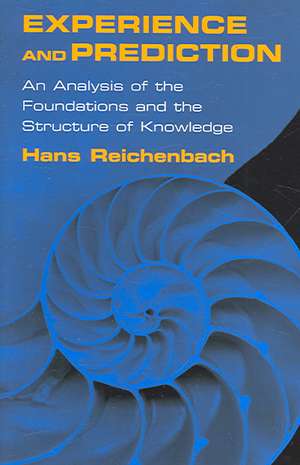
Experience and Prediction
Autor Hans Reichenbachen Limba Engleză Paperback – 30 apr 2006
Ingredientele fundamentale ale acestei lucrări nu sunt obiecte materiale, ci rigoarea logică, datele empirice și structura matematică a probabilității. Ne-a atras atenția modul în care Hans Reichenbach reușește să demonteze mecanismele cunoașterii, oferind o alternativă solidă la speculația metafizică pură. Scrisă într-un moment de exil, Experience and Prediction – An Analysis of the Foundations and the Structure of Knowledge servește drept punte de legătură între tradiția filozofică europeană și pragmatismul anglo-saxon, fiind concepută special pentru a explica principiile empirismului logic unui public nou. Credem că valoarea acestui volum rezidă în capacitatea de a transforma incertitudinea viitorului într-un calcul structurat al probabilităților. Merită menționat că stilul lui Reichenbach este unul de o claritate chirurgicală, influențat profund de revoluția fizicii lui Einstein. Cine a studiat perspectivele din The Routledge Handbook of Logical Empiricism va aprecia aici aplicarea directă a acelor teorii abstracte asupra unor concepte vitale: existența, proiecția și construcția realității. Față de compediile generale, această lucrare oferă vocea autentică a unuia dintre fondatorii mișcării, păstrând o prospețime intelectuală rară pentru un text scris în anii '30. În contextul operei sale, volumul se situează între analizele tehnice din The Philosophy of Space and Time și sinteza finală din Reichenbach, H: Direction of Time, fiind punctul în care autorul își definește cel mai clar epistemologia. Este o invitație la a privi știința nu doar ca pe un set de rezultate, ci ca pe singura metodă validă de a structura experiența umană.
Preț: 398.57 lei
Carte tipărită la comandă
Livrare economică 30 noiembrie-14 decembrie
Specificații
ISBN-10: 0268040559
Pagini: 456
Dimensiuni: 140 x 216 x 27 mm
Greutate: 0.64 kg
Ediția:1
Editura: University of Notre Dame Press
V-ar putea interesa
-
 The Myth of SisyphusAlbert Camus-20%Preț: 45.43 lei56.72 lei
 -
 Locke: A Very Short IntroductionJohn Dunn-20%Preț: 57.07 lei71.06 lei
 -
 Continental Philosophy: A Very Short IntroductionSimon Critchley-19%Preț: 57.35 lei71.23 lei
 -
 -18%Preț: 88.76 lei108.50 lei
 -
 Sensory QualitiesAusten Clark-28%Preț: 358.77 lei500.70 lei
 -
 -29%Preț: 515.33 lei722.75 lei
 -
 -28%Preț: 356.00 lei493.64 lei
 -
 Truth and Meaning: Essays in SemanticsGareth Evans-28%Preț: 492.57 lei687.71 lei
 -
 Points of ViewA. W. Moore-29%Preț: 437.60 lei612.05 lei
 -
 Putting Logic in its Place: Formal Constraints on Rational BeliefDavid Christensen-18%Preț: 367.40 lei447.35 lei
 -
 -28%Preț: 364.77 lei504.21 lei
 -
 Truth, Rationality, and Pragmatism: Themes from PeirceChristopher Hookway-28%Preț: 400.09 lei557.49 lei
 -
 A History of Philosophy in America: 1720-2000Bruce Kuklick-19%Preț: 369.12 lei455.77 lei
 -
 Metaethics after MooreTerry Horgan-21%Preț: 475.10 lei602.25 lei
 -
 -28%Preț: 412.45 lei574.36 lei
 -
 Understanding PicturesDominic Lopes-19%Preț: 351.47 lei435.71 lei
 -
 Truth, Thought, Reason: Essays on FregeTyler Burge-21%Preț: 370.94 lei467.80 lei
 -
 An Introduction to Non-Classical LogicGraham PriestPreț: 346.80 lei
 -
 GenomeMatt RidleyPreț: 92.21 lei
De ce să citești această carte
Pentru cititorul pasionat de filozofia științei și logică, această carte oferă instrumentele necesare pentru a înțelege cum se transformă observația brută în predicție validă. Veți câștiga o perspectivă riguroasă asupra modului în care probabilitatea guvernează cunoașterea umană, totul sub îndrumarea unuia dintre cei mai influenți gânditori ai secolului XX. Este o lectură esențială pentru a înțelege rădăcinile empirismului modern.
Despre autor
Hans Reichenbach (1891-1953) a fost un proeminent filozof al științei, fondator al Cercului de la Berlin și figură centrală a empirismului logic. Profesor la UCLA și Universitatea din Istanbul, Reichenbach a revoluționat modul în care înțelegem timpul, spațiul și probabilitatea, fiind profund influențat de colaborarea sa cu Albert Einstein. Opera sa, care include titluri de referință precum „The Theory of Probability” și „Philosophic Foundations of Quantum Mechanics”, rămâne un pilon fundamental pentru analiza structurilor logice ale fizicii moderne, reflectând angajamentul său de o viață pentru o filozofie bazată pe rigoare științifică.