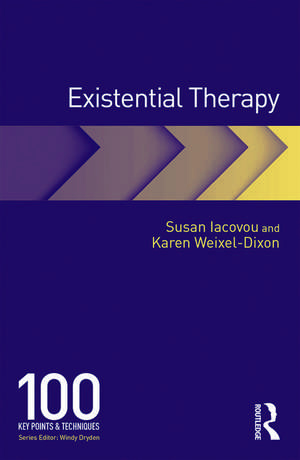
Existential Therapy: 100 Key Points and Techniques: 100 Key Points
Autor Susan Iacovou, Karen Weixel-Dixonen Limba Engleză Paperback – 21 apr 2015
Existentialism – inception to present day
Theoretical assumptions
Existential phenomenological therapy in practice
Ethics and existential therapy
Bringing it all together
Existential Therapy: 100 Key Points and Techniques will be essential reading for all trainee and qualified counsellors, psychotherapists, psychologists and psychiatrists who want to use the wisdom of existential ideas in their work with clients. It will also benefit clients and potential clients who want to find out how existential ideas and existential therapy can help them explore what it means to be alive.




Preț: 256.01 lei
Puncte Express: 384
Carte indisponibilă temporar
Livrare prin curier în România Termenul estimat este afișat lângă disponibilitate.
Transport gratuit de la 400.00 lei Plată online sau ramburs, în funcție de opțiunile comenzii.
Retur gratuit în 14 zile Comandă securizată și suport în română.
Specificații
ISBN-13: 9780415644426
ISBN-10: 0415644429
Pagini: 268
Ilustrații: NO
Dimensiuni: 129 x 198 x 18 mm
Greutate: 0.3 kg
Ediția:1
Editura: Taylor & Francis
Colecția Routledge
Seria 100 Key Points
Locul publicării:Oxford, United Kingdom
ISBN-10: 0415644429
Pagini: 268
Ilustrații: NO
Dimensiuni: 129 x 198 x 18 mm
Greutate: 0.3 kg
Ediția:1
Editura: Taylor & Francis
Colecția Routledge
Seria 100 Key Points
Locul publicării:Oxford, United Kingdom
V-ar putea interesa
-
 Existential Perspectives on Relationship TherapyEmmy van Deurzen-5%Preț: 271.95 lei286.27 lei
 -
 -30%Preț: 472.89 lei674.62 lei
 -
 A Textbook of Social WorkBrian Sheldon-18%Preț: 1370.87 lei1671.79 lei
 -
 -5%Preț: 366.58 lei385.87 lei
 -
 -5%Preț: 387.00 lei407.37 lei
 -
 Preț: 295.70 lei
 -
 -5%Preț: 1267.69 lei1334.41 lei
 -
 The New Handbook of Administrative Supervision in CounselingPatricia G. Henderson-18%Preț: 713.16 lei869.72 lei
 -
 Human developmentPatricia SherwoodPreț: 129.34 lei
 -
 Interpersonal Conflict: An Existential Psychotherapeutic and Practical ModelKaren Weixel Dixon-5%Preț: 1092.62 lei1150.13 lei
 -
 -5%Preț: 281.14 lei295.94 lei
 -
 Group CounselingChristine Schimmel-22%Preț: 529.45 lei677.71 lei
 -
 -8%Preț: 603.53 lei655.80 lei
 -
 -5%Preț: 510.64 lei537.52 lei
 -
 -5%Preț: 291.54 lei306.88 lei
 -
 Mass Trauma and ViolenceNancy Boyd WebbPreț: 128.38 lei
 -
 Preț: 456.45 lei
 -
 Preț: 338.16 lei
Public țintă
Postgraduate, Professional, and Professional Practice & DevelopmentCuprins
Author Biographies. Introduction. Part I: Existentialism – Inception To Present Day. What Is Existentialism? Historical Background, Philosophical Foundations. The Basis Of An Existential Approach To Therapy. Existential Therapy Here And Now. Part II: Theoretical Assumptions. Existence And Essence And The Concept Of Self. Being-In-The-World. Being-In-The-World-With-Others. The Universals Of Human Existence. The Ontic And The Ontological. Existence Precedes Essence – Creating A Self Out Of Nothing. The Contribution Of Phenomenology. The Phenomenological Method. Intentionality. Noema And Noesis. Relatedness And The Formation Of The Self. Intersubjectivity. Freedom, Choice, And Responsibility. Throwness, Limitations And Finitude. The Centrality Of Anxiety, Loss And Suffering. Death And Nothingness. Existential Guilt. Authenticity And Inauthenticity, Bad Faith And Good Faith. Meaning And Absurdity In A Meaningless Cosmos. Temporality And Orientation Towards The Future. Embodiment And The World. An Existential Perspective On Sexuality. Consciousness And The Unconscious. Absolute Truth, The Not-Knowing And The Un-Knowing. A Theory Of Emotions. The Four Worlds: Physical, Personal, Social, Spiritual. Worlding, Worldview, Values And Sedimented Beliefs. The I, You And We Focus. Antipsychiatry And The Social Construction Of Madness. Language And Existentialism. Part III: Existential Phenomenological Therapy In Practice. The Foundational Elements Of An Existential Therapeutic Relationship. The Therapy Environment. The Initial Encounter. The Role Of The Therapist. The Role Of The Client. Contracting And Boundary Setting. Assessment From An Existential Perspective. The Aim Of Existential Psychotherapy. The Centrality Of The Therapeutic Encounter. Key Therapeutic Tasks. Exploring The Four Worlds. Mapping The Client’s Worldview. Tuning In To Emotions. Presence, Immediacy, And Moving To An I-Thou. Making The Implicit, Explicit. Choosing And Changing. Creating/Finding A Project, Meaning And Values. Confronting Freedom And Limitations. Developing An Appreciation For The Authentic Self–In-Relation. Dealing With Breakdowns And Crises. Being And Non-Being And The Courage To Be. Ending Therapy. Working Existentially With What The Client Brings. Exploring Isolation And Loneliness. Working With Unhappiness And Dis-Ease. The Lessons Of Guilt And Shame. Understanding And Managing Dilemmas And Conflict. Working With Paradox, Polarities, And Existential Tensions. Coping With Death, Loss, And Suffering, And The Potential For Growth. Supporting The Client Living With Serious Or Terminal Illness. Using Dreams And Imagination To Elucidate The Client’s Way Of Being-In-The-World. Dealing With Voices And Hallucinations In Existential Therapy. Working With Anxiety, Existential, Neurotic And Normal. Working With Addictions. Working With Depression. An Existential Understanding Of Trauma, And How To Engage With It. An Existential Perspective On Self-Harm. Using Philosophy To Inform Work With Suicide And Suicidal Ideation. Key Competencies Of The Existential Therapist. Developing A Personal Existential Therapy. Adopting An Existential Attitude. Descriptive Interpretation Rather Than Explanation. Being With And Being For The Client. Taking The Role Of The Other. Challenging With Curiosity And Directness. Assuming A Dialogical Attitude. Normalising Verses Diagnosing - An Existential Perspective. Working Existentially In A Time-Limited Way. Using Myth, Metaphor And Philosophy.Exploring Sexuality, Gender And Identity In Existential Terms. Exploring Sexuality, Gender And Identity In Existential Terms. Leaping Ahead Versus Leaping In. Wisdom And The Passionate Life. Working Existentially With Groups.Existential Relationship Therapy. Part IV: Ethics And Existential Therapy. Choosing Who To Work With. Confidentiality, Note Taking And Relations With Outside Agencies. The Issue Of Power In Existential Therapy. Self-Disclosure In An Existential Framework. Existential Supervision Skills. Life After Existential Therapy. Part 5: Bringing It All Together. Critical Perspectives On Existential Psychotherapy. A Critique Of The Dominant Scientific Paradigm In Psychotherapy. Research And The Effectiveness Of Existential Therapy. Shared Origins, Multiple Directions. The British School Of Existential Psychotherapy. The European School Of Existential Therapy. The North American School Of Existential Therapy. Existentialism And Other Therapeutic Orientations. The Case For Existentialism As An Over-Arching Framework.
Notă biografică
Susan Iacovou is an existential psychotherapist working in online education for the University of Derby Online and in private practice in Cheshire. She manages a range of university programmes in psychology and psychotherapy and has developed award-winning, teaching materials for over 100 organizations worldwide. Susan Iacovou has been published widely and this is her fourth book.
Karen Weixel-Dixon is a psychotherapist, supervisor, and accredited mediator in private practice, and a visiting lecturer at Regent's University London. She is co-director for Re-Solution partnership. She has been published widely.
Karen Weixel-Dixon is a psychotherapist, supervisor, and accredited mediator in private practice, and a visiting lecturer at Regent's University London. She is co-director for Re-Solution partnership. She has been published widely.
Recenzii
"A very quick guide to existential therapy, which will help you get your head around some complex philosophical terms and issues in a clear and straightforward way". – Professor Emmy van Deurzen, Principal of the New School of Psychotherapy and Counselling.
"As a clinician who has taught existential therapy to mental health professionals and graduate students for the past twenty-five years, I have long wished for a book that would provide both an introduction and a sophisticated, non-simplistic look at existential therapy. This is not an easy task, considering the complexity of existential philosophy and the varieties of existential therapy. Susan Iacovou and Karen Weixel-Dixon have contributed just such a book. Well-written, accessible, and not full of philosophical jargon, their book makes the sometimes esoteric world of existential therapy accessible to a wide range of readers. Anyone wanting to gain an overview of existential theory and therapy would do well to start with this book. It can be returned to again and again as one gains a greater knowledge of the field and wishes to review its key concepts and practices. I would recommend it to both beginners and experienced therapists of all orientations. It should also prove to be of interested to general readers seeking an alternative to the scientistic technique-driven approaches that often dominate contemporary psychotherapy." - Betty Cannon, Ph.D., author of Sartre and Psychoanalysis, Director of the Boulder Psychotherapy Institute (Colorado), & founder of Applied Existential Psychotherapy (AEP).
"A super contribution to the field. Comprehensive, expertly-informed and laying out existential thought and practice in a highly accessible, engaging, and applicable way." – Mick Cooper, Professor of Counselling Psychology, University of Roehampton, author of 'Existential psychotherapy and counselling: Contributions to a pluralistic practice' (Sage, 2015).
"As a clinician who has taught existential therapy to mental health professionals and graduate students for the past twenty-five years, I have long wished for a book that would provide both an introduction and a sophisticated, non-simplistic look at existential therapy. This is not an easy task, considering the complexity of existential philosophy and the varieties of existential therapy. Susan Iacovou and Karen Weixel-Dixon have contributed just such a book. Well-written, accessible, and not full of philosophical jargon, their book makes the sometimes esoteric world of existential therapy accessible to a wide range of readers. Anyone wanting to gain an overview of existential theory and therapy would do well to start with this book. It can be returned to again and again as one gains a greater knowledge of the field and wishes to review its key concepts and practices. I would recommend it to both beginners and experienced therapists of all orientations. It should also prove to be of interested to general readers seeking an alternative to the scientistic technique-driven approaches that often dominate contemporary psychotherapy." - Betty Cannon, Ph.D., author of Sartre and Psychoanalysis, Director of the Boulder Psychotherapy Institute (Colorado), & founder of Applied Existential Psychotherapy (AEP).
"A super contribution to the field. Comprehensive, expertly-informed and laying out existential thought and practice in a highly accessible, engaging, and applicable way." – Mick Cooper, Professor of Counselling Psychology, University of Roehampton, author of 'Existential psychotherapy and counselling: Contributions to a pluralistic practice' (Sage, 2015).
Descriere
Existential Therapy provides a comprehensive, accessible guide to a fascinating, exciting body of knowledge, and the therapeutic approach it informs