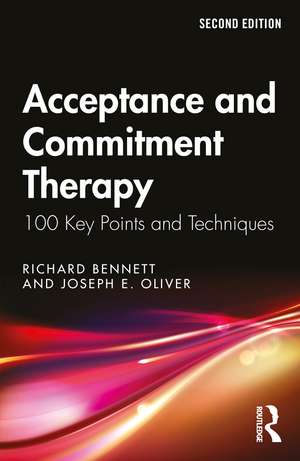
Acceptance and Commitment Therapy: 100 Key Points and Techniques: 100 Key Points
Autor Richard Bennett, Joseph E. Oliveren Limba Engleză Paperback – 31 mar 2025
This thoroughly revised edition explains and demonstrates the range of acceptance, mindfulness, and behaviour change strategies that can be used in the service of helping people increase their psychological flexibility and wellbeing. Divided into three main parts, the book provides the reader with a solid grounding from which to develop their delivery of ACT-consistent interventions. This new edition also includes an update of the research literature and a review of new developments, techniques, and approaches within ACT theory and practice, fortified with a greater appreciation of diversity issues, such as the application of ACT across different groups and cultures.
This book will be of interest to students and practitioners of ACT from a range of disciplines spanning clinical, organisational, coaching, counselling, and psychotherapy settings.




Preț: 182.31 lei
Preț vechi: 191.90 lei
-5%
Puncte Express: 273
Carte disponibilă
Livrare economică 09-23 noiembrie
Livrare express 23-29 octombrie pentru 22.02 lei
Livrare prin curier în România Termenul estimat este afișat lângă disponibilitate.
Transport gratuit de la 400.00 lei Plată online sau ramburs, în funcție de opțiunile comenzii.
Retur gratuit în 14 zile Comandă securizată și suport în română.
Specificații
ISBN-13: 9781032715629
ISBN-10: 1032715626
Pagini: 294
Ilustrații: 8
Dimensiuni: 129 x 198 x 19 mm
Greutate: 0.29 kg
Ediția:2
Editura: Taylor & Francis
Colecția Routledge
Seria 100 Key Points
Locul publicării:Oxford, United Kingdom
ISBN-10: 1032715626
Pagini: 294
Ilustrații: 8
Dimensiuni: 129 x 198 x 19 mm
Greutate: 0.29 kg
Ediția:2
Editura: Taylor & Francis
Colecția Routledge
Seria 100 Key Points
Locul publicării:Oxford, United Kingdom
Public țintă
Postgraduate, Professional Practice & Development, Professional Reference, and Professional TrainingRecenzii
‘I've read a lot of beginning ACT books ... and I've even written one, but in my opinion, this is the best. It's simple and yet comprehensive and rings true on every page. Even experienced ACT people will find it a great refresher. I did! I highly recommend that you do what I did - buy it and read it.’
Dr Steven C. Hayes, Emeritus Professor of Psychology at the University of Nevada, Originator and co-developer of Acceptance and Commitment Therapy and Relational Frame Theory, co-creator of Process-Based Therapy, and author of The Liberated Mind
‘In a clear and concise way, this book presents key concepts and techniques that make ACT what it is – a humane and effective way of changing human behaviour to relieve distress and suffering, and to reorient individuals towards a future they want to have. The book is simple and honest in its aims to present a picture of what ACT looks like, of how it describes itself in its terminology, and of the science it connects most closely with. This combination is hugely workable and simply refreshing. The book grapples with the complexities of clinical problems but manages to inspire the clinician not to be too daunted by this challenge, by offering a range of helpful, well-described tools that are usable, understandable and creative. I would recommend this book for anyone interested in learning ACT or for clinicians wanting to explore ACT techniques.’
Dr Yvonne Barnes-Holmes, co-founder of Perspectives Ireland, co-creator of Process Based Behaviour Therapy, and world-leading researcher in Relational Frame Theory
‘In my opinion, this book deserves to be mentioned in the same breath as the classic ACT texts. I say this because I haven’t read a Contextual Behavioural Science book quite like this, where the depth of the science and practice is covered in such accessible language. It will be the first resource that I recommend to students who are interested in learning about this topic.’
Dr Nic Hooper, Lecturer in psychology at Cardiff University, co-author of The Research Journey of ACT, author of The Unbreakable Student, and co-creator of the annual Diary for Valued Action
‘This book will be essential reading for all trainee and qualified practitioners who want to use the wisdom of ACT ideas in their work. The book provides an accessible reference to the key theoretical concepts and practical issues for practitioners across all settings, such as individual or group psychotherapy, counselling, coaching, community or organisational interventions. The authors have cleverly kept the three important areas of learning the ACT approach central to the writing, that is, the Head (knowledge of theory and concepts), Hands (practical skills and techniques) and Heart (ways of relating to one’s own experiences and the experiences of others). An excellent contribution from innovative authors in the field.’
Professor Louise McHugh, Deputy Head of the School of Psychology at University College Dublin, co-author of A Contextual Behavioural Guide to the Self and co-editor of The Self and Perspective Taking
‘A stand-out book: thorough, knowledgeable, clear and practical. It gives just the right balance of the necessary theoretical foundations, practical skills, and guidance on how to use them in context. The newcomer can work through it to learn what they need to do ACT well, rather than simply ‘know about’ ACT. The veteran can open it at any page and find a new insight, technique, or idea to ponder. To be read cover-to-cover, or dipped into at random, this book is a valuable addition to the shelf of anyone interested in ACT.’
Dr Ray Owen, Consultant Clinical Psychologist, Health Psychologist, Peer Reviewed ACT Trainer, and author of Facing the Storm and Living with the Enemy
‘I can’t recommend this book highly enough. The theoretical underpinnings of ACT are clearly and succinctly explained. There is a careful description of core ACT processes and numerous practical suggestions for therapy. It is a ‘must have’ text for beginners and experienced ACT practitioners alike.’
Dr Sue Clohessy, Clinical Psychologist and co-author of Effective Supervisory Relationships: Best Evidence and Practice
‘There are other ACT books around that will show you more techniques, but being a proficient ACT practitioner is much more than having a large suitcase of exercises. It's about understanding and analysing the functional nature of behaviour, gaining clarity on the context of what is happening, and working deeply with courage in your own vulnerabilities so that you can more authentically connect with the person you are helping. This book is skilfully structured and guides you through the body of knowledge that underpins ACT as well as drawing your attention to the essential processes that will help you gain the depth of practice that is required to be a powerful ACT practitioner.’
Jim Lucas, Cognitive Behavioural Psychotherapist, Founder of Openforwards, Peer Reviewed ACT Trainer, and co-author of SEED: An ACT Supervision Model
Dr Steven C. Hayes, Emeritus Professor of Psychology at the University of Nevada, Originator and co-developer of Acceptance and Commitment Therapy and Relational Frame Theory, co-creator of Process-Based Therapy, and author of The Liberated Mind
‘In a clear and concise way, this book presents key concepts and techniques that make ACT what it is – a humane and effective way of changing human behaviour to relieve distress and suffering, and to reorient individuals towards a future they want to have. The book is simple and honest in its aims to present a picture of what ACT looks like, of how it describes itself in its terminology, and of the science it connects most closely with. This combination is hugely workable and simply refreshing. The book grapples with the complexities of clinical problems but manages to inspire the clinician not to be too daunted by this challenge, by offering a range of helpful, well-described tools that are usable, understandable and creative. I would recommend this book for anyone interested in learning ACT or for clinicians wanting to explore ACT techniques.’
Dr Yvonne Barnes-Holmes, co-founder of Perspectives Ireland, co-creator of Process Based Behaviour Therapy, and world-leading researcher in Relational Frame Theory
‘In my opinion, this book deserves to be mentioned in the same breath as the classic ACT texts. I say this because I haven’t read a Contextual Behavioural Science book quite like this, where the depth of the science and practice is covered in such accessible language. It will be the first resource that I recommend to students who are interested in learning about this topic.’
Dr Nic Hooper, Lecturer in psychology at Cardiff University, co-author of The Research Journey of ACT, author of The Unbreakable Student, and co-creator of the annual Diary for Valued Action
‘This book will be essential reading for all trainee and qualified practitioners who want to use the wisdom of ACT ideas in their work. The book provides an accessible reference to the key theoretical concepts and practical issues for practitioners across all settings, such as individual or group psychotherapy, counselling, coaching, community or organisational interventions. The authors have cleverly kept the three important areas of learning the ACT approach central to the writing, that is, the Head (knowledge of theory and concepts), Hands (practical skills and techniques) and Heart (ways of relating to one’s own experiences and the experiences of others). An excellent contribution from innovative authors in the field.’
Professor Louise McHugh, Deputy Head of the School of Psychology at University College Dublin, co-author of A Contextual Behavioural Guide to the Self and co-editor of The Self and Perspective Taking
‘A stand-out book: thorough, knowledgeable, clear and practical. It gives just the right balance of the necessary theoretical foundations, practical skills, and guidance on how to use them in context. The newcomer can work through it to learn what they need to do ACT well, rather than simply ‘know about’ ACT. The veteran can open it at any page and find a new insight, technique, or idea to ponder. To be read cover-to-cover, or dipped into at random, this book is a valuable addition to the shelf of anyone interested in ACT.’
Dr Ray Owen, Consultant Clinical Psychologist, Health Psychologist, Peer Reviewed ACT Trainer, and author of Facing the Storm and Living with the Enemy
‘I can’t recommend this book highly enough. The theoretical underpinnings of ACT are clearly and succinctly explained. There is a careful description of core ACT processes and numerous practical suggestions for therapy. It is a ‘must have’ text for beginners and experienced ACT practitioners alike.’
Dr Sue Clohessy, Clinical Psychologist and co-author of Effective Supervisory Relationships: Best Evidence and Practice
‘There are other ACT books around that will show you more techniques, but being a proficient ACT practitioner is much more than having a large suitcase of exercises. It's about understanding and analysing the functional nature of behaviour, gaining clarity on the context of what is happening, and working deeply with courage in your own vulnerabilities so that you can more authentically connect with the person you are helping. This book is skilfully structured and guides you through the body of knowledge that underpins ACT as well as drawing your attention to the essential processes that will help you gain the depth of practice that is required to be a powerful ACT practitioner.’
Jim Lucas, Cognitive Behavioural Psychotherapist, Founder of Openforwards, Peer Reviewed ACT Trainer, and co-author of SEED: An ACT Supervision Model
Cuprins
Introduction Part 1: HEAD: Philosophy and Theory 1. The Head of ACT – Philosophy and Theory Section 1 Key Behavioural Principles 2. The 'B' in CBT 3. Learning by Association 4. Learning by Consequence 5. Appetitive and Aversive Control 6. Functional Contextualism 7. A Pragmatic Truth 8. The Function of Behaviour 9. Function Versus Form 10. The Importance of Context 11. Learning Through Language and Cognition Section 2 Relational Frame Theory (RFT) 12. Background to Relational Frame Theory 13. Relational Responding 14. Different Ways of Relating 15. Transformation of Stimulus Functions 16. Coherence 17. Language as a Gift and a Curse 18. The Illusion of Control 19. Experiential Avoidance 20. Cognitive Fusion 21. Rule-Governed Behaviour Section 3 Key Processes in ACT 22. The Targets of ACT 23. Psychological Flexibility 24. Discrimination and Tracking 25. Widening Behavioural Repertoires 26. A Focus on Process 27. The Hexaflex Model 28. Contact with the Present Moment 29. Self-as-Context 30. Acceptance 31. Defusion 32. Values 33. Committed Action Part 2: HANDS: Technique and Practice 34. The Hands of ACT – Technique and Practice Section 4 Assessment and Formulation 35. ACT as a Cognitive Behavioural Therapy 36. Experiential Learning 37. The Utility of Metaphor 38. Retaining a Process Focus 39. Open, Aware, and Active 40. Focussed Assessment 41. Creative Hopelessness 42. Workability 43. Sharing the ACT Model 44. Maintenance Cycles 45. Towards and Away Moves 46. The ACT Matrix Section 5 Techniques for Moving ACT Processes 47. Techniques for Promoting Contact with the Present Moment 48. Mindfulness with a Small ‘m’ 49. Formal Mindfulness Exercises 50. Techniques for Promoting Self-as-Context 51. The ‘Sky and Weather’ Exercise 52. Perspective Taking 53. Techniques for Promoting Acceptance 54. The ‘Tug of War’ Exercise 55. The ‘Chinese Finger Traps’ Exercise 56. Techniques for Promoting Defusion 57. 'I’m Having the Thought That…' 58. Physicalising Exercises 59. Techniques for Promoting Values Clarification 60. The ‘Top Ten Moments’ Exercise 61. An Alternative ‘Miracle Question’ 62. Techniques for Promoting Committed Action 63. The ‘Values, Goals, and Actions’ Exercise 64. Exposure and Inhibitory Learning Section 6 Structuring Intervention 65. Structuring a Course of Sessions 66. Structuring a Single Session 67. Using Overarching Metaphors 68. The 'Passengers on the Bus' Exercise 69. The 'Lifeline Steps' Exercise Part 3: HEART: Context and Strategy 70. The Heart of ACT – Context and Strategy Section 7 ACT in Context 71. Human Suffering Is Not a Disease 72. Fundamental Human Requirements 73. Our Clients Are Stuck, Not Broken 74. The Therapeutic Stance 75. ACT in a Cultural Context 76. ACT and the Medical Model Section 8 Making Decisions in Practice 77. Process or Protocol? 78. Using Functional Analysis in Session 79. Functional Analytic Psychotherapy 80. Model, Initiate, Reinforce 81. Promoting Practitioner–Client Co-Ordination 82. Doing Over Talking 83. Function Over Form 84. Context Over Content 85. Pragmatism Over Truth 86. Working by Addition 87. Increasing Behaviour Over Reducing Behaviour 88. Values Over Goals 89. Ensuring Values Do Not Become Rules 90. Targeting Metaphors Section 9 Issues Within the Therapeutic Relationship 91. When Control and Avoidance Might Be Helpful 92. Self-Disclosure 93. Staying Present 94. Awareness of Practitioner Fusion 95. Steering Clear of the ‘Fix-It’ Trap 96. Staying with Difficult Emotions 97. Learning to Love Your Self-Doubt 98. Modelling the Model 99. The ‘On Track, Off Track’ Exercise 100. Maintaining Fidelity to the Model Appendix: Supervision Worksheet
Notă biografică
Richard Bennett works as a Clinical Psychologist and Cognitive Behavioural Psychotherapist and is an Associate Professor of Psychology at the University of Birmingham. He runs a private therapy practice, Think Psychology, and ACTivatingYourPractice.com, offering ACT training and supervision.
Joseph E. Oliver is a Consultant Clinical Psychologist, Associate Professor at UCL, and founder of Contextual Consulting, providing ACT-focused training, supervision, and therapy.
Joseph E. Oliver is a Consultant Clinical Psychologist, Associate Professor at UCL, and founder of Contextual Consulting, providing ACT-focused training, supervision, and therapy.
Descriere
This book offers a comprehensive overview of the central theoretical tenets of Acceptance and Commitment Therapy (ACT), guidance on key practical applications of the approach, and reflection on the strategic issues inherent to the delivery of this psychological intervention.