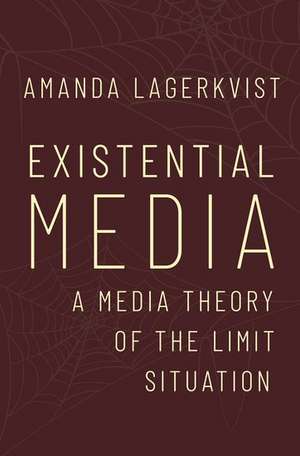
Existential Media: A Media Theory of the Limit Situation
Autor Amanda Lagerkvisten Limba Engleză Hardback – 16 aug 2022
Preț: 589.73 lei
Preț vechi: 841.09 lei
-30%
Puncte Express: 885
Carte tipărită la comandă
Livrare economică 04-15 decembrie
Livrare prin curier în România Termenul estimat este afișat lângă disponibilitate.
Transport gratuit pentru acest produs Plată online sau ramburs, în funcție de opțiunile comenzii.
Retur gratuit în 14 zile Comandă securizată și suport în română.
Specificații
ISBN-13: 9780190925567
ISBN-10: 0190925566
Pagini: 256
Dimensiuni: 242 x 161 x 22 mm
Greutate: 0.52 kg
Editura: Oxford University Press
Colecția OUP USA
Locul publicării:New York, United States
ISBN-10: 0190925566
Pagini: 256
Dimensiuni: 242 x 161 x 22 mm
Greutate: 0.52 kg
Editura: Oxford University Press
Colecția OUP USA
Locul publicării:New York, United States
Recenzii
Amanda Lagerkvist, an established scholar of media, memory and global urban landscapes, in this book breaks radical new ground, both for herself and for the whole field of media and communications research. Reflecting deeply not just on the inheritance of existentialist philosophy, but on the contemporary crises of climate change, datafication and the global pandemic, Lagerkvist's writing is fresh, precise and impassioned: this book urgently needs to be read.
We live through media and always have. Yet rarely do scholars take the courageous and risky approach of Lagerkvist in explaining what media do to how we understand our own existence. If Sartre were to write about existentialism today, this is how he would write — or rather, he might wish HE had written this. A deep and original account of how we through media, come closer to and push away from the limits of human existence.
In a world obsessed with acceleration and optimisation, Existential Media arrives like a tremor beneath the surface, revealing how our technological lives are permeated with fragility, fracture and finitude. Amanda Lagerkvist's bold reorientation of media theory links our digital condition to bigger existential questions, offering a profoundly original framework for thinking about what it means to live - and die - with media.
Existential Media invites media theorists besotted with the posthuman to ponder the fundamental human condition: finitude. Lagerkvist writes about encounters at the limit – encounters with death and breakdown and crisis – as sources of unexpected insight, mostly untapped by media scholars. Existential Media is one of those rare works that leaves the reader disoriented into uncertainty. That is among this field-establishing book's major achievements, to implore us to consider that our digital enclosures are also mortal, also marked by disconnection and decay.
Amanda Lagerkvist's Existential Media is both a stunning demonstration of the illuminative power of existential philosophy and a declaration of a new way forward for media studies. Drawing timeless lessons from the existentialist tradition (especially the work of Jaspers, but also Kierkegaard, Sartre, and many more), Lagerkvist draws attention to ways in which death, loss, disability and precarity figure in and challenge contemporary logics of speed and control. In an era of totalising technological fatalism, Existential Media calls us back to the human, to the vulnerable and mortal - in short, to existence - and to a hope in the possibilities of care and connection.
Amanda Lagerkvist's Existential Media marks a watershed in our understanding of media. The conventional emphasis in communication research is on questions of power (who wields it, and over whom) and meaning (who makes it). Lagerkvist offers a critical reorientation by insisting that the key issue is human existence as such, and how media are among the fundamental conditions of our being as mortal and limited. Theoretically bold and philosophically profound, Lagerkvist's writing is infused with a deep sense of care for the lives of those living with crisis (which, given that life is finite, ultimately includes everyone), of "gentle listening" to the distress of others. Existential Media forces us to think in new ways about media, vulnerability, hope, and the very stakes of being alive.
We live through media and always have. Yet rarely do scholars take the courageous and risky approach of Lagerkvist in explaining what media do to how we understand our own existence. If Sartre were to write about existentialism today, this is how he would write — or rather, he might wish HE had written this. A deep and original account of how we through media, come closer to and push away from the limits of human existence.
In a world obsessed with acceleration and optimisation, Existential Media arrives like a tremor beneath the surface, revealing how our technological lives are permeated with fragility, fracture and finitude. Amanda Lagerkvist's bold reorientation of media theory links our digital condition to bigger existential questions, offering a profoundly original framework for thinking about what it means to live - and die - with media.
Existential Media invites media theorists besotted with the posthuman to ponder the fundamental human condition: finitude. Lagerkvist writes about encounters at the limit – encounters with death and breakdown and crisis – as sources of unexpected insight, mostly untapped by media scholars. Existential Media is one of those rare works that leaves the reader disoriented into uncertainty. That is among this field-establishing book's major achievements, to implore us to consider that our digital enclosures are also mortal, also marked by disconnection and decay.
Amanda Lagerkvist's Existential Media is both a stunning demonstration of the illuminative power of existential philosophy and a declaration of a new way forward for media studies. Drawing timeless lessons from the existentialist tradition (especially the work of Jaspers, but also Kierkegaard, Sartre, and many more), Lagerkvist draws attention to ways in which death, loss, disability and precarity figure in and challenge contemporary logics of speed and control. In an era of totalising technological fatalism, Existential Media calls us back to the human, to the vulnerable and mortal - in short, to existence - and to a hope in the possibilities of care and connection.
Amanda Lagerkvist's Existential Media marks a watershed in our understanding of media. The conventional emphasis in communication research is on questions of power (who wields it, and over whom) and meaning (who makes it). Lagerkvist offers a critical reorientation by insisting that the key issue is human existence as such, and how media are among the fundamental conditions of our being as mortal and limited. Theoretically bold and philosophically profound, Lagerkvist's writing is infused with a deep sense of care for the lives of those living with crisis (which, given that life is finite, ultimately includes everyone), of "gentle listening" to the distress of others. Existential Media forces us to think in new ways about media, vulnerability, hope, and the very stakes of being alive.
Notă biografică
Amanda Lagerkvist is Professor of Media and Communication Studies in the Department of Informatics and Media at Uppsala University. She is principal investigator of the Uppsala Informatics and Media Hub for Digital Existence. As Wallenberg Academy Fellow (2014-2018) she founded the field of existential media studies. She heads the project: "BioMe: Existential Challenges and Ethical Imperatives of Biometric AI in Everyday Lifeworlds" funded by the Marianne and Marcus Wallenberg Foundation, in which her group studies the lived experiences of biometric AI, for example voice and face recognition technologies. She is the editor of Digital Existence: Ontology, Ethics and Transcendence in Digital Culture (2019).
Cuprins
- Preface to the Paperback Edition
- Preface
- Note on sources
- Introduction: Media of Limits
- PART I Existentializing Media
- Chapter 1. Limit Situations (of the Digital): Restoring Karl Jaspers for Media Theory
- Chapter 2. Into the Slow Field: The What, the How, and the Why
- Chapter 3. Existential Media Studies: Lineages and Lines
- Chapter 4. Existential Media: Propositions and Properties
- PART II Digital Limit Situations
- Chapter 5. Metric Media: Numerical Being, Marginal Beings, and the Limits of Measuring
- Chapter 6. Caring Media: Beings on the (Life)line
- Chapter 7. Transcendent Media: Caring for the Dead, Relating at the Threshold
- Chapter 8. Anticipatory Media: Futurability on the Brinks of Time
- Postscript. Going dark: Refusals in Slowness, Silence, and Waiting
- Index