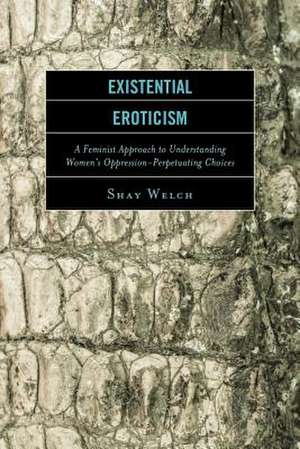
Existential Eroticism: A Feminist Approach to Understanding Women's Oppression-Perpetuating Choices
Autor Shay Welchen Limba Engleză Paperback – 19 iul 2017
Preț: 357.85 lei
Preț vechi: 482.74 lei
-26%
Puncte Express: 537
Carte tipărită la comandă
Livrare economică 23 noiembrie-07 decembrie
Livrare prin curier în România Termenul estimat este afișat lângă disponibilitate.
Transport gratuit de la 400.00 lei Plată online sau ramburs, în funcție de opțiunile comenzii.
Retur gratuit în 14 zile Comandă securizată și suport în română.
Specificații
ISBN-13: 9781498505437
ISBN-10: 1498505430
Pagini: 256
Dimensiuni: 150 x 229 x 18 mm
Greutate: 0.32 kg
Editura: Bloomsbury Publishing
Colecția Lexington Books
Locul publicării:New York, United States
ISBN-10: 1498505430
Pagini: 256
Dimensiuni: 150 x 229 x 18 mm
Greutate: 0.32 kg
Editura: Bloomsbury Publishing
Colecția Lexington Books
Locul publicării:New York, United States
V-ar putea interesa
-
 ShatteredRebecca AsherPreț: 89.83 lei
 -
 On the Frontlines: Gender, War, and the Post-Conflict ProcessFionnuala Ní Aoláin-11%Preț: 376.55 lei423.82 lei
 -
 New Women in Colonial Korea: A SourcebookHyaeweol Choi-18%Preț: 1307.32 lei1594.29 lei
 -
 Incomplete RevolutionGosta Esping-AndersenPreț: 156.45 lei
 -
 I Am an Emotional CreatureEve Ensler-20%Preț: 78.97 lei99.08 lei
 -
 Does God Hate Women?Ophelia Benson-37%Preț: 217.93 lei346.97 lei
 -
 Bad Shoes: And the Women Who Love ThemLeora Tanenbaum-30%Preț: 62.37 lei88.99 lei
 -
 The Tattooed LadyAmelia Klem OsterudPreț: 128.56 lei
 -
 -25%Preț: 81.86 lei109.32 lei
 -
 Passing Through Missing Pages: The Intriguing Story of Annie Garland FosterFrances Clay WelwoodPreț: 109.87 lei
 -
 StrippedJennifer Hayashi DannsPreț: 64.14 lei
Cuprins
Chapter One: Setting the "Stage"
Chapter Two: Existential Eroticism and Autonomy
Chapter Three: Forms of Restriction and Systemic Patriarchy
Chapter Four: Duress and Necessity under Existential Eroticism
Chapter Five: Trauma as Desperation
Chapter Six: Desperate Rationality
Chapter Seven: Self-Perpetuated Oppression: Individuated Acts, Complicity, and Moral Responsibility
Chapter Eight: Blaming and Forgiving Each Other
Chapter Two: Existential Eroticism and Autonomy
Chapter Three: Forms of Restriction and Systemic Patriarchy
Chapter Four: Duress and Necessity under Existential Eroticism
Chapter Five: Trauma as Desperation
Chapter Six: Desperate Rationality
Chapter Seven: Self-Perpetuated Oppression: Individuated Acts, Complicity, and Moral Responsibility
Chapter Eight: Blaming and Forgiving Each Other
Recenzii
This is no small achievement. As I read the book, these insights are important because they apply more generally than just to the experience of marginal women. . . I think it achieves something. . . remarkable, which is to show that reflecting on invisible, marginal lives illuminates the experience of the privileged.
Throughout Existential Eroticism, Welch draws subtle distinctions and makes forceful arguments concerning staggeringly difficult issues. . . .[The book] is a resolute philosophical inquiry into the suffering she herself, her family members, and her friends endured (and that so many women like them continue to endure), and it is a sustained reclamation of their dignity as agents.
Existential Eroticism is a compelling and original contribution to feminist philosophy. It raises and attempts to resolve important issues about complicity under systemic conditions of disadvantage under patriarchy and grapples with the uncomfortable territory of intra-group blame and resentment, while providing a constructive way forward in intra-group forgiveness. Most of all, Welch successfully achieves her goal of providing a nuanced account in which women living in some of the most desperate scenarios of existential eroticism are not simply to be understood as victims or dupes, but in fact as agents, sometimes blameworthy sometimes not, sometimes fighters, and sometimes employing highly sophisticated forms of desperate rationality.
Throughout Existential Eroticism, Welch draws subtle distinctions and makes forceful arguments concerning staggeringly difficult issues. . . .[The book] is a resolute philosophical inquiry into the suffering she herself, her family members, and her friends endured (and that so many women like them continue to endure), and it is a sustained reclamation of their dignity as agents.
Existential Eroticism is a compelling and original contribution to feminist philosophy. It raises and attempts to resolve important issues about complicity under systemic conditions of disadvantage under patriarchy and grapples with the uncomfortable territory of intra-group blame and resentment, while providing a constructive way forward in intra-group forgiveness. Most of all, Welch successfully achieves her goal of providing a nuanced account in which women living in some of the most desperate scenarios of existential eroticism are not simply to be understood as victims or dupes, but in fact as agents, sometimes blameworthy sometimes not, sometimes fighters, and sometimes employing highly sophisticated forms of desperate rationality.