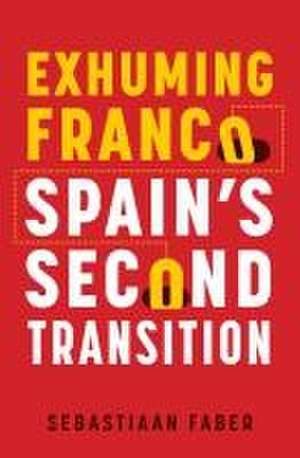
Exhuming Franco: Spain's Second Transition, Second Edition
Autor Sebastiaan Faberen Limba Engleză Hardback – 15 noi 2023
This new edition, with additional interviews and a new introduction, illuminates the dangers of the rise of right-wing nationalist revisionism by using Spain as a case study for how nations face, or don't face, difficult questions about their past.
Preț: 161.04 lei
Puncte Express: 242
Carte indisponibilă temporar
Livrare prin curier în România Termenul estimat este afișat lângă disponibilitate.
Transport gratuit de la 400.00 lei Plată online sau ramburs, în funcție de opțiunile comenzii.
Retur gratuit în 14 zile Comandă securizată și suport în română.
Specificații
ISBN-13: 9780826506375
ISBN-10: 0826506372
Pagini: 300
Dimensiuni: 133 x 203 x 25 mm
Greutate: 0.5 kg
Ediția:Îmbunătățită
Editura: Vanderbilt University Press
Colecția Vanderbilt University Press
ISBN-10: 0826506372
Pagini: 300
Dimensiuni: 133 x 203 x 25 mm
Greutate: 0.5 kg
Ediția:Îmbunătățită
Editura: Vanderbilt University Press
Colecția Vanderbilt University Press
Recenzii
Reviews for the first edition:
“A notable reportage... An exercise in independent critique that concludes differently than one would expect.” —Jordi Amat, El País
“Faber’s book returns to a crucial problem for Spanish democracy and offers a catalogue of answers that … are an invitation to rewrite the history of Francoism.” —Óscar Buznego, El periódico de España
“Independent, intelligent, uncomfortable, open to dialogue and discussion. Necessary.” —Guillem Martínez, Contexto
“Faber’s scholarship is unique among Hispanists, bringing together the rigor of academia with the incisiveness of journalism. Few scholars of contemporary Spain have taken the role of writing for a learned but non-specialist readership as seriously and successfully as he has.” —Mari Paz Balibrea, The Historian
“A notable reportage... An exercise in independent critique that concludes differently than one would expect.” —Jordi Amat, El País
“Faber’s book returns to a crucial problem for Spanish democracy and offers a catalogue of answers that … are an invitation to rewrite the history of Francoism.” —Óscar Buznego, El periódico de España
“Independent, intelligent, uncomfortable, open to dialogue and discussion. Necessary.” —Guillem Martínez, Contexto
“Faber’s scholarship is unique among Hispanists, bringing together the rigor of academia with the incisiveness of journalism. Few scholars of contemporary Spain have taken the role of writing for a learned but non-specialist readership as seriously and successfully as he has.” —Mari Paz Balibrea, The Historian
Notă biografică
Sebastiaan Faber, professor of Hispanic studies at Oberlin College, is the author of several books, including Memory Battles of the Spanish Civil War and Exile and Cultural Hegemony: Spanish Intellectuals in Mexico, 1939–1975 (both published by Vanderbilt University Press).
Extras
The removal of the General [Queipo de Llano]’s remains from the Basilica in Seville in the early morning of November 3 was one of the first measures prompted by Spain’s new Law of Democratic Memory, which the country’s Senate approved on October 5, 2022, and which went into effect on October 20. The left-of-center coalition government of prime minister Pedro Sánchez, the leader of the Spanish Socialist Party, hailed the law as an important next step in the country’s coming to terms with the legacies of the Civil War (1936-39) and the Franco dictatorship (1939-75). But not everyone agreed.
The Law of Democratic Memory was adopted two years after the event that sparked the first edition of this book: the exhumation of the dictator’s remains from his tomb at the Valley of the Fallen. Much like Franco’s exhumation, the debate around the memory law served to reveal not only the fault lines that divide the political Left from the Right, but also the considerable gap between the demands of the grassroots memory movement—whose insistent pressure helped prompt both the exhumation and the law—and the government’s response to those demands.
The stated objective of the new legislation, which occupies 55 single-spaced pages in the Boletín Oficial del Estado, is to build on, update, and improve the memory law adopted 15 years earlier, in 2007, under the government of José Luis Rodríguez Zapatero, then leader of the Socialist Party. Indeed, comparing the two laws is as good a way as any to measure what’s changed in the way Spain, or at least part of Spain, thinks about its violent twentieth-century past.
The Law of Democratic Memory was adopted two years after the event that sparked the first edition of this book: the exhumation of the dictator’s remains from his tomb at the Valley of the Fallen. Much like Franco’s exhumation, the debate around the memory law served to reveal not only the fault lines that divide the political Left from the Right, but also the considerable gap between the demands of the grassroots memory movement—whose insistent pressure helped prompt both the exhumation and the law—and the government’s response to those demands.
The stated objective of the new legislation, which occupies 55 single-spaced pages in the Boletín Oficial del Estado, is to build on, update, and improve the memory law adopted 15 years earlier, in 2007, under the government of José Luis Rodríguez Zapatero, then leader of the Socialist Party. Indeed, comparing the two laws is as good a way as any to measure what’s changed in the way Spain, or at least part of Spain, thinks about its violent twentieth-century past.
Cuprins
Introduction to the New Edition
Introduction to the First Edition
1. Securely Tied Down
2. How Dead Is He?
3. Surreptitious Survival
4. Ignacio Echevarría
5. Guillem Martínez
6. The Judiciary
7. Sebastián Martín
8. Ricardo Robledo
9. José Antonio Zarzalejos
10. Politics and the Territorial Challenge
11. Marina Garcés
12. Enric Juliana
13. Antonio Maestre
14. The Media
15. Cristina Fallarás
16. Olga Rodríguez
17. Marije Hristova
18. Ricard Vinyes
19. Emilio Silva
Conclusion. Not So Different After All
Acknowledgments
Interviews and Correspondence
Bibliography
Index
Introduction to the First Edition
1. Securely Tied Down
2. How Dead Is He?
3. Surreptitious Survival
4. Ignacio Echevarría
5. Guillem Martínez
6. The Judiciary
7. Sebastián Martín
8. Ricardo Robledo
9. José Antonio Zarzalejos
10. Politics and the Territorial Challenge
11. Marina Garcés
12. Enric Juliana
13. Antonio Maestre
14. The Media
15. Cristina Fallarás
16. Olga Rodríguez
17. Marije Hristova
18. Ricard Vinyes
19. Emilio Silva
Conclusion. Not So Different After All
Acknowledgments
Interviews and Correspondence
Bibliography
Index
Descriere
Does digging up a dead fascist finally put his legacy to rest?